
Back to all articlesDental Implants Dr. Muhammad Rahim, DMDJune 4, 202611 min read
Tooth Replacement Options: Implants vs Bridges vs Dentures
Dr. Muhammad Rahim, DMDJune 4, 202611 min read
Loading blog post
Dr. Muhammad Rahim, DMDJune 4, 202611 min readCall and you'll reach a real person on our team: no phone tree, no hold music. We'd genuinely love to help.
(603) 924-3664Rather write to us? Contact us
Your main tooth replacement options are dental implants, bridges, and dentures. Each one can restore your smile and your bite, but they differ a lot in how they're anchored, how long they last, what they cost, and how they affect the teeth and bone around them.
You're in good company if you're weighing them. About 120 million Americans are missing at least one tooth, according to the American College of Prosthodontists. Some lost a tooth last week. Others have worn a denture for twenty years and wonder if there's something better. At Peterborough Family Dental & Implant Center, we place dental implants in Peterborough and make bridges and dentures in the same office, so we can compare every option honestly.
This guide walks through each choice, a side-by-side comparison, how to decide, what affects cost, and real results from our patients.
Your three main options at a glance
Dental implants
A titanium root in the jaw holds a crown, bridge, or full arch. Closest to a natural tooth.
Bridges
False teeth anchored to neighboring teeth or implants. Fixed in place, no surgery for traditional bridges.
Dentures
Removable teeth for a few gaps or a full arch. The most affordable way to replace many teeth.
Not sure which option fits you?
Book a consultation with Dr. Muhammad Rahim or Dr. Jasper Ainslie. We'll examine your mouth, take a 3D scan if needed, and lay out every option side by side.
Request an Appointment →After tooth loss, the most important thing to know is that timing and bone health shape your tooth replacement options. The jawbone under a gap starts to shrink within months, and nearby teeth can drift, so the longer a space stays open, the more planning a replacement may need.

A gap rarely stays just a gap. Teeth tip toward the space, the opposing tooth can drift, and your bite slowly changes. We break down what happens when a missing tooth isn't replaced in a separate guide, so here's the short version: earlier decisions usually mean simpler treatment.
If your tooth hasn't been removed yet, you have two decisions worth making before the extraction:
Already missing a tooth for years? That's common, and your options are still open. A scan simply shows how much bone is left to work with.
Dental implants replace missing teeth with a small titanium post placed in the jawbone, which fuses with the bone over a few months and then supports a crown, bridge, or full set of teeth. Because the implant replaces the root, it helps keep the jawbone stimulated and doesn't rely on neighboring teeth.
One tooth
Single-tooth implant
One implant and one crown fill a single gap without touching the teeth beside it.
Several in a row
Implant bridge
Two implants can support a bridge that replaces three or more teeth.
Full arch, removable
Implant-supported denture
A denture snaps onto implants for a much more secure fit.
Full arch, fixed
All-on-4
Four implants hold a fixed set of teeth that doesn't come out.
The track record is strong. Dental implants have a 95-98% success rate over 10 years, according to the Journal of Oral and Maxillofacial Surgery, and implant-supported teeth can restore up to 90% of natural chewing power, according to the American Academy of Implant Dentistry.
The tradeoffs are time and cost. Implants need surgery and a healing period of roughly three to six months before the final tooth goes on, and they cost more upfront than other options. If you're considering them, it helps to understand how long dental implants last and what the implant recovery timeline looks like week by week.
A dental bridge is often the right choice when you're missing one or a few teeth in a row and want a fixed, non-removable option without implant surgery. A traditional bridge anchors false teeth to crowns on the neighboring teeth, while an implant bridge anchors them to implants instead.
Traditional bridge
Implant bridge
A traditional bridge makes the most sense when the teeth next to the gap already need crowns, or when surgery isn't a good fit for you. As the ADA's MouthHealthy guide to bridges notes, a bridge's success depends on its foundation, so keeping the supporting teeth healthy is essential. Weighing an implant bridge vs a traditional bridge comes down to the health of those neighboring teeth, your bone, and your budget.
Bridges are fixed, so you brush them like natural teeth, plus a little extra cleaning under the false tooth with a floss threader or water flosser.
Yes, dentures are still a good tooth replacement option, especially when many or all teeth are missing or when budget is a major factor. Modern dentures look far more natural than older versions, and they come as full, partial, or immediate dentures placed the same day teeth are removed.
| Type | Best for | Good to know |
|---|---|---|
| Full (complete) denture | Replacing all teeth in an arch | Rests on the gums; relines keep the fit snug |
| Partial denture | Several gaps with healthy teeth remaining | Clasps onto natural teeth |
| Immediate denture | Teeth being extracted | Placed the same day, adjusted as gums heal |
| Implant-supported denture | Denture wearers who want more stability | Snaps onto implants for a secure fit |
The main limits of traditional dentures are fit and stability over time. Because they rest on the gums, the bone underneath gradually shrinks and the fit loosens. Complete dentures typically last about five to seven years, and we cover the signs of when dentures need replacing in detail.
Many long-time wearers also ask about switching from dentures to implants. It's often possible, even after years, and a scan shows whether there's enough bone to support it.
The best tooth replacement is the one that fits your mouth, your health, and your life, not the one that sounds most impressive.
Implants usually last longest, feel most natural, and protect bone best, but they cost the most and take months. Bridges are fixed and faster but rely on neighboring teeth. Dentures cost the least and replace many teeth at once, but they're removable and need relining or replacement over time.
| Dental implants | Bridges | Dentures | |
|---|---|---|---|
| Fixed or removable | Fixed (or snap-in) | Fixed | Removable |
| Effect on nearby teeth | None | Traditional: reshapes neighbors | Partials clasp onto teeth |
| Effect on jawbone | Helps preserve it | Doesn't stop loss under the gap | Doesn't stop loss under the base |
| Typical lifespan | Decades with good care | Many years; depends on support teeth | About 5-7 years |
| Surgery needed | Yes | No (traditional) | No |
| Upfront cost | Highest | Moderate | Lowest |
| Treatment time | About 3-6 months | A few weeks | A few weeks |
Quick comparison
| How it scores | Implants | Bridges | Dentures |
|---|---|---|---|
| Natural feel | ●●● | ●●● | ●●● |
| Bone protection | ●●● | ●●● | ●●● |
| Speed of treatment | ●●● | ●●● | ●●● |
| Lower upfront cost | ●●● | ●●● | ●●● |
More dots means a stronger fit for that factor. General guidance only; your own result depends on your exam.
No option wins every row. That's exactly why the comparison only becomes useful once it's applied to your own mouth.
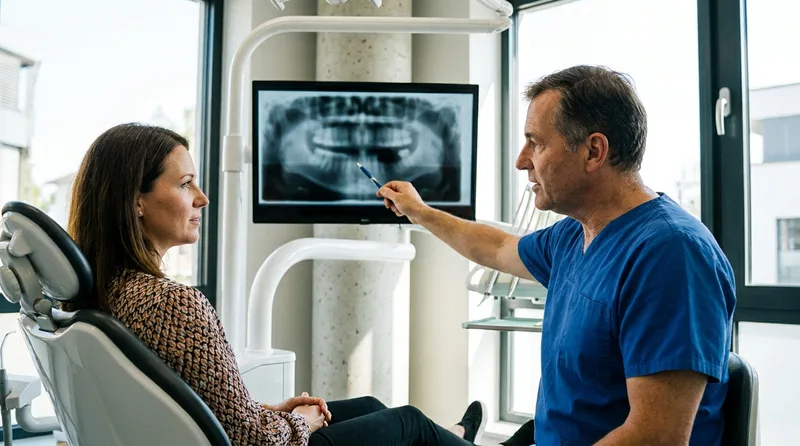
Choosing the right tooth replacement option comes down to how many teeth are missing, the health of your bone and remaining teeth, your general health, your budget, and how you feel about removable versus fixed teeth. An exam and 3D scan turn those factors into a clear recommendation.
A quick way to narrow it down
↓
Questions to bring to your consultation
Check each one that applies to you.
Bring these questions, and ask to see your scan.
Tooth replacement costs vary with the type of treatment, how many teeth are involved, and whether extra steps like extractions or bone grafts are needed. In general, dentures cost the least upfront, bridges fall in the middle, and implants cost the most but often last the longest.
$
Dentures
Lowest upfront cost; plan for relines and a new set every several years.
$$
Bridges
Moderate cost; future work depends on the health of the supporting teeth.
$$$
Implants
Highest upfront cost; designed to last decades with good care.
Upfront price isn't the whole story. A denture replaced every five to seven years, or a bridge that eventually needs redoing, adds up over time. It's worth comparing the long-term picture, not just the first bill.
We're in-network with Delta Dental Premier and file claims with most other major plans. Every plan comes as a written, itemized quote before treatment starts, and our financing options include CareCredit for predictable monthly payments.
Want real numbers for your smile?
Your consultation includes an exam, imaging, and a written quote for each option that fits, so you can compare cost and value side by side.
Book a Consultation →Real patient results show how natural modern tooth replacement can look. A single implant usually blends in so well that people can't tell which tooth was replaced, while full-arch treatment can take someone from failing teeth or a loose denture to a stable, complete smile.

The “before” is often a visible space, a failing tooth, or a tooth recently removed. The “after” is a crown on a titanium root, so it feels anchored rather than loose, and the healthy teeth beside it stay untouched.
This is where the change is most dramatic. Patients who have lived with loose dentures or several failing teeth leave with a fixed bite they can trust, and foods that were off the table come back.
The confidence side is real too. Nearly 99.7% of Americans consider a smile an important social asset, according to the American Academy of Cosmetic Dentistry. You can see more transformations in our before-and-after gallery, all from real patients of our practice.
Results may vary. Please consult with your dentist at Peterborough Family Dental for personalized treatment recommendations.
The right choice among tooth replacement options depends on your mouth, not a general ranking. Implants suit people who want the most natural, long-lasting result, bridges suit those who want fixed teeth without surgery, and dentures suit those replacing many teeth on a tighter budget.
Nationally, tooth loss becomes more common with age, as the National Institute of Dental and Craniofacial Research's data on tooth loss in adults shows. But the decision is always personal. The best next step is an exam and a straightforward conversation about what each option would look like for you.
Patients from Peterborough, Jaffrey, Dublin, Hancock, and across the Monadnock region trust us with that conversation. We'll show you your scan, compare your options side by side, and help you choose with no pressure.
Compare Your Tooth Replacement Options
Schedule a consultation at our Peterborough, NH office. You'll leave with a clear plan and a written quote for every option that fits.
Request an Appointment →Prefer to talk it through first? Our front desk opens at 7 AM.
Call (603) 924-3664 →
Dr. Muhammad Rahim, DMD
Dentist · Peterborough Family Dental & Implant Center
Peterborough, NH dentist providing gentle general, cosmetic, restorative, and implant dentistry for the whole family.
Was this article helpful?
Dental implants usually look and feel the most natural, because the crown is supported by a root in the jawbone rather than resting on the gums. A well-made bridge can also look very natural, especially when it's shade-matched to the teeth around it.
Our Peterborough team is happy to answer questions and get you on the calendar.


