
Back to all articlesDental Implants Dr. Muhammad Rahim, DMDOctober 6, 202613 min read
What Happens If You Don't Replace a Missing Tooth?
Dr. Muhammad Rahim, DMDOctober 6, 202613 min read
Loading blog post
Dr. Muhammad Rahim, DMDOctober 6, 202613 min readCall and you'll reach a real person on our team: no phone tree, no hold music. We'd genuinely love to help.
(603) 924-3664Rather write to us? Contact us
What happens if you don't replace a missing tooth? At first, usually nothing you'd notice. The gap feels strange for a week, your tongue gets used to it, and life goes on. But below the gumline, your mouth starts adjusting to that empty space almost right away.
Those adjustments rarely work in your favor. Teeth are a team, and each one leans on its neighbors and presses against the tooth above or below it. Take one away and the others slowly move, the jawbone under the gap begins to shrink, and your bite can shift in ways that only show up years later. If you're already leaning toward fixing it, our team can help you replace a single missing tooth once we've looked at the space.
You're far from alone. According to the American College of Prosthodontists, 120 million Americans are missing at least one tooth. This guide covers the real risks of leaving a gap: shifting teeth, bone loss, bite changes, and a few problems most people don't expect.
Have a gap you've been meaning to ask about?
Dr. Muhammad Rahim and Dr. Jasper Ainslie can check how the teeth and bone around your gap are holding up during a simple visit in Peterborough, NH.
Request an Appointment →Your remaining teeth begin to drift, the jawbone under the gap slowly shrinks, and your bite can shift out of balance. These changes start within months, build quietly over years, and are usually easier to prevent than to reverse once they're well underway.
120 million
Americans are missing at least one tooth
Source: American College of Prosthodontists
42%
of adults aged 30+ have some form of periodontal disease
Source: CDC, 2024
60%
lower odds of tooth loss for people who see a dentist regularly
Source: Journal of Dental Research
Think of it as a chain reaction, not a single problem. Here's the order it usually follows:
Not everyone goes through every step. How far things progress depends on which tooth is gone, how healthy your gums are, and how long the gap stays open. A gap left for six months behaves very differently from one left for six years.
Neighboring teeth shift because teeth are held in place partly by contact with each other. When one tooth is lost, the teeth on either side lose that support and slowly tip toward the space, while the opposing tooth can drift into it from above or below.

Your teeth aren't cemented into the jaw. They sit in sockets held by a thin ligament that allows tiny movements, which is exactly how braces are able to straighten teeth. That flexibility is useful. It also means teeth respond to empty space by leaning into it.
The tooth behind a gap usually tips forward, and lower molars are especially prone to it. Once a tooth leans, chewing forces hit it at an angle instead of straight down the root. That's harder on the tooth and the gum tissue around it.
This one surprises people. A tooth with no partner to bite against can slowly extend out of its socket, which dentists call over-eruption or supra-eruption. Over time, an upper molar can drop down far enough to expose part of its root and crowd the space where a replacement would eventually go.
Why it matters later
Shifted teeth can shrink the room needed to replace a missing tooth. Some patients end up needing orthodontic treatment to reopen a gap before any replacement will fit properly.
Watch for floss catching in new places, food packing near the gap, or a tooth that looks taller than its neighbors. Those are early signs of movement worth mentioning at your next visit.
A missing tooth causes jawbone loss because the bone that held the root no longer gets stimulated by chewing. Your body treats that unused bone as unnecessary and gradually reabsorbs it, so the ridge under the gap becomes thinner and shorter, especially during the first year.
Bone is living tissue. Like muscle, it stays strong when it's used. Every time you bite down, your tooth roots send pressure into the surrounding bone, called the alveolar ridge, and that pressure tells your body to keep it. Remove the root and the signal stops.
Research in the International Journal of Periodontics & Restorative Dentistry followed patients for 12 months after single-tooth extractions. The ridge narrowed considerably over that year, and most of the change happened in the first few months. In other words, the clock starts early.
Related: Just had a tooth removed? What to do after a tooth extraction →
Here's the tricky part: you can't feel bone loss happening. There's no ache and no obvious warning. Dental X-rays and 3D scans are the only reliable way to see it, which is one reason a gap is worth having checked even if it doesn't bother you.
Not sure how your gap is holding up?
A quick exam and X-rays at our Peterborough office can show whether the teeth or bone around your gap have started to change. Patients come to us from Jaffrey, Dublin, Hancock, and across the Monadnock region.
Book a Gap Check →Yes, a single missing tooth can change your bite. As nearby teeth tip and the opposing tooth drifts, your upper and lower teeth stop meeting the way they used to, which can shift chewing pressure, wear teeth unevenly, and put extra strain on your jaw joints.
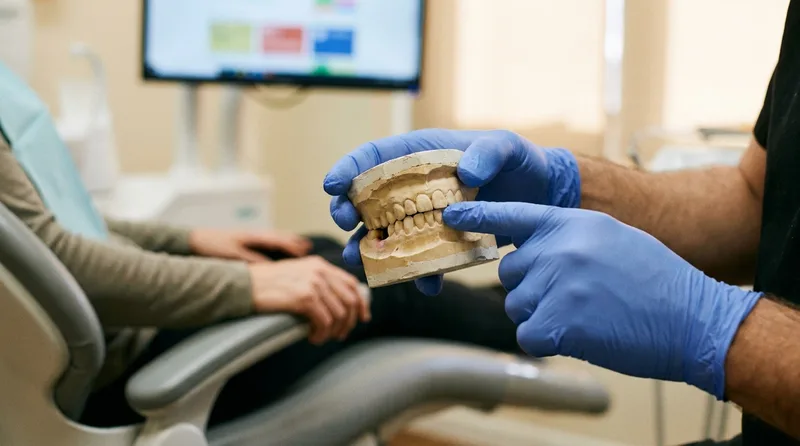
Your bite works a bit like a set of gears. Move one and the others take on loads they weren't built for. The temporomandibular joints (TMJ) that hinge your jaw feel some of that change, and so do the teeth that end up taking the hardest hits.
Most people also start chewing on the other side without realizing it. That habit puts double duty on teeth that used to share the work. Over time, it can speed up wear, chipping, or small cracks on the busy side.
Myth
“If the gap doesn't bother me, nothing is changing.”
Fact
Drifting and bone loss are usually quiet while they happen. Discomfort, if it shows up at all, tends to arrive after teeth have already moved.
Bite changes from a gap build slowly, so they're easy to blame on stress or age. If two or more of these sound familiar, ask your dentist to check your bite alignment along with the gap itself.
Beyond shifting and bone loss, a missing tooth can raise your risk of gum disease and decay around neighboring teeth, change how certain words sound, and, when several teeth are gone, affect facial support and the foods you're comfortable eating. The impact grows the longer a gap stays open.
Tilted teeth create angles that a toothbrush and floss can't reach well. Plaque builds up there, and gum pockets can deepen. That's a real concern, since the CDC reports that 42% of adults aged 30 and older have some form of periodontal disease, and the ADA's MouthHealthy guide to gum disease explains how untreated gum disease can lead to tooth loss. One lost tooth can quietly set up the next one.
Decay follows the same pattern. About 1 in 5 U.S. adults aged 20 to 64 already has at least one untreated cavity, according to CDC data, and hard-to-clean surfaces beside a gap only add to that risk.
Front teeth and premolars help shape sounds like “s,” “f,” and “th.” A gap there can cause a slight whistle or lisp. Most people adapt. Some never quite do.
Losing a molar or two often nudges people toward softer foods without them noticing. Raw vegetables, nuts, and tougher meats slowly drop off the menu. The National Institute of Dental and Craniofacial Research's data on tooth loss in adults shows missing teeth become more common with age, which is exactly when steady nutrition matters most.
Good to know
Facial changes like sunken cheeks are mostly linked to losing several teeth, not one. A single gap is more likely to affect your bite and neighboring teeth than your appearance.
Yes, the location of the missing tooth changes the risks. A missing back molar mainly affects chewing and nearby tooth movement, a missing front tooth affects appearance and speech, and missing wisdom teeth usually don't need replacing at all. Your dentist weighs location alongside your bite and bone health.
| Missing tooth | Main risks if left open | When changes tend to show |
|---|---|---|
| Front teeth (incisors) | Visible gap, speech changes, neighbors tilting into the space | Appearance right away; shifting over months |
| Canines | Loss of guidance when your jaw slides sideways, extra load on other teeth | Gradually, over months to years |
| Premolars | Neighbor drift, opposing tooth over-erupting, a gap that shows when you smile | Months to years |
| First and second molars | Biggest loss of chewing power, back teeth tipping forward, bite changes | Can begin within months |
| Wisdom teeth | Usually little to none | Rarely a concern |
Molars carry most of your chewing force. So a missing lower molar can set off more drifting than people expect, and it's easy to ignore because nobody sees it when you smile.
One caveat on molars: a missing second molar at the very back sometimes causes few problems, depending on how your teeth meet. That's a call for an exam, not a guess.
Changes after losing a tooth usually begin within the first few months. Bone loss is typically fastest during the first year, while tooth drifting and bite changes tend to build more slowly over several years. Every mouth is different, so timelines vary with age, gum health, and which tooth is missing.

What a gap typically looks like over time
A typical pattern, not a fixed schedule. Your own timeline depends on your mouth.
The early months are the window that matters most. That's when the jawbone changes fastest, so a conversation with your dentist soon after losing a tooth usually keeps more doors open than one years later.
Already had the gap for a while? That's common. It doesn't mean your options are gone. It just means an X-ray is the only way to know where things stand today.
Sometimes, yes. Missing wisdom teeth rarely need replacing, and some back gaps cause few problems when the bite stays stable. For most other teeth, though, leaving a gap means accepting slow changes, so the decision is best made with a dentist after X-rays rather than by waiting to see.
Some people choose to wait for good reasons: budget, health, timing, or a big life event. That's a fair choice. Waiting isn't the same as ignoring, though. Use the quick self-check below.
Is it time to get your gap checked?
Check each one that applies to you.
Checked two or more? It's worth booking an exam sooner rather than later.
In the meantime, keep the area extra clean and stay on top of checkups. People who see a dentist regularly are 60% less likely to lose teeth, according to the Journal of Dental Research, and the ADA notes regular visits can catch 80% of oral health issues before they become serious.
Related: Once you understand the risks, the next step is choosing how to close the gap. Compare your options for replacing a missing tooth →
Start with an exam, not a decision. Knowing the risks of an open gap is useful, but only X-rays and a bite check can show whether your teeth and bone have already started to change, and how much time you realistically have.
A gap is quiet. That's the whole problem. Teeth drift and bone thins without much fanfare, and by the time something feels off, the fix is often bigger than it needed to be.
At Peterborough Family Dental & Implant Center, we see patients from all over the Monadnock region who have lived with a gap for years. A simple visit lets us look at the space, take X-rays, and talk through what's changing and what isn't.
Results may vary. Please consult with your dentist at Peterborough Family Dental for personalized treatment recommendations.
Find Out Where Your Gap Stands
Schedule a visit at our Peterborough, NH office. We'll check the teeth and bone around your gap and explain what we see in plain language.
Request an Appointment →Prefer to talk it through first? Our front desk opens at 7 AM.
Call (603) 924-3664 →
Dr. Muhammad Rahim, DMD
Dentist · Peterborough Family Dental & Implant Center
Peterborough, NH dentist providing gentle general, cosmetic, restorative, and implant dentistry for the whole family.
Was this article helpful?
Over several years, neighboring teeth can drift noticeably, the opposing tooth may over-erupt, and the jaw ridge under the gap usually becomes thinner. Small spaces can open elsewhere in your smile. A long-standing gap can still often be treated, but planning may involve more steps.
Our Peterborough team is happy to answer questions and get you on the calendar.


