
Back to all articlesDental Implants Dr. Muhammad Rahim, DMDOctober 6, 202610 min read
Can You Get Dental Implants After Years of Wearing Dentures?
Dr. Muhammad Rahim, DMDOctober 6, 202610 min read
Loading blog post
Dr. Muhammad Rahim, DMDOctober 6, 202610 min readCall and you'll reach a real person on our team: no phone tree, no hold music. We'd genuinely love to help.
(603) 924-3664Rather write to us? Contact us
Yes, you can usually get dental implants after wearing dentures, even after many years. Age is rarely the deciding factor. What matters most is how much jawbone you have left, the health of your gums, and your general health, all of which a quick exam and 3D scan can check.
A lot of long-time denture wearers assume the window has closed. They've heard that the bone shrinks under dentures, or they figure implants are for younger people. Neither has to stop you. Even when bone has thinned, there are often ways to work with what's there, from implant-supported dentures that need only a few implants to approaches designed for limited bone.
This guide focuses on one question: are you still a candidate? Below, you'll find what affects eligibility, what happens if bone is low, and how to know when it's time to ask.
Implants after dentures at a glance
Is it too late?
Usually not. Age alone isn't a barrier to implants.
Biggest factor
How much jawbone remains after years of denture wear
Low bone?
Grafting or implant options designed for less bone may help
How to know
An exam and 3D scan show exactly where you stand
Wondering if you still qualify?
Dr. Muhammad Rahim and Dr. Jasper Ainslie can check your bone with a 3D scan and tell you honestly what's possible, no matter how long you've worn dentures.
Request an Appointment →Yes, most people can get dental implants after wearing dentures for years. The time you've spent in dentures matters less than the bone and gum health you have today. Many patients switch after ten, twenty, or even thirty years, sometimes with extra steps to rebuild bone first.
It's one of the most common questions we hear from denture wearers in Peterborough and the Monadnock region. Usually it comes with a little hesitation, as if the answer must be no. More often than not, it isn't.
Here's the honest picture of where most long-time denture wearers land:
You won't know which group you're in from the mirror. That's what the scan is for.
Long-term denture wear affects eligibility because the jawbone slowly shrinks once natural tooth roots are gone. Dentures rest on top of the gums and don't stimulate the bone the way roots did, so over years the ridge can become thinner and shorter, leaving less bone to anchor an implant.
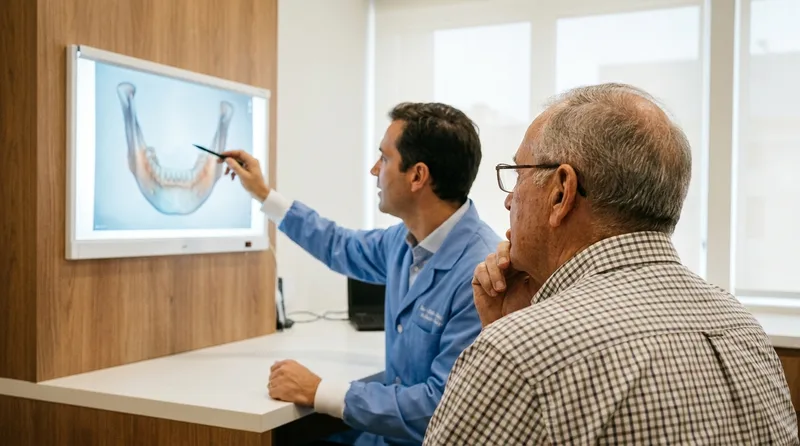
Bone loss starts right after teeth are removed and is fastest in the first year. A systematic review in Clinical Oral Implants Research found the ridge can lose 29-63% of its width within six to seven months of an extraction. After that, the shrinking continues more slowly under a denture, year after year.
Height
How tall the ridge is
Determines how long an implant can be without reaching nerves or the sinus.
Width
How thick the ridge is
An implant needs bone wrapped around it on all sides.
Density
How solid the bone is
Denser bone holds an implant more firmly while it heals.
Location
Where the bone is
Shows which spots can support implants and which can't.
That's also why an older denture often feels looser than it used to. The denture hasn't changed, but the bone beneath it has. A loose fit is frequently the first clue that the ridge is shrinking.
The good news: a 3D cone beam CT (CBCT) scan measures all four of those precisely, so decisions are based on numbers, not guesses. The lower jaw often shrinks more than the upper jaw over the years, which is one reason lower dentures tend to feel loosest.
A good candidate has enough healthy jawbone, or can rebuild it, healthy gums, and general health that supports healing. Being a non-smoker and having well-controlled conditions like diabetes also help. Your age and how long you've worn dentures are much less important than these factors.
Factors that help
Factors that need a closer look
A factor in the right-hand column isn't an automatic no. It means your dentist will look more carefully, may coordinate with your physician, and might adjust the plan. Plenty of patients with one or two of these still go on to get implants.
How your eligibility is checked
Conversation about your goals
What bothers you about your dentures, and what you'd like to be able to eat and do.
Health and medication review
Conditions and medications that affect healing are noted, so nothing is missed.
Exam of gums and ridge
Your dentist checks the tissue under your denture for irritation or infection.
3D scan
The scan maps bone height, width, and density across both jaws.
Written plan
You leave knowing which options fit, what each involves, and an itemized quote.
Bring a list of your medications to your consultation. It's the single most useful thing you can do to get a clear answer quickly. And if you've been nervous about dental visits for years, you're far from alone: about 36% of Americans have dental anxiety, according to research in BMC Oral Health, and sedation options are available.
No, there's no upper age limit for dental implants. Research on patients aged 65 and older shows implants succeed at high rates, and reviewers have concluded that age alone shouldn't rule anyone out. Overall health and bone quality matter far more than the number of birthdays.

97.7%
one-year implant survival in patients aged 65+
Source: Clinical Oral Implants Research, 2017
96.2%
five-year implant survival in patients aged 65+
Source: Clinical Oral Implants Research, 2017
90%
of natural chewing power can be restored with implant-supported teeth
Source: AAID
Those figures come from a systematic review of dental implants in the elderly, which pooled prospective studies of patients 65 and older. The authors concluded that implants are a predictable long-term option for older adults and that age by itself shouldn't limit treatment.
Myth
“I’m too old for implants.”
Fact
Age alone isn’t a barrier. Many patients get implants in their 70s and 80s. Bone, gum health, and general health are what decide.
If you don't have enough bone, you may still have options. Bone grafting can rebuild the ridge, and some implant approaches are designed to use less bone, such as placing fewer implants to support a denture or angling implants toward denser areas. Your scan shows which of these fits.
Low bone? How the options usually narrow down
↓
Upper back teeth add one wrinkle. The sinus sits just above them, and after years without teeth there's often little bone below it. In those cases, a sinus lift or an approach that avoids that area may be considered, sometimes in coordination with an oral surgeon.
And if implants aren't right today, that isn't the end of the conversation. Some patients start with a better-fitting denture and revisit implants once their health or priorities change.
See what your bone can support
A 3D scan at our Peterborough office shows exactly how much bone you have and which options are realistic, so you can decide with real information.
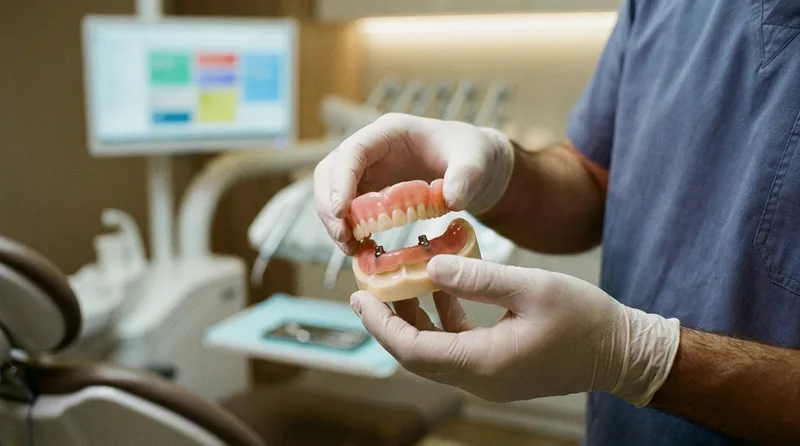
Book a Consultation →Long-time denture wearers usually choose between a removable implant-supported denture, which snaps onto two to four implants, and a fixed full arch that stays in place. Snap-on dentures need fewer implants and less bone, while fixed options feel more like natural teeth but often need more support.
| Snap-on implant denture | Fixed full arch | |
|---|---|---|
| Implants per arch | Usually 2-4 | Usually 4 or more |
| Removable? | Yes, for cleaning | No, fixed in place |
| Bone needed | Less | More, though angled implants help |
| Feel | Much more stable than a regular denture | Closest to natural teeth |
| Upfront cost | Lower | Higher |
For the lower jaw especially, the snap-on approach has strong backing. The McGill consensus statement, issued by an international group of experts in 2002, named a two-implant overdenture as the first-choice standard of care for people with no lower teeth. It's often the simplest step up from a loose lower denture.
In some cases, your current denture can even be adapted to attach to new implants, at least as a temporary step. Ask about it.
Consider switching when your denture slips, rubs, or limits what you eat, when you're relying on more adhesive, or when it's time for a new set anyway. That last point matters: the moment you'd replace a worn denture is a natural time to ask whether implants make more sense.
Is it time to ask about implants?
Check each one that applies to you.
Checked a few? Bring this list to your consultation.
If your current set is getting old, it helps to know the signs your dentures are wearing out. A loose fit from bone changes is one of them, and it's exactly the kind of problem implants are designed to address.
The day you need a new denture is the best day to ask whether you need a denture at all.
For most people, it isn't too late to get dental implants after wearing dentures, whether it's been five years or thirty. The real question is how much bone you have and whether your health supports healing, and a single consultation with a 3D scan can answer both.
Dentures are still a solid choice for many people, and the ADA's MouthHealthy overview of dentures explains the main types well. But if yours slip, rub, or keep you from foods you love, it's worth knowing whether implants are on the table.
Related: Want to see how implants, bridges, and dentures stack up before deciding? Compare all tooth replacement options →
Patients from Peterborough, Jaffrey, Dublin, Hancock, and across the Monadnock region come to us after years in dentures, often expecting a no. We'll show you your scan, explain what's realistic, and help you decide with no pressure, whichever path you choose.
Results may vary. Please consult with your dentist at Peterborough Family Dental for personalized treatment recommendations.
Find Out If Implants Are Still an Option for You
Schedule a consultation at our Peterborough, NH office. We'll take a 3D scan and give you a clear, honest answer about your eligibility.
Request an Appointment →Prefer to talk it through first? Our front desk opens at 7 AM.
Call (603) 924-3664 →
Dr. Muhammad Rahim, DMD
Dentist · Peterborough Family Dental & Implant Center
Peterborough, NH dentist providing gentle general, cosmetic, restorative, and implant dentistry for the whole family.
Was this article helpful?
There's no fixed cutoff. Many people get implants after decades in dentures. The longer teeth have been missing, the more bone may have shrunk, which can mean extra steps like grafting. A 3D scan shows whether implants are possible now or after rebuilding bone.
Our Peterborough team is happy to answer questions and get you on the calendar.


