
Back to all articlesDental Implants Dr. Muhammad Rahim, DMDOctober 6, 202612 min read
Can You Get an Implant the Same Day as Extraction?
Dr. Muhammad Rahim, DMDOctober 6, 202612 min read
Loading blog post
Dr. Muhammad Rahim, DMDOctober 6, 202612 min readCall and you'll reach a real person on our team: no phone tree, no hold music. We'd genuinely love to help.
(603) 924-3664Rather write to us? Contact us
Can you get an implant the same day as extraction? In many cases, yes. Dentists call it immediate implant placement: the damaged tooth comes out and the implant goes into the same socket during one visit, instead of waiting months for the area to heal first.
That sounds like an obvious win, and often it is. One surgery instead of two. One recovery. No long stretch with a gap. But not every tooth or every mouth is a good fit, and the deciding factors aren't always visible until your dentist looks at a 3D scan. At Peterborough Family Dental & Implant Center, we offer same-day implants when the bone, gums, and tooth position support them.
This guide explains what happens during a same-day visit, who tends to qualify, when waiting is the smarter call, and what the research says about how well immediate implants hold up.
Have a tooth that needs to come out?
Ask about immediate placement before your extraction is scheduled. A 3D scan at our Peterborough, NH office shows whether same-day placement makes sense for your tooth.
Request an Appointment →Yes, an implant can often be placed the same day a tooth is removed, as long as the surrounding bone is healthy, there's no active infection, and the implant can be held firmly in place. Your dentist confirms this with an exam and a 3D scan before the extraction is planned.
Related: If your tooth is removed without an implant the same day, here's how to care for the site. Tooth extraction aftercare →
The traditional route takes longer. The tooth is extracted, the socket heals for roughly three to six months, and then a second procedure places the implant. Immediate placement folds those two steps into one appointment.
There's also a middle path many people don't hear about. Implant teams generally describe three timing options:
The short version
Same-day placement is a timing choice, not a different kind of implant. The implant itself is the same. What changes is when it goes in, and that depends on what your scan shows.
So the real question isn't whether same-day implants exist. They do, and they're common. It's whether your specific tooth and bone are a good match.
A same-day visit combines the extraction and the implant into one appointment. Your dentist numbs the area, gently removes the tooth while protecting the surrounding bone, cleans the socket, places the implant, and covers it with a healing cap or temporary tooth. Most visits take a couple of hours.
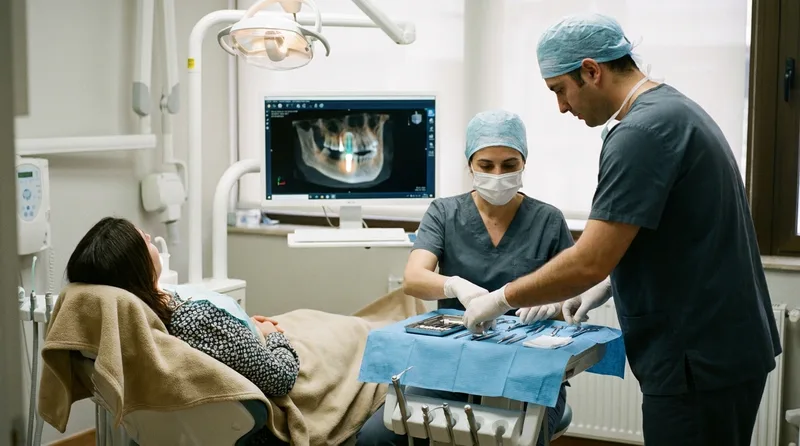
What a typical same-day visit looks like
Planning with a 3D scan
Before the day of surgery, a cone beam CT (CBCT) scan maps the bone around the tooth so the implant position can be planned digitally.
Comfort first
Local anesthetic numbs the area. Sedation options are available if you feel nervous.
Gentle extraction
The tooth is removed carefully, with the goal of keeping the thin bone walls of the socket intact.
Socket cleaning and implant placement
The socket is cleaned, then the implant is placed into the bone beyond the old root tip so it's held firmly.
Healing cap or temporary tooth
Depending on how stable the implant is, you leave with a healing cap or a temporary crown.
Nervous about a longer visit? That's common. About 36% of Americans have dental anxiety, and 12% have extreme dental fear, according to research published in BMC Oral Health in 2024. For many of those patients, the biggest appeal of same-day placement is simple: one procedure to get through instead of two.
Good candidates usually have healthy bone around the tooth being removed, no active infection at the site, healthy gums, and good general health. The implant also needs enough bone beyond the root tip to sit firmly, which a 3D scan can confirm before your extraction is scheduled.
Often a good fit
Often better to wait
It can. Front teeth and premolars usually have a single root, so the socket shape often suits an implant well. Molars have two or three roots and a wider socket, which can make it harder to get a snug fit right away. That doesn't rule molars out. It just means the scan matters even more.
Front teeth come with their own consideration: appearance. The bone over the front of upper teeth is often very thin. If it's damaged during extraction, the gumline can shift over time, so your dentist may suggest a different timing to protect how the tooth looks.
Sometimes the scan shows there isn't enough bone to hold an implant securely on day one. That's the main situation where your dentist will talk about when a bone graft is needed first, rather than placing the implant right away.
Your dentist may recommend waiting if there's an active infection, not enough healthy bone, untreated gum disease, or a health factor that slows healing. In those cases, letting the site heal first usually gives the implant a more stable foundation and a better long-term outcome.
Infection is the most common reason. A tooth with an abscess or significant swelling around it often needs time, and sometimes treatment, before anything goes into the socket. Abscesses deserve respect: according to JADA, an untreated dental abscess can spread to other parts of the body within 48 hours. Dentists don't take that lightly.
That said, research is more nuanced than a simple yes or no. A 2024 systematic review in Medicina found that implants placed into sockets with chronic infection at the root tip had survival rates similar to implants in sockets without it, when the sites were thoroughly cleaned. Each case still needs an individual decision.
Waiting isn't a failure or a downgrade. It's a different route to the same result, and sometimes it's the more predictable one.
Wondering which route fits your tooth?
Dr. Muhammad Rahim and Dr. Jasper Ainslie review your 3D scan with you and explain whether same-day or staged placement makes more sense, before anything is scheduled.
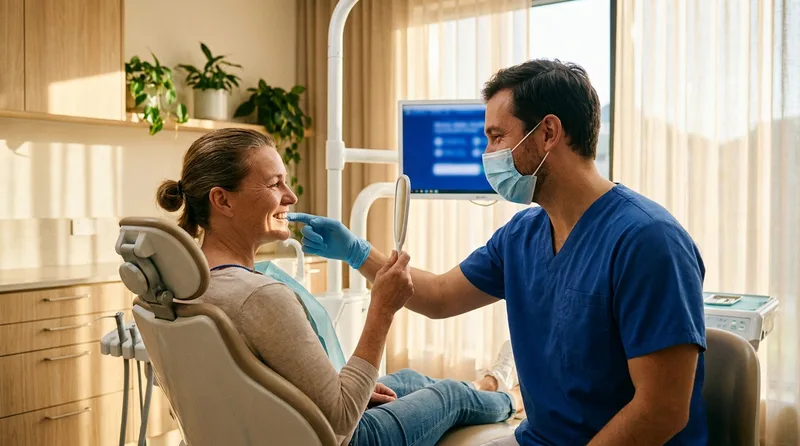
Book a Consultation →Often, yes, but it's usually a temporary tooth rather than the final crown. If the implant is stable enough, your dentist may attach a temporary crown the same day so you don't leave with a gap. The permanent crown comes a few months later, after the implant has bonded with the bone.
Myth
“Same-day implant means my final tooth is done in one visit.”
Fact
The implant goes in the same day, and many patients also get a temporary tooth. The permanent crown is placed after healing, typically a few months later.
That temporary tooth has a job: to look natural and support the gums while the implant heals underneath. It's usually shaped so it doesn't take full biting pressure. Chewing hard on a brand-new implant can disturb the healing process, so you'll likely be asked to favor the other side for a while.
If the implant isn't stable enough for a temporary crown, you'll leave with a small healing cap instead. For a back tooth that no one sees, that's often perfectly fine. For a front tooth, your dentist can discuss a removable option to cover the space.
Once healing is complete, the final crown is made to match your other teeth. Our in-house lab and CEREC technology can help speed up that last step for many patients.
Immediate implants have high success rates when patients are carefully selected, though implants placed into healed sockets tend to do slightly better overall. Large reviews report survival rates above 95% for immediate implants, which is why case selection and a careful scan matter so much.
98.4%
two-year survival rate for immediate implants across 46 studies
Source: Clinical Oral Implants Research, 2012
95.2%
survival for immediate implants vs. 98.4% for delayed implants
Source: Int. J. Oral & Maxillofacial Surgery, 2017
95-98%
success rate for dental implants overall over 10 years
Source: J. of Oral and Maxillofacial Surgery
The numbers come from different study groups, so they're not a perfect apples-to-apples comparison. A 2012 review in Clinical Oral Implants Research pooled 46 studies and found a two-year survival rate of 98.4% for immediate implants. A 2017 meta-analysis comparing immediate and delayed implants found 95.21% survival for immediate placement and 98.38% for implants placed in healed sockets, and advised using immediate placement with caution.
Here's what that means in practice. Same-day placement works very well for the right patient. It's less forgiving when the bone or gums aren't ideal, so a good team will tell you honestly when your case points toward waiting.
The main benefits of same-day implant placement are fewer surgeries, a shorter overall timeline, and less time with a gap. The tradeoffs are stricter requirements for bone and gum health and a slightly higher risk in less-than-ideal sites, so it works best when your scan shows good conditions.

| Same-day (immediate) | Healed site (delayed) | |
|---|---|---|
| Number of surgeries | One for extraction and implant | Two separate procedures |
| Time with a gap | Little or none if a temporary tooth fits | Often several months |
| Total timeline to final crown | Usually shorter | Usually longer |
| Requirements | Healthy bone, no active infection, good stability | More flexible; site heals first |
| Survival in reviews | About 95-98% | About 98% |
| Best for | Single teeth in healthy sites | Infected, thin, or complex sites |
The ADA's patient resource on dental implants describes the basic healing process that both routes share: the implant needs time to fuse with the jawbone before it carries a final tooth. Same-day placement shortens the path, but it doesn't skip that biology.
Related: Still deciding whether an implant is the right fit at all? Our main guide compares implants, bridges, and dentures side by side. tooth replacement options →
One more practical point. Combining two procedures into one often means fewer appointments and less time off work, which matters if you're driving in from Jaffrey, Dublin, or Hancock.
Before your extraction is booked, ask whether you're a candidate for immediate placement, what your 3D scan shows about the bone, and whether you'd leave with a temporary tooth. Asking early matters, because the decision affects how the tooth is removed and how the visit is planned.
Questions to bring to your consultation
Check each one that applies to you.
Bring this list to your visit. There are no wrong questions.
If the tooth is already gone, same-day placement is off the table, but other timing options still are. And if your scan says wait, ask what the plan looks like and how long each stage takes. Clear answers make the whole process feel far less uncertain.
Yes, it's worth asking about before any extraction. If your bone and gums are healthy, same-day placement can save you a second surgery and months with a gap. If they aren't, knowing that early lets your dentist plan the extraction to protect the site for later.
The timing of that conversation is the part people miss. Once a tooth is out, the same-day option is gone. So ask first.
Patients across Peterborough and the Monadnock region come to us with a tooth that needs to go and one simple question about what comes next. We'll look at your scan with you, explain your options in plain language, and help you choose the route that fits your mouth and your schedule.
Results may vary. Please consult with your dentist at Peterborough Family Dental for personalized treatment recommendations.
Ask About Same-Day Implants Before Your Extraction
Schedule a consultation at our Peterborough, NH office. We'll take a 3D scan and tell you honestly whether immediate placement is right for you.
Request an Appointment →Prefer to talk it through first? Our front desk opens at 7 AM.
Call (603) 924-3664 →
Dr. Muhammad Rahim, DMD
Dentist · Peterborough Family Dental & Implant Center
Peterborough, NH dentist providing gentle general, cosmetic, restorative, and implant dentistry for the whole family.
Was this article helpful?
Sometimes. A tooth with active swelling or an abscess usually needs to heal first. Chronic infection at the root tip doesn't always rule it out, because some studies show similar survival when the socket is thoroughly cleaned. Your dentist decides case by case.
Our Peterborough team is happy to answer questions and get you on the calendar.
Healing and final crown
The implant bonds with the bone over a few months. Then your permanent crown is made and placed.


