
Back to all articlesRestorative Dentistry Dr. Muhammad Rahim, DMDNovember 16, 202611 min read

Partial Denture vs Bridge: Which Fits Your Missing Teeth?
Dr. Muhammad Rahim, DMDNovember 16, 202611 min read
Loading blog post
Dr. Muhammad Rahim, DMDNovember 16, 202611 min readCall and you'll reach a real person on our team: no phone tree, no hold music. We'd genuinely love to help.
(603) 924-3664Rather write to us? Contact us
Partial denture vs bridge is the question almost everyone asks when they're missing a few teeth and want a replacement that fits their life. Both fill the gap, both restore chewing, and both stop the teeth around the gap from drifting. The big difference is simple: one is fixed in place, and the other comes out. At Peterborough Family Dental & Implant Center in Peterborough, NH, we offer restorative and tooth replacement care, including both options, so our advice isn't tilted toward one.
About 120 million Americans are missing at least one tooth, according to the American College of Prosthodontists, and many are weighing exactly this choice. Leaving a gap alone is rarely the right answer, because neighboring teeth shift toward the space and the bone beneath can lose density.
This guide compares how each option works, how it feels and is cared for, what happens to your remaining teeth, and how to choose.
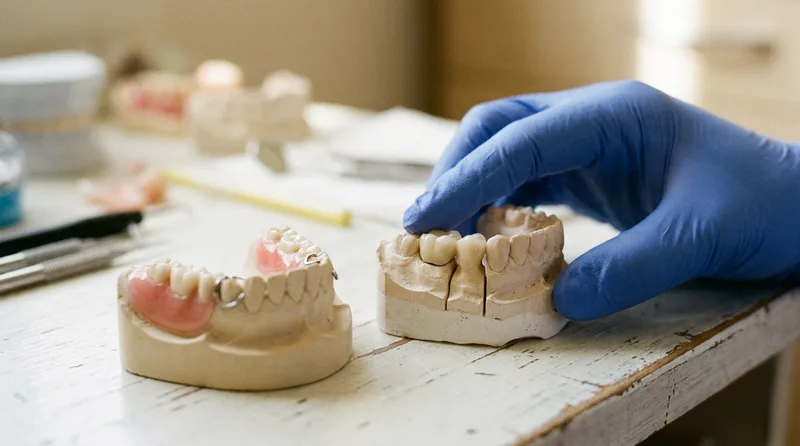
A bridge is a fixed restoration cemented in place and anchored to teeth on either side of the gap or to an implant, while a partial denture is a removable appliance that clasps onto your remaining teeth. You can take a partial out for cleaning. A fixed bridge can only be removed by a dentist.
The American Dental Association's guide to bridges explains that a bridge replaces missing teeth with artificial teeth and literally bridges the gap, is attached to surrounding teeth for support, and can be made from gold, alloys, porcelain, or a combination. It also notes that, unlike a removable bridge, a fixed bridge can only be removed by a dentist, and that its success depends on a foundation of healthy remaining teeth.
Our partial dentures work differently. They replace one or more missing teeth while keeping your healthy natural teeth, using a lightweight framework that clasps onto the teeth you have left. They also keep those remaining teeth from shifting.
A bridge is fixed, feels like part of your teeth, and needs anchor teeth on either side, while a partial denture is removable, clasps onto remaining teeth, and can replace teeth in several areas. Neither is better for everyone. The table shows where each one stands on the points patients ask about most.
| Feature | Dental bridge | Partial denture |
|---|---|---|
| Fixed or removable | Fixed, cemented in place | Removable, comes out for cleaning |
| How it's held | Anchored to teeth on either side of the gap, or to an implant | A lightweight framework clasps onto your remaining teeth |
| Suits | One or more missing teeth in a row | One or more missing teeth, including gaps in different areas |
| Effect on neighboring teeth | Traditional bridges crown the anchor teeth | Clasps hold on without crowning |
| Treatment time | Often two appointments over one to two weeks | Several visits, with a wax try-in and one to two weeks to fabricate |
| Daily care | Brush and floss, and clean under the bridge | Remove it, brush it, and soak it |
| Feel | Feels like part of your teeth | May feel awkward for a few weeks while you adjust |
| Insurance | Covered by most dental plans, with limits | Most plans cover a portion |
The pattern is clear. A bridge asks something of the teeth beside the gap and gives you a fixed result. A partial denture asks you to take it out and clean it daily, and it doesn't alter your natural teeth. Which of those trade-offs you prefer is a personal call.
Not sure which one fits your gap?
Book a free consultation at our Peterborough office and we'll show you what's possible for your teeth.
Request an Appointment →A traditional bridge crowns the teeth on either side of the gap and suspends an artificial tooth between them, while an implant-supported bridge anchors to implants instead. A Maryland bonded bridge uses wings bonded behind the neighboring teeth, mostly for front-tooth gaps. Most traditional bridges take two appointments.
At the first visit your dentist prepares the anchor teeth, takes impressions, and fits a temporary bridge. At the second, the finished bridge is checked and cemented. Most patients are done within one to two weeks. Our dental bridges page walks through the steps, and our guide to how long dental bridges last covers what affects lifespan.
If you're weighing an implant-anchored version, our comparison of implant bridges and traditional bridges explains the difference.
A partial denture is made from precise impressions and has replacement teeth attached to a lightweight framework that clasps onto your remaining teeth. You wear it during the day and remove it to clean. It takes several visits, including a wax try-in so you can approve the fit and look before the final version is made.
The process is straightforward. Your dentist examines your mouth and discusses your goals, takes impressions and measurements, and does a wax try-in. The denture is then fabricated, which takes one to two weeks, and finally fitted and adjusted until it feels right.
The ADA's guide to dentures notes that new dentures may feel awkward for a few weeks, may feel loose while the muscles of your cheeks and tongue learn to keep them in place, and that minor irritation or soreness is not unusual. Follow-up visits let your dentist check and adjust the fit. If a denture stays loose, our guide to loose dentures explains what helps.
In the partial denture vs bridge comparison, a bridge feels most like your own teeth because it's fixed, with extra cleaning care under the replacement tooth. A partial denture takes a few weeks to adjust to and comes out daily for cleaning. Both are manageable once you settle in.

Speech and eating matter too. A removable appliance can feel bulky at first, and speech usually adjusts with practice. A fixed bridge rarely changes how you talk once you've adapted.
The ADA advises brushing dentures daily to remove food and plaque, rinsing first to remove loose debris, and cleaning your gums, tongue, and palate every morning. Our guide to cleaning dentures has the full routine.
Gum health protects both options. The CDC reports that 42% of adults aged 30 and older have some form of periodontal disease, so cleanings and checkups matter whichever option you choose.
With a traditional bridge, the teeth beside the gap are prepared and crowned, which carries some of the load. With a partial denture, clasps hold onto the remaining teeth without crowning them. Either way, replacing the gap stops the teeth around it from drifting toward the space.
Leaving a gap untreated causes problems. The teeth on either side tend to shift toward the space, the opposing tooth can over-erupt, and the jawbone beneath the gap gradually loses density. Both options hold your bite in place and restore chewing.
The trade-off is what each asks of your natural teeth. A bridge relies on strong anchor teeth, so those teeth need to be healthy. A partial relies on clasp teeth and a good fit, which may need adjustments over time as your mouth changes.
Implants offer a third route: an implant-supported bridge that doesn't alter neighboring teeth, or an implant-supported partial that snaps into place. They preserve bone and feel the most natural, though they need surgery, healing time, and enough bone. A scan shows whether they're an option for you.
The Journal of Oral and Maxillofacial Surgery reports implant success rates of 95-98% over 10 years, and the American Academy of Implant Dentistry reports that implant-supported teeth can restore up to 90% of natural chewing power. Our comparison of a dental implant and a bridge and our comparison of implants and dentures explain the trade-offs in more detail.
You don't have to decide alone. At a consultation we'll show you a bridge, a partial denture, and an implant option side by side, with a written quote for each, so you can compare fairly.
Want to see all three options for your mouth?
Send us a note and we'll explain how a written plan compares them side by side.
Contact Our Office →Dentures are generally the most accessible option for replacing teeth, while bridges cost more up front and are covered by most dental insurance plans. Coverage varies by plan and by the reason for replacement. We verify your benefits and give you a written quote before any treatment begins.

Ask what's included in each quote: follow-up visits, adjustments, and any repair or replacement terms. A clear written plan lets you compare fairly.
We're in-network with Delta Dental Premier and check your benefits in writing. Our guide to implant insurance coverage explains terms like annual maximums. If you already have a quote from another office, we offer a free second opinion and match the price on comparable care.
Decide partial denture vs bridge by looking at where the gaps are, how healthy the teeth beside them are, whether you want fixed or removable teeth, and what you can invest. An exam and X-rays turn those four questions into a clear recommendation. Ask to see your own images before you decide.
Nerves about starting are normal. BMC Oral Health (2024) reports that 36% of Americans have dental anxiety and 12% have extreme dental fear, and the Journal of Dental Anesthesia reports that sedation dentistry has helped 75% of fearful patients keep up with regular visits. We offer nitrous oxide and oral sedation.
Book a free consultation so your dentist can look at your gaps and show you your options. A short exam and X-rays tell you which route fits, and you'll leave with a written quote. Regular care protects your investment whichever option you choose.
The Journal of Dental Research reports that people who see a dentist regularly are 60% less likely to lose teeth, and the ADA notes that regular visits can catch 80% of oral health issues before they become serious. We welcome patients from Peterborough, Jaffrey, Dublin, Hancock, and across the Monadnock region, with early-morning hours from 7 AM Monday through Thursday. Bring your questions to Dr. Muhammad Rahim or Dr. Jasper Ainslie. If you request a time online, a real person from our team replies the same business day to confirm your visit.
Results may vary. Please consult with your dentist at Peterborough Family Dental for personalized treatment recommendations.
Compare your options in person
Request a free consultation at Peterborough Family Dental & Implant Center and get a clear recommendation and a written quote.
Request an Appointment →Prefer to talk to someone first?
Call (603) 924-3664 →
Dr. Muhammad Rahim, DMD
Dentist · Peterborough Family Dental & Implant Center
Peterborough, NH dentist providing gentle general, cosmetic, restorative, and implant dentistry for the whole family.
Was this article helpful?
It depends on where the gaps are. A bridge needs strong anchor teeth on either side of a gap, so it suits missing teeth in a row. A partial denture can replace teeth in several areas by clasping onto the remaining teeth. An exam shows which fits.
Our Peterborough team is happy to answer questions and get you on the calendar.


