
Back to all articlesDental Implants Dr. Muhammad Rahim, DMDOctober 6, 20269 min read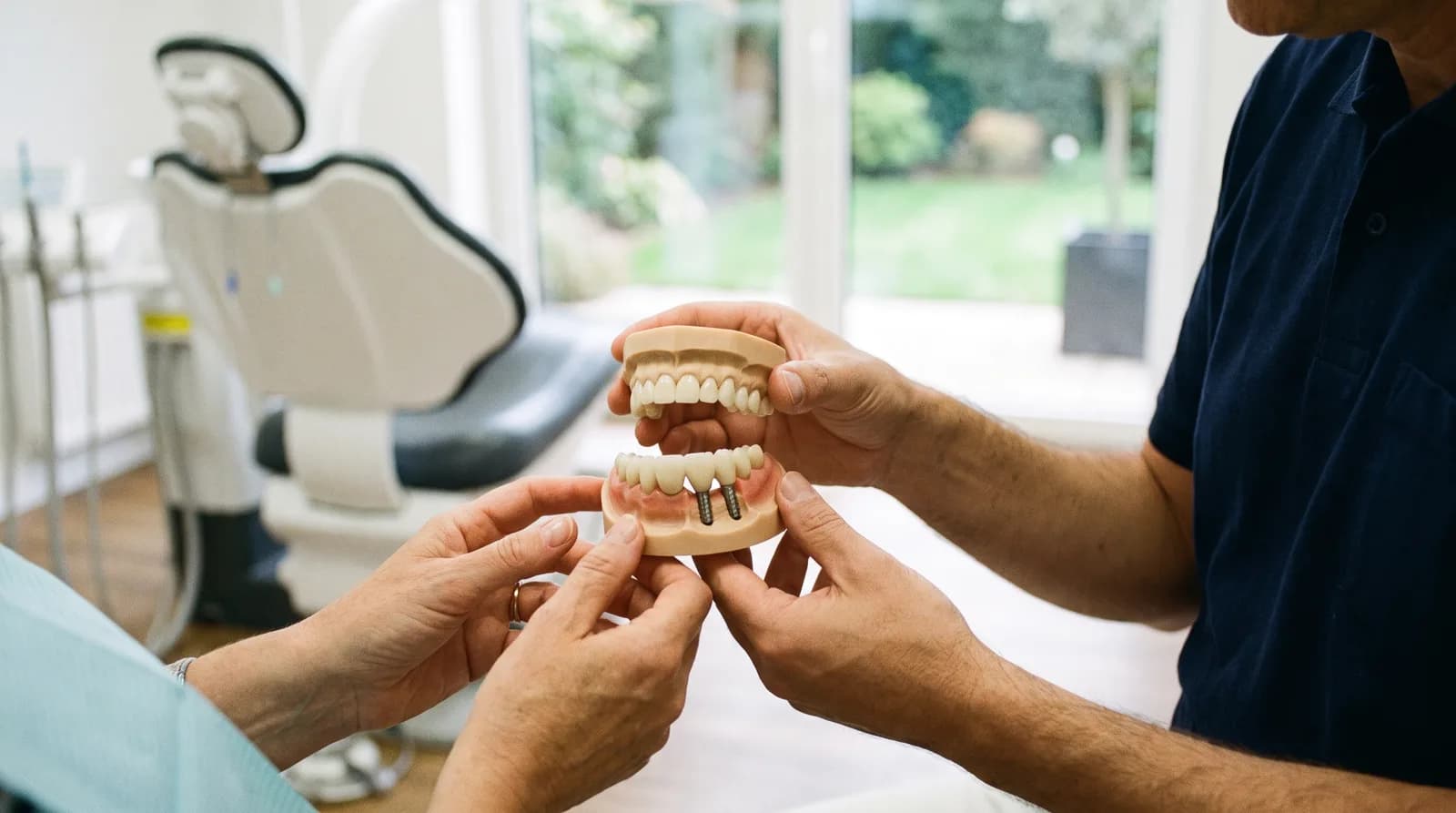
Implant Bridge vs Traditional Bridge: Which Is Better?
Dr. Muhammad Rahim, DMDOctober 6, 20269 min read
Loading blog post
Dr. Muhammad Rahim, DMDOctober 6, 20269 min readCall and you'll reach a real person on our team: no phone tree, no hold music. We'd genuinely love to help.
(603) 924-3664Rather write to us? Contact us
Implant bridge vs traditional bridge: both replace several missing teeth in a row with a fixed set of teeth that doesn't come out. The difference is what holds them up. A traditional bridge is anchored to crowns on your natural teeth, while an implant bridge is anchored to implants in the jawbone.
That one difference ripples into everything else: what happens to your neighboring teeth, whether the bone under the gap is preserved, how long treatment takes, and what it costs. Neither option is better for everyone. At Peterborough Family Dental & Implant Center, we offer both traditional bridges and implant bridges, so we can recommend whichever genuinely fits your mouth.
This guide compares the two side by side, so you can walk into a consultation knowing the right questions to ask.
The two bridges at a glance
Traditional bridge
Anchored to crowns on the teeth beside the gap. No surgery, finished in weeks.
Implant bridge
Anchored to two or more implants. Leaves neighboring teeth untouched.
10-year survival
About 89% traditional vs. 87% implant bridges in a major review
Deciding factor
The health of the teeth next to the gap, and your bone
Missing several teeth in a row?
Book a consultation in Peterborough, NH. We'll check the teeth beside the gap and the bone beneath it, then explain which bridge fits best.
Request an Appointment →A traditional bridge uses the natural teeth on each side of a gap as anchors, covering them with crowns that hold the replacement teeth in between. An implant bridge uses implants placed in the jawbone as anchors instead, so it doesn't rely on or alter your natural teeth at all.
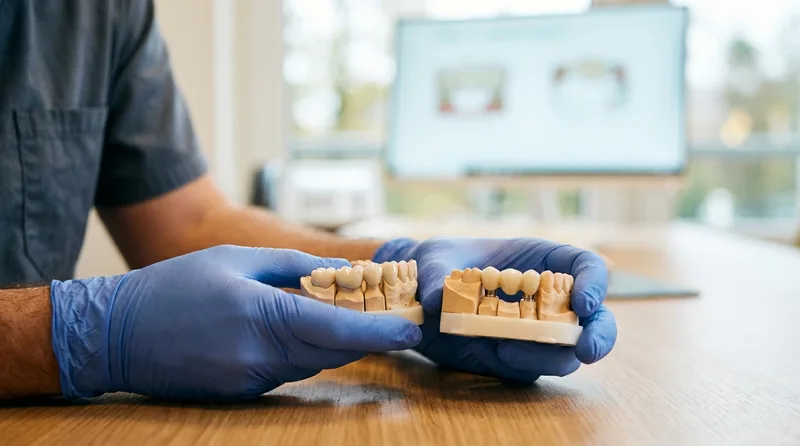
Traditional bridge
Implant bridge
You don't need one implant per missing tooth. That's the key point many people miss. With an implant bridge, implants at each end of the gap can support the teeth in between, which keeps surgery and cost lower than replacing every tooth individually.
There are other bridge designs too, like bonded “Maryland” bridges for some front-tooth gaps. But for several missing teeth in a row, the real choice is usually between these two.
A traditional bridge requires reshaping the teeth on each side of the gap so they can hold crowns, which permanently changes those teeth. An implant bridge leaves them untouched. That makes the health of your neighboring teeth one of the most important factors in choosing between the two bridges.
If those neighboring teeth are healthy and untouched, reshaping them for crowns is a real tradeoff. Once enamel is removed, it doesn't grow back, and those teeth will need crowns for life.
But if they already have large fillings, cracks, or old crowns, the picture changes. They may need crowns anyway, and a traditional bridge puts that work to double use.
Myth
“A traditional bridge is always the gentler option because there’s no surgery.”
Fact
It avoids surgery, but it does permanently reshape the teeth that support it. If those teeth are healthy, an implant bridge may protect them better long term.
Supporting teeth also carry some long-term risk. In a major review of traditional bridges, decay under the supporting crowns and loss of retention were among the most common reasons a bridge needed attention over 10 years.
With a traditional bridge, the jawbone under the missing teeth isn't stimulated, so it can slowly shrink over the years. With an implant bridge, the implants stimulate the bone where they sit, which helps preserve it. The bone under the replacement teeth between the implants may still change gradually.

Why does bone matter if the bridge looks fine? Over time, shrinking bone can leave a visible gap or dark space under a traditional bridge, especially in the front of the mouth. It can also limit options later if you ever want implants in that area.
How each bridge compares
| Factor | Traditional bridge | Implant bridge |
|---|---|---|
| Protects neighboring teeth | ●●● | ●●● |
| Helps preserve bone | ●●● | ●●● |
| Speed of treatment | ●●● | ●●● |
| Lower upfront cost | ●●● | ●●● |
| No surgery needed | ●●● | ●●● |
More dots means a stronger fit for that factor. General guidance only; your exam decides.
Notice the pattern in that comparison. A traditional bridge wins on speed, cost, and avoiding surgery. An implant bridge wins on protecting teeth and bone. Your priorities decide which column matters more.
Both bridge types last a long time, and their 10-year survival rates are close. A major review found about 89% of traditional bridges and about 87% of implant bridges were still in place after 10 years. With good care, many bridges of either type last 10 to 20 years or longer.
89.1%
10-year survival of traditional bridges
Source: Clinical Oral Implants Research, 2004
86.7%
10-year survival of implant-supported bridges
Source: Clinical Oral Implants Research, 2004
92.8%
10-year survival of the implants supporting those bridges
Source: Clinical Oral Implants Research, 2004
The implant figures come from a systematic review of implant-supported bridges that tracked them for at least five years. The implants themselves did slightly better than the bridges on top, which makes sense: the visible bridge takes the wear, while the implants stay anchored. If a bridge on implants needs replacing, the implants underneath can usually be reused.
For traditional bridges, the weak point is usually the supporting teeth. For implant bridges, it's more often the gum around the implants or wear on the bridge itself. Our guide on implant lifespan covers the implant side in more depth, and we also explain how long dental bridges last and how to care for them.
A traditional bridge usually costs less upfront and takes a few weeks. An implant bridge costs more and takes several months, mostly for healing. Over decades, though, the gap narrows, because a traditional bridge may need redoing if a supporting tooth develops problems, while implants can often support a new bridge.
What each timeline usually looks like
Traditional bridge, visit 1
The supporting teeth are prepared, impressions are taken, and a temporary bridge is placed.
Traditional bridge, visit 2
About two weeks later, the final bridge is fitted and cemented.
Implant bridge, planning and placement
A 3D scan guides placement of the implants at each end of the gap.
Implant bridge, healing
The implants bond with the bone over roughly three to six months.
Implant bridge, final fitting
The permanent bridge is attached to the implants.
| Traditional bridge | Implant bridge | |
|---|---|---|
| Upfront cost | Lower | Higher |
| Typical timeline | About 2-3 weeks, two visits | Several months, including healing |
| Surgery | None | Implant placement |
| Insurance | Often partly covered | Coverage varies more by plan |
| If it needs replacing | Supporting teeth must still be healthy | Implants can usually be reused |
Two implants supporting a bridge of three or four teeth is often far less expensive than three or four individual implants, which is why implant bridges are popular for longer gaps. We give you a written, itemized quote for each option, so you can compare real numbers, not estimates.
Compare both bridges for your mouth
Your consultation includes an exam, a 3D scan if needed, and a written quote for each bridge option that fits.
Book a Consultation →A traditional bridge is often better when the neighboring teeth already need crowns, when you want to avoid surgery, or when you need a faster result. An implant bridge is often better when the neighboring teeth are healthy, you want to preserve bone, and you have enough bone at each end of the gap.
A quick way to narrow it down
↓
Traditional bridge often fits when
Implant bridge often fits when
Before choosing, ask about the condition of the teeth next to your gap, how much bone you have at each end, the total timeline for each option, what each would cost after insurance, and what future maintenance looks like. Clear answers to those five questions usually make the decision obvious.
Questions to bring to your consultation
Check each one that applies to you.
Bring this list and ask to see your X-rays or 3D scan.
Either way, cleaning under a bridge takes a little extra effort. A floss threader or water flosser makes it easy, and the ADA's MouthHealthy guide to bridges is a helpful overview of how bridges work.
When comparing an implant bridge vs traditional bridge, choose based on your neighboring teeth and your bone. If those teeth need crowns anyway, a traditional bridge makes sense. If they're healthy and you have enough bone, an implant bridge protects them and the jaw for the long term.
The right bridge isn’t the newest or the cheapest. It’s the one that protects the most of what you already have.
Related: Weighing bridges against implants and dentures too? Read our full guide to tooth replacement →
Patients from Peterborough, Jaffrey, Dublin, Hancock, and across the Monadnock region rely on Dr. Muhammad Rahim and Dr. Jasper Ainslie to explain these tradeoffs plainly. We'll show you your X-rays, compare both bridges for your specific gap, and let you decide with no pressure.
Results may vary. Please consult with your dentist at Peterborough Family Dental for personalized treatment recommendations.
Find the Right Bridge for Your Smile
Schedule a consultation at our Peterborough, NH office. We'll compare both bridge options for your gap and give you a written plan.
Request an Appointment →Prefer to talk it through first? Our front desk opens at 7 AM.
Call (603) 924-3664 →
Dr. Muhammad Rahim, DMD
Dentist · Peterborough Family Dental & Implant Center
Peterborough, NH dentist providing gentle general, cosmetic, restorative, and implant dentistry for the whole family.
Was this article helpful?
A bridge anchored to the jawbone is called an implant-supported bridge, often shortened to implant bridge. Instead of resting on crowned natural teeth, it attaches to dental implants placed in the jaw, so the neighboring teeth stay untouched and the bone under the gap keeps getting stimulation.
Our Peterborough team is happy to answer questions and get you on the calendar.


