
Back to all articlesgeneral-dentistry Dr. Muhammad Rahim, DMDNovember 16, 202610 min read
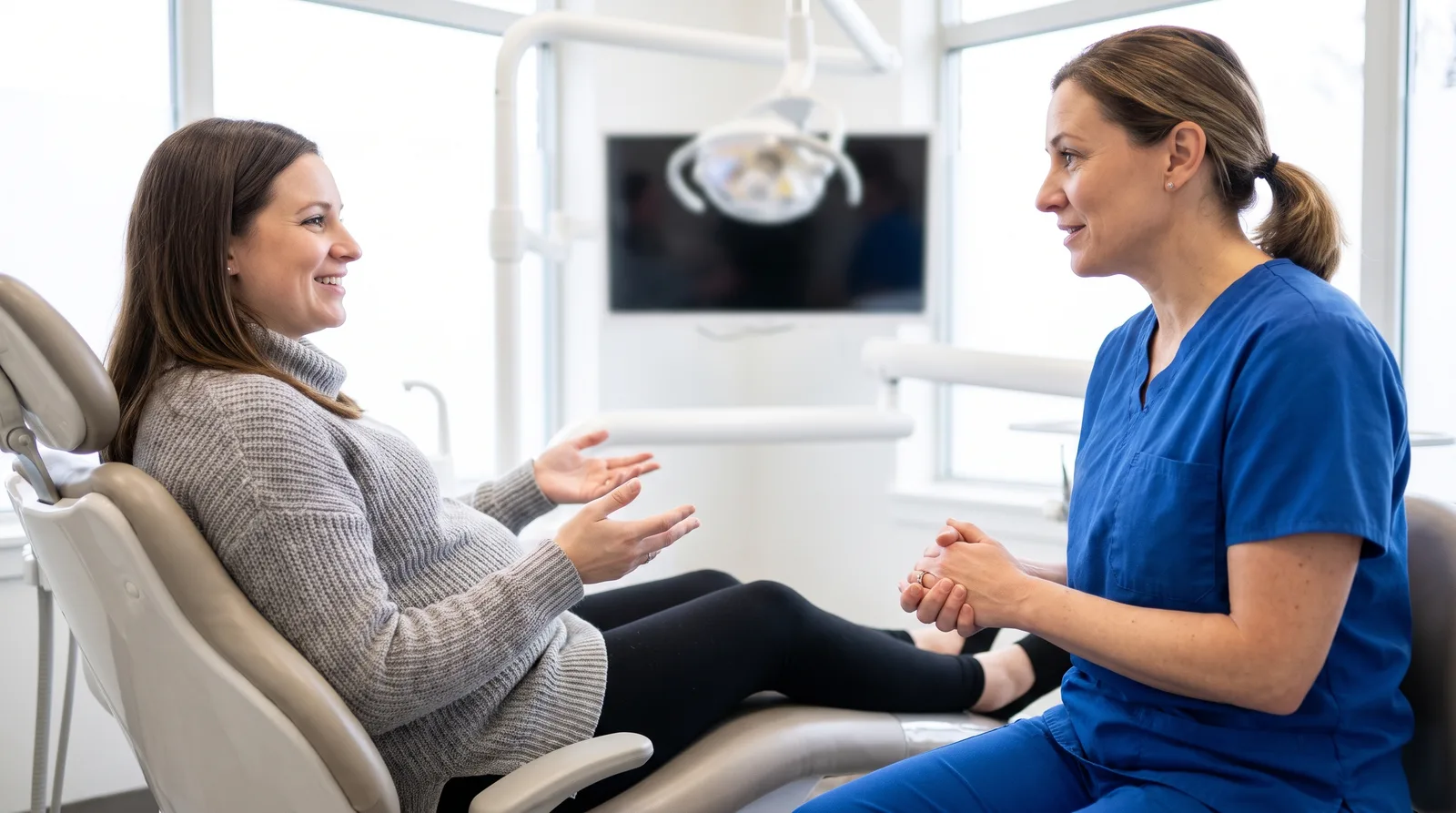
Dental Care During Pregnancy: What Is Safe and What Isn't
Dr. Muhammad Rahim, DMDNovember 16, 202610 min read
Loading blog post
Dr. Muhammad Rahim, DMDNovember 16, 202610 min readCall and you'll reach a real person on our team: no phone tree, no hold music. We'd genuinely love to help.
(603) 924-3664Rather write to us? Contact us
Dental care during pregnancy is safe and recommended, and skipping it is the bigger risk. Many expectant parents wonder whether cleanings, X-rays, numbing, or a needed filling are okay, and the short answer from the American Dental Association is yes, with a few important exceptions. At Peterborough Family Dental & Implant Center in Peterborough, NH, we provide preventive and restorative dental care, and we're glad to care for you throughout your pregnancy.
Pregnancy changes your mouth. Hormones, cravings, and morning sickness all raise the risk of gum problems and cavities, which is why regular visits matter even more now.
This guide explains what's safe, what to avoid, how to handle morning sickness, and what to tell your dentist and your obstetrician.
Yes. Dental care during pregnancy is safe. The ADA states that preventive, diagnostic, restorative, and surgical treatment to promote health is safe throughout pregnancy, and that the American College of Obstetricians and Gynecologists (ACOG) supports this. It encourages regular exams and needed treatment at every stage.
The American Dental Association's guidance on pregnancy and oral health adds that emergency treatments, such as extractions, root canals, or restorations, can be safely performed during pregnancy, and that delaying treatment may result in more complex problems. In other words, putting off a needed filling can cost more than doing it now.
Many people put off dental visits during pregnancy out of worry or because they feel too tired. Skipping care tends to let small problems grow, which is exactly what the ADA and ACOG caution against.
This guide is general information, not medical advice. Your obstetrician and dentist know your situation, so tell both that you're pregnant, and ask either one if you have questions about your own care.
Pregnancy raises the risk because hormonal changes exaggerate the gums' response to bacteria, and because of changes in eating habits, vomiting, and dry mouth. The ADA lists gingivitis, cavities, erosion, and a gum growth called pyogenic granuloma as conditions that are more common during pregnancy.

Most of these are manageable with good daily care and regular visits. If you notice a growth on your gums, show your dentist, since it needs an exam to confirm what it is.
Yes. The ADA says dental radiographs are safe at any stage of pregnancy, and that abdominal or thyroid shielding is no longer recommended. X-rays should still be taken only when they're needed, so it's reasonable to ask why one is recommended and what it will show.
X-rays help your dentist find problems that can't be seen, such as decay between teeth or infection around a root. When a tooth is aching or an infection is suspected, an X-ray is often what allows safe, accurate treatment.
Radiation from dental X-rays is very low, and the images focus on your teeth and jaw, not your abdomen. If you've had X-rays recently at another office, bring copies so you don't repeat them.
If you'd like to talk through X-rays before your visit, ask us. We'll explain what's needed and why, and you're always welcome to ask your obstetrician too.
Pregnant and due for a checkup?
Request an appointment at our Peterborough office and tell us you're expecting, so we can plan your visit around you.
Request an Appointment →Local numbing medicine is safe. The ADA says local anesthetics, with or without epinephrine, may be used during pregnancy. Nitrous oxide is different. The ADA lists it as a pregnancy Category C medication, with a risk of fetal harm, and recommends that pregnant patients avoid exposure to it.
We offer nitrous oxide and oral sedation for many nervous patients, but if you're pregnant, tell us right away so we plan around it. Any other sedation should only be considered after talking with your obstetrician. Plenty of calm, comfortable dentistry happens with local numbing medicine, clear explanations, and breaks whenever you need them.
Local numbing medicine works the same way during pregnancy as at any other time. It simply blocks sensation in the area being treated, so treatment can happen without discomfort.
Dental care during pregnancy can include exams, cleanings, X-rays when needed, fillings, root canal treatment, extractions, and deep cleaning for gum disease. Nitrous oxide should be avoided, and cosmetic work such as whitening is usually postponed. The table summarizes the ADA's guidance.
| Treatment | During pregnancy? | What to know |
|---|---|---|
| Exams and cleanings | Yes | Preventive and diagnostic care is safe throughout pregnancy, and the ADA encourages it |
| Dental X-rays | Yes, when needed | The ADA says radiographs are safe at any stage |
| Fillings | Yes | Restorative treatment is safe, and untreated cavities can become larger problems |
| Root canal treatment | Yes | ADA and ACOG agree it can be done safely when needed |
| Extractions | Yes, when needed | Treatment of infection or damaged teeth shouldn't be delayed |
| Deep cleaning for gum disease | Yes | The ADA says scaling and root planing is safe |
| Local numbing medicine | Yes | The ADA says local anesthetics may be used, with or without epinephrine |
| Nitrous oxide | Avoid | The ADA recommends pregnant patients avoid exposure |
| Cosmetic work such as whitening |
The general rule is simple. Treat what needs treating now, put off what can wait, and keep your obstetrician informed. A problem like an infection or a broken tooth is not one to wait out.
After vomiting, don't brush right away, since stomach acid has softened the enamel. Rinse with a mixture of 1 cup of water and 1 teaspoon of baking soda to neutralize the acid, then brush later. The ADA advises this approach because brushing immediately exposes the teeth to acid.

The ADA also notes that if a topical fluoride treatment is needed to limit the effects of erosion, fluoride varnish may be preferred over gel because of nausea. Mention your morning sickness at your visit so your dentist can plan accordingly.
For dental care during pregnancy at home, brush twice a day for two minutes with a soft-bristled brush and fluoride toothpaste, clean between your teeth once a day, and keep your regular visits. The ADA emphasizes daily oral hygiene because of the higher risk of gingivitis and cavities.
Checkups pay off. The Journal of Dental Research reports that people who see a dentist regularly are 60% less likely to lose teeth, and the ADA notes that regular visits can catch 80% of oral health issues before they become serious. Our guide on how often to see the dentist explains how risk sets your schedule, and our teeth cleaning service covers professional cleanings.
Research has found associations between gum disease and pregnancy complications, though more research is needed. The ADA notes that an overview of 23 systematic reviews found associations between periodontitis and preterm birth, low birthweight, and pre-eclampsia. Treating gum disease during pregnancy is safe and improves oral health.
ACOG's statement, quoted by the ADA, says that despite a lack of evidence for a causal relationship, treating maternal periodontal disease during pregnancy is not associated with adverse maternal or birth outcomes, and is associated with improved oral health. The ADA says scaling and root planing is safe to perform if periodontitis develops.
Gum health also matters beyond pregnancy. The National Institute of Dental and Craniofacial Research describes gum disease as an infection that can spread to the bones supporting the teeth, and the CDC reports that 42% of adults aged 30 and older have some form of periodontal disease. Our gum disease treatment service and our guide to scaling and root planing explain how it's treated.
Tell your dentist that you're pregnant, your due date, whether your pregnancy is considered high-risk, and any medicines or supplements you take. Ask your obstetrician whether anything about your pregnancy should change your dental plan. The ADA suggests dentists ask about these same points when they treat pregnant patients.

On medicines, the ADA says local anesthesia and certain antibiotics, such as penicillin, amoxicillin, cephalosporins, clindamycin, and metronidazole, are considered safe options. For discomfort relief, the ADA notes that the FDA said published research on over-the-counter relief medicines in pregnancy is too limited to make recommendations, so it advises deciding after consultation with your obstetrician. Check with your obstetrician before taking any medicine for a toothache. In an emergency, don't wait.
Have a toothache or swelling while pregnant?
Call us right away and tell us you're expecting. Infections shouldn't wait.
Call (603) 924-3664 →Book an exam and cleaning to start your dental care during pregnancy, tell us you're pregnant, and bring any questions for your dentist or obstetrician. If you have a toothache, swelling, or a broken tooth, call right away, since delaying treatment may result in more complex problems. Our guide to tooth abscess symptoms lists signs of infection to watch for.
Nerves are normal, and pregnancy can add to them. BMC Oral Health (2024) reports that 36% of Americans have dental anxiety and 12% have extreme dental fear. Our tips for nervous dental patients can help, and we'll go at your pace.
Looking ahead helps too. The CDC reports that 20% of children ages 5 to 11 have at least one untreated decayed tooth, and that dental sealants can reduce the risk of cavities in school-age children by nearly 80%. Our guide to dental sealants for kids explains how they work when your child is older.
We welcome patients from Peterborough, Jaffrey, Dublin, Hancock, and across the Monadnock region, with early-morning hours from 7 AM Monday through Thursday. Bring your questions to Dr. Muhammad Rahim or Dr. Jasper Ainslie. If you request a time online, a real person from our team replies the same business day to confirm your visit.
Results may vary. Please consult with your dentist at Peterborough Family Dental for personalized treatment recommendations.
Take care of your smile while you're expecting
Request an appointment at Peterborough Family Dental & Implant Center, and let us know you're pregnant so we can plan around you.
Request an Appointment →Prefer to talk to someone first?
Call (603) 924-3664 →
Dr. Muhammad Rahim, DMD
Dentist · Peterborough Family Dental & Implant Center
Peterborough, NH dentist providing gentle general, cosmetic, restorative, and implant dentistry for the whole family.
Was this article helpful?
Yes. The ADA states that preventive, diagnostic, and restorative dental treatment is safe throughout pregnancy, and it encourages pregnant people to keep regular exams. Cleanings matter more because pregnancy raises the risk of gingivitis.
Our Peterborough team is happy to answer questions and get you on the calendar.
| Usually postponed |
| Ask your dentist and obstetrician, since it's not urgent |


