
Back to all articlesPeriodontal Care Dr. Muhammad Rahim, DMDOctober 13, 20269 min read
Scaling and Root Planing: What a Deep Cleaning Involves
Dr. Muhammad Rahim, DMDOctober 13, 20269 min read
Loading blog post
Dr. Muhammad Rahim, DMDOctober 13, 20269 min readCall and you'll reach a real person on our team: no phone tree, no hold music. We'd genuinely love to help.
(603) 924-3664Rather write to us? Contact us
Scaling and root planing is the standard non-surgical treatment for gum disease, and it's what most dentists mean by a "deep cleaning." It removes plaque and hardened tartar from below the gumline, then smooths the tooth roots so your gums can heal and fit snugly against the teeth again.
If you've just been told you need one, you probably have questions. At Peterborough Family Dental & Implant Center in Peterborough, NH, gum treatment is part of the everyday dental services we provide, and we'd rather you understand the plan than simply agree to it. This guide covers when a deep cleaning is needed, what it feels like, and what comes after.
Worried about bleeding or tender gums?
A gum check measures your pocket depths and tells you exactly where you stand.
Request an Appointment →It's a two-part deep cleaning for gum disease. Scaling removes plaque and tartar from the tooth surfaces and from the pockets below the gumline. Root planing smooths the root surfaces so bacteria have a harder time reattaching and the gums can tighten back around the teeth.
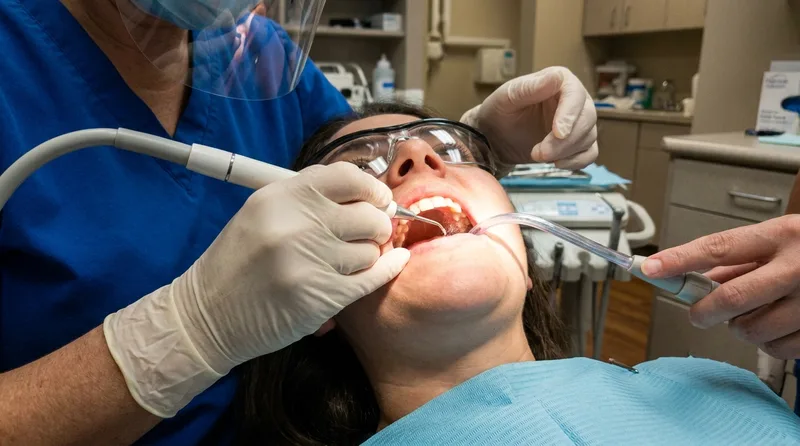
Here's why it's needed. When plaque sits along the gumline, the gums get inflamed and start pulling away from the teeth, forming spaces called pockets. According to the ADA's MouthHealthy guide to deep cleaning, plaque trapped in those pockets can't be reached by brushing. Left alone, the infection can damage the bone that holds your teeth in place.
A deep cleaning goes after the source. By clearing out the pockets and smoothing the roots, it gives the gum tissue a clean surface to heal against. For many people with early to moderate gum disease, that's enough to bring the problem under control without surgery.
It's a common need. A national study in The Journal of the American Dental Association found that about 42% of U.S. adults aged 30 and older have periodontitis, the stage of gum disease that usually calls for this treatment. About 8% have the severe form.
You need a deep cleaning when your exam shows periodontitis, not just gingivitis. The main clue is pocket depth. Healthy gum pockets are usually 1 to 3 millimeters deep, while deeper pockets, especially with bleeding, tartar below the gumline, or bone loss on X-rays, point to deeper treatment.
Gum disease often causes no discomfort until it's advanced, so the measurements matter more than how your mouth feels. Still, these signs are worth paying attention to:
If several of those sound familiar, our guide to gum disease warning signs explains what each one can mean. And if your main concern is persistent bad breath, our article on chronic bad breath causes is worth a read, because gum pockets are a common source.
At your visit, the hygienist gently measures around each tooth with a thin probe. Those numbers, along with X-rays, tell your dentist whether a routine cleaning is enough or whether a deep cleaning is the right next step.
Gingivitis is the early, reversible stage of gum disease, limited to the gum tissue. Periodontitis is the advanced stage, where the infection has reached the bone that supports your teeth. Gingivitis usually needs a thorough cleaning and better home care, while periodontitis typically calls for a deep cleaning.
| Gingivitis | Periodontitis | |
|---|---|---|
| What's affected | Gum tissue only | Gums plus the supporting bone |
| Common signs | Red, puffy gums that bleed when you brush | Deeper pockets, receding gums, loose or shifting teeth |
| Reversible? | Yes, with professional cleaning and home care | Damage is permanent, but it can be stabilized |
| Typical treatment | Routine cleaning and better brushing and flossing | Deep cleaning, then maintenance every 3 to 4 months |
Periodontitis is also staged by severity. Early to moderate stages are usually managed with a deep cleaning and maintenance. Advanced stages with significant bone loss often need input from a periodontist, the dental specialist for gums.
That's why catching gum disease early matters so much. At the gingivitis stage, a few weeks of better habits can make a real difference. Once bone is involved, the goal shifts from reversing the problem to protecting what's left.
A deep cleaning is usually done in two or more visits, treating one area of the mouth at a time. The area is numbed with local anesthetic, the pockets are cleaned with ultrasonic and hand instruments, and the roots are smoothed. A follow-up visit a few weeks later checks how your gums responded.
Splitting the work across visits keeps each appointment manageable and lets the numbing cover just the area being treated. If you're anxious, Peterborough Family Dental also offers nitrous oxide and oral sedation, and our team will talk through those options before you book.
How is this different from your usual cleaning? A routine cleaning works above and just below the gumline on healthy gums. Our guide on what happens during a dental cleaning covers the routine version step by step.
Most people feel some tenderness for a day or two after a deep cleaning, and the ADA notes that teeth can stay sensitive to temperature for up to a week. Your gums may also look a bit swollen and bleed slightly when you brush at first. These effects usually fade as the gums heal.

A few things help in the first days:
Some sensitivity can actually be a sign of progress. As inflammation goes down, the gums tighten, and a little more of the root surface may be exposed for a while. If sensitivity gets worse instead of better, or you notice swelling or a bad taste, call the office.
Most people go back to work or school the same day. The numbness usually wears off within a few hours, so plan meals around that and avoid hot drinks until you can feel your lips again. If you're treating both sides on separate days, you'll usually have a week or two between visits, which gives the first side time to settle before the second.
Daily home care is what keeps a deep cleaning working. Brush twice a day with a soft brush, clean between your teeth every day, avoid tobacco, and keep every follow-up visit. Without that, plaque refills the pockets and gum disease can return.
Your hygienist will show you the technique that fits your mouth. For many people, that means an electric brush for better gumline cleaning and floss, interdental brushes, or a water flosser for the spaces between teeth. Our comparison of water flossers vs floss can help you choose.

Smoking deserves its own mention. It raises the risk of gum disease and slows healing, and it can hide early warning signs like bleeding. If you smoke or vape, cutting back is one of the most helpful things you can do for your gums.
Health conditions matter too. Poorly controlled diabetes makes gum disease harder to manage, and research has linked untreated gum disease with other conditions like heart disease. Treating your gums is good for more than your mouth.
Yes, it can, which is why follow-up care matters so much. Gingivitis can be fully reversed, but periodontitis is managed rather than erased. The bone lost to gum disease doesn't grow back, so the goal is to stop further damage and keep the pockets healthy over time.
After active treatment, most patients move to periodontal maintenance visits every three to four months instead of standard six-month cleanings. These visits include updated pocket measurements and targeted cleaning of the areas that were affected.
Sometimes pockets don't tighten enough after the first round. The American Academy of Periodontology notes that non-surgical treatment has limits, and some people need further care from a periodontist. At our office, more advanced cases are coordinated with a specialist when that's the right move.
Gum recession is a related concern. If your gums have pulled back, our article on receding gums treatment explains your options.
Have questions about your gum health?
Our team will walk you through your pocket measurements and what they mean.
Learn About Gum Treatment →Most dental insurance plans cover scaling and root planing as a periodontal benefit, often at a different level than routine cleanings. Our team verifies your benefits for free before treatment and gives you a written estimate, so you'll know your share before anything starts.
Without insurance, our VIP Membership Plan includes a Periodontal plan for patients with gum disease. It covers three to four maintenance visits, two exams, routine X-rays, and an oral cancer screening each year, plus member savings on most treatment.
Some patients also spread costs with CareCredit or use HSA or FSA funds. Our guide to dental financing options explains how to combine them, step by step, so the amount you finance stays small.
Whatever the cost question, waiting rarely helps. Bone lost to gum disease is permanent, and treating it early is almost always simpler than treating it late. Learn more on our gum disease treatment page.
Results may vary. Please consult with your dentist at Peterborough Family Dental for personalized treatment recommendations.
Get your gum health checked
Book a visit at our Peterborough office and find out whether you need a routine cleaning or a deep cleaning.
Request an Appointment →Prefer to talk it through first? Call our Peterborough office at (603) 924-3664.
Call (603) 924-3664 →
Dr. Muhammad Rahim, DMD
Dentist · Peterborough Family Dental & Implant Center
Peterborough, NH dentist providing gentle general, cosmetic, restorative, and implant dentistry for the whole family.
Was this article helpful?
It's usually split into two or more appointments, often one side or area of the mouth at a time. Each visit commonly runs about 45 to 90 minutes depending on how much tartar there is and how deep the pockets are. A re-evaluation visit follows a few weeks later.
Our Peterborough team is happy to answer questions and get you on the calendar.


