
Back to all articlesPeriodontal Care Dr. Muhammad Rahim, DMDSeptember 3, 202610 min read
Gum Disease Warning Signs You Shouldn't Ignore at Any Age
Dr. Muhammad Rahim, DMDSeptember 3, 202610 min read
Loading blog post
Dr. Muhammad Rahim, DMDSeptember 3, 202610 min readCall and you'll reach a real person on our team: no phone tree, no hold music. We'd genuinely love to help.
(603) 924-3664Rather write to us? Contact us
Gum disease is one of the most common dental conditions in adults, yet most patients do not recognize the gum disease warning signs until the disease is well established.
The trouble is that the early warning signs of gum disease are easy to dismiss: a little blood when brushing, gums that look slightly different, a sensitivity that comes and goes.
Knowing the gum disease warning signs, and acting on them early, is the difference between catching gum disease early and dealing with its more serious consequences later.
This guide covers the warning signs patients in Peterborough, NH most commonly overlook, explains what is happening in the gum tissue at each stage, and clarifies when a symptom warrants a call to the dentist. At Peterborough Family Dental, Dr. Muhammad Rahim, DMD, sees and treats gum disease at every stage, and the consistent finding is that earlier intervention means simpler, more effective care.
This is one of the dental services offered at Peterborough Family Dental & Implant Center in Peterborough, NH.
Gum disease is very common. Nearly 42% of US adults aged 30 and older have some form of periodontitis, according to Centers for Disease Control and Prevention data, and about 8% have severe periodontitis. That means roughly 2 in 5 adults have gum disease, and most of them don't know it.
The reason so many cases go undetected is that gum disease is often painless in its earlier stages. Unlike a cavity, which tends to announce itself with sensitivity or discomfort, gum disease can quietly damage the bone and tissue supporting teeth for years before it causes obvious symptoms. By the time patients notice something clearly wrong, the disease has often progressed significantly.
This is why annual dental checkups are essential even for patients who feel fine. A professional exam with periodontal probing and X-rays can detect early gum disease before it becomes visible, giving you the best chance of resolving it with straightforward treatment.

The early warning signs of gum disease include bleeding gums when brushing or flossing, red or swollen gum tissue, and persistent bad breath that does not clear with brushing. These are signs of gingivitis, the earliest and most reversible stage, before the inflammation reaches the bone.
Here are the specific signs to watch for at this stage:
According to the American Academy of Periodontology, gingivitis is reversible with professional cleaning and improved home care. The key is not letting it progress to periodontitis, where the damage to bone and connective tissue becomes irreversible.
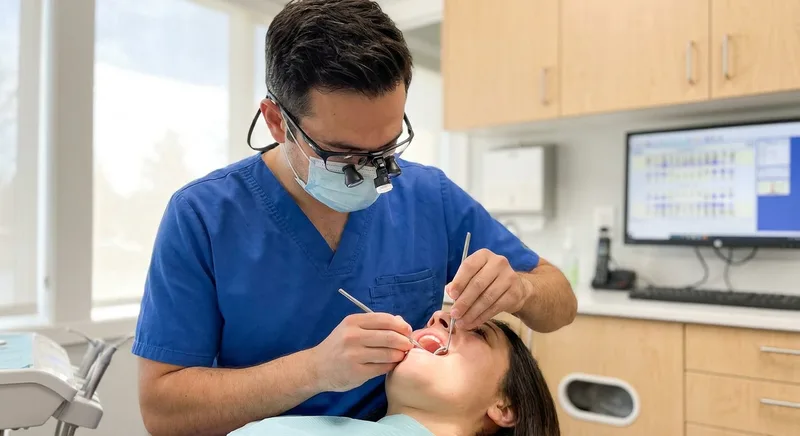
Advanced gum disease, or periodontitis, produces more serious and more noticeable warning signs as the infection spreads from the gum tissue to the bone and connective structures holding the teeth in place. By this stage, the disease has moved beyond what improved brushing alone can address, and professional treatment is essential.
Signs that gum disease has progressed beyond gingivitis include:
The National Institute of Dental and Craniofacial Research notes that periodontitis involves damage that cannot be reversed, only managed and stabilized. The treatment at this stage is more involved than a simple cleaning, but it is still effective at stopping the disease from progressing further.
| Stage | What You Notice | Is It Reversible? |
|---|---|---|
| Healthy | Firm pink gums, no bleeding | Not applicable |
| Gingivitis | Bleeding when brushing, mild redness | Yes, with cleaning and hygiene |
| Early periodontitis | Persistent bad breath, slight recession | Manageable, not fully reversible |
| Advanced periodontitis | Loose teeth, pus, visible bone loss | No, but it can be stabilized |
Gums bleed because inflammation makes the tissue fragile and more prone to rupturing under the mechanical force of brushing or flossing. It is almost always a problem, even when it seems minor. Many people respond by brushing more gently or skipping floss, which actually lets the bacteria build up further.
Healthy, non-inflamed gum tissue is resilient and does not bleed from normal brushing. If your gums bleed regularly, the appropriate response is not to back off but to see a dentist who can assess whether the cause is straightforward gingivitis or something more advanced.
Occasional bleeding during flossing when you first start a new flossing routine is more nuanced, but persistent or widespread bleeding during routine oral care is a consistent sign that inflammation is present.
Certain medications, including blood thinners, can increase bleeding tendency, and pregnancy can make gums more susceptible to inflammation. These factors can amplify gum bleeding, but they do not cause gum disease on their own. If you are on a medication that affects bleeding and notice gum changes, it is worth mentioning to both your dentist and your prescribing physician.
Gum disease is caused by bacterial plaque and tartar accumulating along and below the gum line. The bacteria trigger an inflammatory immune response that gradually destroys the tissue and bone supporting the teeth. Risk factors including smoking, diabetes, and genetics can significantly accelerate how quickly that destruction progresses.
Gum disease is caused by bacterial plaque that accumulates along and below the gum line. When plaque is not consistently removed through brushing and flossing, it hardens into tartar, which can only be removed by a dental professional.
The bacteria in tartar trigger an immune response in the gum tissue, and it is that inflammatory response, rather than the bacteria directly, that destroys gum tissue and bone over time.
Several factors raise the risk of developing gum disease or accelerate its progression. Smoking is one of the strongest, nearly doubling the risk of periodontitis. Diabetes impairs the body's ability to manage infection and inflammation, making gum disease more likely and more severe.
Genetics also plays a role, as some people are more susceptible regardless of how well they clean their teeth. Stress, certain medications that reduce saliva, and hormonal changes such as pregnancy can all increase vulnerability.
Understanding your personal risk factors is part of a good periodontal evaluation. At Peterborough Family Dental, Dr. Rahim assesses not just the current state of the gums but the factors that may be contributing, which shapes the treatment plan and the prevention strategy going forward.

Gingivitis, the earliest stage of gum disease, can be fully reversed with professional cleaning and consistent home care. The inflammation resolves and the tissue returns to a healthy state once the bacterial buildup is removed and plaque control improves. This is why early detection matters so much: the window for full reversal is narrow.
Periodontitis, the more advanced stage involving bone loss, cannot be reversed. The bone that has been lost does not grow back on its own in most cases. What treatment can do is halt the progression, stabilize the situation, and help the body maintain what remains. Left untreated, periodontitis can eventually loosen teeth until they are lost, and our guide to tooth loss from untreated gum disease explains what happens when a missing tooth isn't replaced.
Scaling and root planing, sometimes called a deep cleaning, removes bacteria and deposits from below the gum line and is typically the first treatment for periodontitis. Maintenance visits at closer intervals, usually every three to four months, are then used to keep the disease stable long-term.
For most patients, treatment follows a clear sequence:
The practical implication is clear: catching gum disease at the gingivitis stage is categorically better than catching it at the periodontitis stage, both for the simplicity of treatment and for the long-term outcome for the teeth.
Call the dentist if you notice bleeding, swelling, recession, loose teeth, or any persistent change in how your gums look or feel. Gum disease warning signs that are visible or noticeable are more meaningful than pain, which is a late symptom. Prompt contact gives you the simplest treatment options.
You should call the dentist if your gums bleed regularly when brushing or flossing, if they look redder or more swollen than usual, or if you have noticed a change in how your teeth fit together or feel when you bite.
Any tooth that feels loose, any persistent pain around a tooth or in the jaw, and any pus visible near the gum line are more urgent signs that warrant a prompt call rather than waiting for your next scheduled visit.
Regular checkups are your best early-warning system. Routine dental visits can catch 80% of oral health issues before they become serious, according to the ADA, and people who see a dentist regularly are 60% less likely to lose teeth, according to the Journal of Dental Research.
Do not wait for pain to decide something is wrong. Gum disease is largely painless until it is quite advanced, and most patients with significant periodontitis describe their gums as feeling normal right up until the point they develop an abscess or a tooth loosens noticeably. Pain is a late symptom, not an early warning.
If it has been more than a year since your last dental checkup and you live in the Peterborough, NH area, that alone is reason enough to schedule. A proactive exam is far simpler than treating established gum disease. You can reach the office at (603) 924-3664 or request an appointment at peterboroughfamilydental.com/contact.
Noticed any of these warning signs?
Book a periodontal evaluation at Peterborough Family Dental. Dr. Rahim will assess your gum health, identify the stage of any disease present, and outline a straightforward plan to get it under control.
Request an AppointmentGum health is connected to your broader oral health and general wellbeing. The articles below go deeper on related preventive care topics and what Peterborough Family Dental offers to keep your smile healthy.
Results may vary. Please consult with your dentist at Peterborough Family Dental for personalized treatment recommendations.

Dr. Muhammad Rahim, DMD
Dentist · Peterborough Family Dental & Implant Center
Peterborough, NH dentist providing gentle general, cosmetic, restorative, and implant dentistry for the whole family.
Was this article helpful?
Early signs include bleeding gums when brushing or flossing, red or swollen gum tissue, persistent bad breath, and gums that look different than usual. These signs indicate gingivitis, the earliest and still-reversible stage of gum disease.
Our Peterborough team is happy to answer questions and get you on the calendar.


