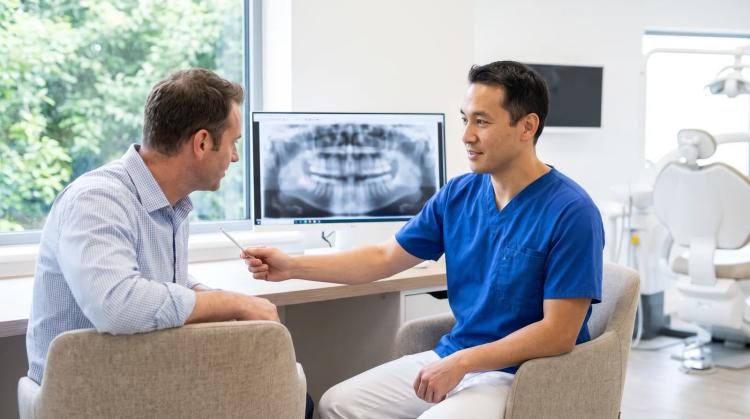
How Often Should You Go to the Dentist? What Decides It
Dr. Muhammad Rahim, DMDOctober 13, 20269 min read
How often should you go to the dentist? For most people, about every six months for a checkup and cleaning. But that's a starting point, not a rule. Some people need visits every three or four months, and some healthy adults can safely go longer. The right interval depends on your own risk, and your dentist should be able to explain why they picked it.
At Peterborough Family Dental & Implant Center in Peterborough, NH, regular exams and cleanings are the foundation of the general dentistry services we offer. This guide explains where the six-month habit came from, what the research says, and who needs to come in more or less often.
Not sure when you're due?
We'll look at your history and recommend a schedule that fits your mouth, not a calendar.
How often should you go to the dentist as an adult?
Most adults do well with a checkup and cleaning about every six months, and that's what most dental offices and insurance plans are set up around. But the best interval is personal. People with active gum disease may need visits every three to four months, while low-risk adults may go longer.
Your next visit date should be based on your risk, not just the calendar.
The UK's National Institute for Health and Care Excellence (NICE) puts actual numbers on this. Its guideline on dental recall intervals says the shortest routine interval for any patient should be three months, and the longest for adults should be 24 months. Children and teens should be seen at least every 12 months.
That's a wide range on purpose. A 30-year-old with no fillings and healthy gums is in a very different spot from a 60-year-old with a history of gum disease and a dry mouth from medications. One schedule can't fit both.
Dental CheckupsOral Health TipsPeterborough NHPreventive Care
Dentist · Peterborough Family Dental & Implant Center
Peterborough, NH dentist providing gentle general, cosmetic, restorative, and implant dentistry for the whole family.
Was this article helpful?
Frequently asked questions
Most people benefit from a professional cleaning about every six months. If you've had gum disease, cleanings every three to four months are common. Low-risk adults may go a bit longer if their dentist agrees, but tartar keeps building, so many people still prefer six-month cleanings.
For some healthy, low-risk adults, yes. If you have healthy gums, no recent cavities, and good home care, your dentist may recommend yearly exams. People with gum disease, frequent decay, or health conditions that affect the mouth usually need more frequent visits.
Keep your regular dental checkups and cleanings during orthodontic treatment, often every six months or more. Brackets and attachments trap plaque, which raises the risk of white spots and decay. Your orthodontic check-ins are separate and don't replace cleanings or exams.
Yes. Many dental problems, including early cavities and gum disease, cause no symptoms until they're advanced. Regular visits catch these changes while treatment is simpler and less costly. Waiting for discomfort usually means the problem has already grown.
Many older adults need visits every three to six months. Receding gums, older fillings, dry mouth from medications, and denture or implant care all raise the need for regular checks. Your dentist will set an interval based on your gums, teeth, and overall health.
Many dental plans cover two preventive exams and cleanings a year, but details vary. Some cover more frequent gum maintenance visits for people with periodontal disease. Our team can verify your benefits for free before your visit so you know what's covered.
The six-month checkup is a long-standing habit rather than a rule proven by one landmark study. It became the standard because it's easy to remember, it lines up with how most insurance plans pay for preventive care, and it catches most problems early for most people.
Researchers have tried to test it. A Cochrane review looked at two trials with 1,736 people. In adults, it found little to no difference in tooth decay, gum disease, or quality of life after four years between six-monthly checkups and checkups set by the dentist based on each person's risk.
That doesn't mean checkups don't matter. Both groups were still seeing a dentist regularly. What the evidence suggests is that a personalized schedule works about as well as a fixed one, and it can mean more visits for people who need them and fewer for people who don't.
So if your dentist suggests something other than six months, that's not a red flag. It's what current evidence supports. Just ask what they're basing it on.
Who needs to see the dentist more often?
You may need visits more often than every six months if you have a history of gum disease, get frequent cavities, smoke, have diabetes, take medications that dry your mouth, are pregnant, or are in orthodontic treatment. Each of these raises your risk or makes problems move faster.
Gum disease history. After a deep cleaning, gum maintenance visits every three to four months help keep the disease under control. Our guide to scaling and root planing explains why.
Frequent cavities. If you've had new decay in the last few years, closer monitoring catches the next one sooner.
Diabetes. Poorly controlled blood sugar makes gum disease harder to manage, and gum disease can make blood sugar harder to control.
Smoking or vaping. Tobacco raises gum disease risk and can hide early warning signs like bleeding.
Dry mouth. Many common medications reduce saliva, which normally helps protect teeth from decay.
Pregnancy. Hormone changes can make gums more prone to inflammation.
Gum measurements at each visit show whether your schedule needs to change.
Older adults often move into this group too. Receding gums, older fillings, and medication changes all add up. Our article on senior dental care covers what changes with age.
Can you go to the dentist less often if your teeth are healthy?
Yes, some low-risk adults can safely stretch to once a year, as long as their dentist agrees. That usually means healthy gums, no new cavities for several years, good home care, and no health changes. The decision should come from your exam results, not from skipping appointments.
NICE caps adult intervals at 24 months for a reason. Longer gaps make it harder to spot slow changes, and life can change faster than you expect: a new medication, a pregnancy, or a stressful year of grinding your teeth.
There's also a practical side. Even if your dentist says you're fine with yearly exams, tartar still builds up. Many people with a longer exam interval still come in for cleanings more often, because the cleaning is what keeps their gums healthy in the first place. Think of the exam interval and the cleaning interval as two separate questions, and ask your dentist about both.
If cost is the reason you're thinking about stretching visits, talk to us first. There may be a better answer, like our membership plan or a payment option covered in our dental financing guide.
How often should kids and teens see the dentist?
Children should see a dentist by their first birthday or when their first tooth appears, according to the ADA, and then at least once a year. Many kids do best with visits every six months, because cavities can progress faster in baby teeth and young permanent teeth than in adult teeth.
Regular visits for kids also cover things adults don't need. The dentist tracks how adult teeth are coming in, checks the bite, and decides when sealants or fluoride make sense. Our guides on your child's first dental visit and children's dental care by age go into more detail.
Teens in braces or aligners are a special case. Brackets and attachments trap plaque, so cleanings every few months can help prevent white spots and decay while teeth are moving.
Sports are another reason to keep visits regular. A dentist can fit a custom mouthguard and check for chips or cracks after a hit, and our comparison of custom vs boil-and-bite mouthguards explains the difference.
Not exactly, though they usually happen at the same visit. The cleaning is done by a hygienist and removes plaque and tartar. The checkup, or exam, is done by the dentist and looks for decay, gum disease, bite problems, and signs of oral cancer. Most routine visits include both.
This matters when you read your insurance plan or a membership plan. Exams and cleanings are often listed separately, and some plans cover a different number of each per year.
It also explains why your visit can look different from year to year. One appointment might be a quick cleaning and a brief look from the dentist. Another might include X-rays, gum measurements around every tooth, and an oral cancer screening. Both count as routine care. The dentist just adjusts what's needed based on how long it's been and what changed.
If you want a step-by-step look at the cleaning part, our guide on what happens during a dental cleaning walks through it. And if you're wondering whether you'll need X-rays every time, the answer is no. Our article on dental x-ray safety explains how that's decided.
What happens if you skip the dentist for years?
Skipping the dentist for years usually lets small, fixable problems grow into bigger and more costly ones. A small cavity can reach the nerve, early gum inflammation can turn into bone loss, and many of these changes don't cause symptoms until they're advanced.
Here's how a small problem typically grows when visits stop:
Early decay. A soft spot in the enamel, often fixable with fluoride or a small filling.
Deeper cavity. Decay reaches the softer layer under the enamel and needs a larger filling.
Nerve involvement. Bacteria reach the pulp, and the tooth may need a root canal and a crown.
Tooth loss. If it goes untreated long enough, the tooth may need to be removed and replaced.
You wouldn't be alone. According to the ADA's MouthHealthy site, about 100 million Americans don't see a dentist each year. The CDC reports that about 1 in 5 adults aged 20 to 64 (21%) has at least one untreated cavity, and a national JADA study found that about 42% of adults 30 and older have periodontitis.
If it's been a while, the best time to come back is now. We see patients who've been away for years all the time, and we never judge. The first visit back is about getting a clear picture, not a lecture.
Been a while since your last visit?
Start with an exam and an honest plan. No judgment, no pressure.
How does Peterborough Family Dental decide your schedule?
Your schedule is based on what we find at your exam: your gum measurements, cavity history, X-rays when needed, health conditions, and medications. Most patients come in once or twice a year for exams, alongside regular cleanings, and we'll tell you plainly if that should change.
We explain why we recommend your interval, so the plan makes sense to you.
Dr. Rahim, Dr. Ainslie, and Dr. Almaaz take the same approach: start with a careful dental exam, then build a schedule around what you actually need. Patients without insurance can use our VIP Membership Plan, which includes two cleanings and two exams a year, or the Periodontal plan with three to four gum maintenance visits.
The bottom line? Visit as often as your mouth needs, and your dentist should be able to tell you exactly why. If you're in the Peterborough or Monadnock area, our early hours make it easier to fit in.
Results may vary. Please consult with your dentist at Peterborough Family Dental for personalized treatment recommendations.
Find the right checkup schedule for you
Book an exam at our Peterborough office and get a recommendation based on your mouth, not a calendar.


 Dr. Muhammad Rahim, DMDOctober 13, 20269 min read