Dental Sealants for Kids: Ages, Process, How Long They Last
Dr. Muhammad Rahim, DMDOctober 7, 20269 min read
Dental sealants for kids are thin, protective coatings placed on the chewing surfaces of the back teeth, where most childhood cavities start. If your child's dentist just suggested them, you probably have three questions: when, how, and how long they last.
This guide answers all three, using research from the ADA, the CDC, and Cochrane reviews. Sealants are one of the simplest dental services we offer, and one of the best studied. Here's what the evidence actually says.
Were sealants recommended for your child?
Dr. Muhammad Rahim and Dr. Jasper Ainslie are happy to show you which teeth need them and why, at our family office in Peterborough, NH.
Dental sealants for kids are a thin plastic coating that bonds to the deep grooves on the chewing surfaces of back teeth. They block food and bacteria from settling into grooves a toothbrush can't reach, which is why the ADA's MouthHealthy guide to sealants describes them as raincoats for the teeth.
Back molars aren't smooth. Their chewing surfaces have pits and fissures, and some grooves are narrower than a single toothbrush bristle. Plaque settles in, acids build up, and decay starts quietly in a spot nobody can clean properly.
At a glance: sealants
What
A thin coating bonded to the chewing surface of a back tooth.
Where
Mostly permanent molars, sometimes baby molars with deep grooves.
Oral Health TipsPediatric DentistryPreventive CarePreventive Dentistry
Dentist · Peterborough Family Dental & Implant Center
Peterborough, NH dentist providing gentle general, cosmetic, restorative, and implant dentistry for the whole family.
Was this article helpful?
Frequently asked questions
Some dental plans cover sealants, often for children's permanent molars, but coverage varies by plan, age, and tooth. Call your insurer or ask our front desk to check your benefits before the visit. If you don't have insurance, ask about membership and financing options.
Sometimes. According to the ADA, sealants can cover very early decay that hasn't formed a hole yet and help stop it from progressing. Clear sealants also let the dentist keep watching the spot. A tooth with a true cavity usually needs a filling instead.
Yes. Sealants work best soon after molars come in, but older teens and adults with deep, cavity-free grooves can benefit as well. Your dentist will check whether the grooves are still healthy enough to seal and whether your cavity risk makes sealants worthwhile.
Usually not. Sealants sit on the chewing surfaces of back teeth, which aren't visible when your child talks or smiles. They may be clear, white, or slightly tinted so the dentist can spot them easily during checkups.
Yes. Sealants protect only the chewing surfaces of the sealed teeth. Fluoride toothpaste and professional fluoride varnish strengthen every other surface, including the sides of teeth and the spaces between them, where sealants can't reach.
The ADA reports no health concern from the brief, very low BPA exposure linked to sealants.
When
Soon after new molars come in, usually around ages 6 and 12.
How long
Several years, with checks and touch-ups at regular visits.
Sealants don't replace brushing or fluoride. They protect one specific weak spot, and they work best alongside everything else your child already does.
At What Age Should Kids Get Dental Sealants?
Most kids get sealants soon after their permanent molars come in: the first molars around age 6 and the second molars around age 12, according to the ADA. Sealing them early protects the grooves before decay has a chance to start. Some children also benefit from sealants on baby molars.
Tooth milestones timeline
Around age 6
First permanent molars come in behind the baby teeth. This is the first big sealant window.
Ages 6 to 8
Sealants are ideally placed once the whole chewing surface has fully come through the gum.
Around age 12
Second permanent molars arrive, the second sealant window.
Teen years
Your dentist checks existing sealants and repairs any worn spots at checkups.
Any age, if needed
Baby molars or premolars with deep grooves or early decay may be sealed too.
Baby teeth aren't left out. A 2016 clinical guideline from the ADA and the American Academy of Pediatric Dentistry recommends sealants on the chewing surfaces of both baby and permanent molars in children and teens.
Timing depends on your child, not the calendar. A molar that's only partly through the gum is hard to keep dry, so your dentist may wait a few months for a better seal.
How Well Do Dental Sealants Prevent Cavities?
Very well. According to the CDC, sealants can reduce the risk of cavities in school-age children by nearly 80%. A 2017 Cochrane Review found resin sealants sharply cut decay on first molars over two years, and the protection held up at four years of follow-up as well.
Molar chewing surfaces with decay after 2 years (example from the Cochrane Review)
No sealant40%
With resin sealant6.25%
Source: Ahovuo-Saloranta et al., Cochrane Database of Systematic Reviews, 2017
The 2017 Cochrane Review by Ahovuo-Saloranta and colleagues pooled 38 trials with 7,924 children. As an example, if 40% of unsealed chewing surfaces decayed over two years, sealing them would bring that down to about 6%. That's the gap in the chart above.
~80%
lower cavity risk in school-age kids with sealants
Source: CDC
3x
more decayed or filled first molars in low-income kids without sealants
Source: CDC MMWR, 2016
Under 50%
of kids ages 6 to 11 had sealants in 2011 to 2014
Source: CDC MMWR, 2016
Even so, many children go without. A 2016 CDC report by Griffin and colleagues found that 38.7% of low-income and 47.8% of higher-income children ages 6 to 11 had sealants. Among low-income kids, those without sealants had almost three times as many decayed or filled first molars.
Myth
Once my child has sealants, brushing the back teeth matters less.
Fact
Sealants only cover the chewing surface. The sides of each tooth and the spaces between teeth still need brushing, flossing, and fluoride.
How Are Dental Sealants Applied, Step by Step?
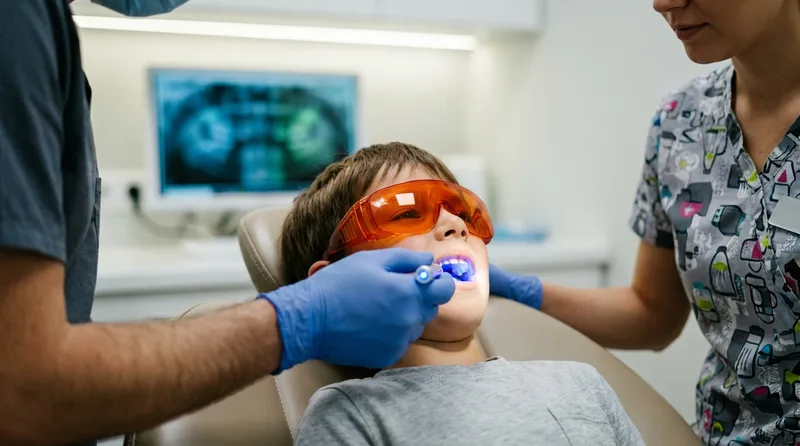
Sealants take a few minutes per tooth and nothing is removed from the tooth. The dentist cleans and dries the tooth, applies a gentle gel to help the sealant bond, rinses it off, brushes the sealant into the grooves, and hardens it with a special blue light.
A blue curing light hardens each sealant in seconds.
The ADA lays out the same basic steps, and most kids find the hardest part is keeping their mouth open:
Clean the tooth so no plaque or food is left in the grooves.
Dry and isolate it with cotton or a small suction tip, because moisture weakens the bond.
Apply a mild gel for a few seconds to roughen the surface slightly so the sealant grips.
Rinse and dry again.
Brush on the sealant so it flows into every groove.
Harden it with a blue curing light, usually in seconds.
Check the bite and smooth any high spots.
There's usually no local anesthetic and no dental handpiece involved, because nothing is being repaired. Many kids are surprised it's over so quickly. A few sealants often fit right into a regular checkup.
Tip for nervous kids
Tell your child the dentist is giving their teeth a raincoat, then using a special flashlight to dry it. Simple, true, and easy to picture.
How Long Do Dental Sealants Last?
Sealants usually last several years, and many protect teeth much longer. The ADA notes that dentists check sealants at regular visits and reapply them when needed. A landmark 15-year study still found 27.6% of sealants fully intact and 35.4% partly intact on first molars.
That study, published in the Journal of the American Dental Association by Simonsen in 1991, also compared matched teeth. After 15 years, 31.3% of sealed surfaces had decayed or been filled, versus 82.8% of unsealed ones. Even partly worn sealants seemed to help.
What affects how long a sealant lasts
Why it matters
How dry the tooth stayed during placement
Moisture is the main reason a sealant loosens early.
Chewing habits
Ice, hard candy, and chewing on pens can wear or chip sealants.
Teeth grinding
Constant pressure wears the coating faster.
Regular checkups
Small chips get repaired before decay can sneak underneath.
A worn sealant isn't an emergency. It's simply touched up at the next visit, which takes a few minutes. The same applies when a sealant comes off completely.
Are Dental Sealants Safe for Children?
Yes. The ADA says current evidence shows no health concern from the very low BPA exposure that dental materials, including sealants, can cause for a few hours after placement. Apart from a rare allergy to the material, MouthHealthy reports no known side effects from sealants.
The BPA question comes up often, so here are the details. A 2010 review in Pediatrics by Fleisch and colleagues found BPA can show up in saliva for up to three hours after resin placement. They recommended continued use of sealants because of their proven benefits and the brief exposure, along with rinsing right after placement. You can read the ADA overview of dental sealants for the full position.
Questions about sealant materials are welcome at any visit.
For perspective, MouthHealthy notes that touching a receipt, using cosmetics, or contact with household dust can expose you to more BPA than a sealant does. If you have concerns, ask us which material we use and how we rinse afterward. We're glad to walk you through it.
Which Kids Benefit Most From Dental Sealants?
Almost every child with deep grooves on their molars can benefit, but sealants matter most for kids with past cavities, deep or sticky grooves, braces, frequent snacking, or low fluoride exposure. Your dentist looks at each new molar and your child's overall cavity risk before recommending them.
Signs your child may get extra value from sealants:
Deep, narrow grooves that catch food even after brushing.
A history of cavities, in baby teeth or permanent ones.
Braces or other appliances that make cleaning the back teeth harder.
Frequent snacks or sweet drinks between meals.
Little fluoride exposure, such as well water that hasn't been tested.
Is my child a good candidate?
Has a new permanent molar fully come in recently?
Yes: Ask about sealing it at the next visit.
No ↓
Has your child had cavities before, or do they snack often between meals?
Yes: Sealants are a strong extra layer of protection.
No ↓
Does your family drink well water or water without added fluoride?
Yes: Ask about sealants and fluoride varnish together.
No ↓
None of these? Your dentist may still suggest sealants for deep grooves, or simply watch the teeth at checkups.
Water is part of the picture in our area. Peterborough's town water doesn't have added fluoride, so read our guide to fluoride in your water to see where your family stands.
And if a tooth already has a cavity? A sealant can sometimes cover very early decay to stop it from growing, but a true cavity usually needs a small filling instead. Your dentist will explain which applies.
How Do We Handle Sealants at Peterborough Family Dental?
We check every new molar as it comes in, explain which teeth would benefit and why, and place sealants during regular visits whenever possible. At each checkup after that, we look over existing sealants and touch up any worn spots so the protection lasts.
Sealants are part of our sealants and preventive care for kids, alongside gentle cleanings, fluoride, and brushing coaching. We explain every step before we start, and parents are always welcome in the room.
Brushing and flossing still matter, since sealants only cover the chewing surfaces.
After-sealant checklist
Small habits that help sealants last.
Sealants are one stage in a bigger plan. Our children's dental care guide shows what kids need from baby teeth through the teen years.
A few minutes per tooth now can mean far fewer fillings later. If your child's molars are coming in, it's a good time to ask.
Results may vary. Please consult with your dentist at Peterborough Family Dental for personalized treatment recommendations.
Ask about sealants at your child's next visit
We'll check your child's molars and let you know which teeth would benefit. Call (603) 924-3664 or request an appointment online.


 Dr. Muhammad Rahim, DMDOctober 7, 20269 min read