
Back to all articlesDental Implants Dr. Muhammad Rahim, DMDOctober 6, 202610 min read
Dental Implant Procedure Step by Step: What to Expect
Dr. Muhammad Rahim, DMDOctober 6, 202610 min read
Loading blog post
Dr. Muhammad Rahim, DMDOctober 6, 202610 min readCall and you'll reach a real person on our team: no phone tree, no hold music. We'd genuinely love to help.
(603) 924-3664Rather write to us? Contact us
The dental implant procedure, step by step, usually looks like this: a consultation with a 3D scan, digital planning, a short surgery to place the implant, a few months of healing, and a final visit to attach your custom crown. Most single-implant cases take three to four main appointments spread over a few months.
Knowing what happens at each visit takes most of the mystery, and much of the nervousness, out of the process. There's no single marathon appointment. Each step is short, planned in advance, and spaced out so your body can heal in between. At Peterborough Family Dental & Implant Center, we plan and place dental implants in the same office, so you'll see the same team from first scan to final crown.
This guide walks through what happens in the chair at each appointment, how long each visit takes, and what it feels like.
Your implant journey in five stops
Visit 1
Consultation
Exam, 3D scan, and a written plan
Behind the scenes
Planning
Implant position mapped digitally
Visit 2
Surgery
The implant is placed, often in about an hour
3-6 months
Healing
The implant fuses with your jawbone
Visit 3+
Crown
Your custom tooth is attached
Curious what your own steps would look like?
Your implant consultation includes 3D imaging and a written plan, so you'll know exactly what each visit involves before anything begins.
Request an Appointment →The dental implant procedure step by step includes an exam and 3D scan, digital treatment planning, any preparatory work like an extraction or bone graft, surgery to place the implant, a healing period of about three to six months, and finally attaching an abutment and custom crown.
Not everyone needs every step. Many patients skip step three entirely. And in some cases, steps three and four happen on the same day. Your plan will show exactly which steps apply to you and roughly when each one happens.
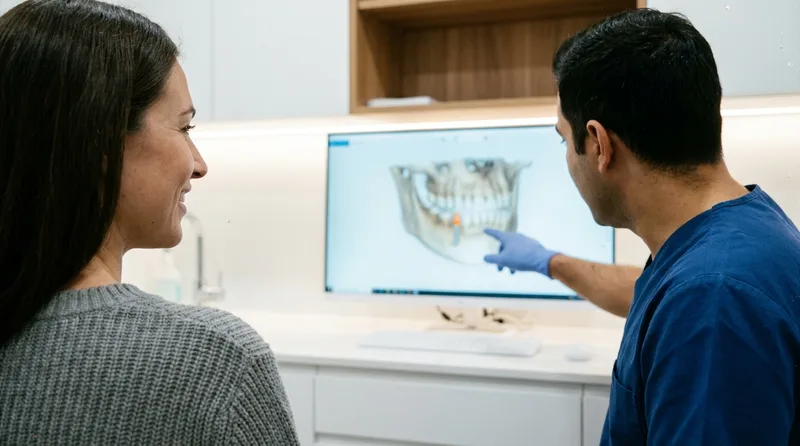
At your implant consultation, your dentist examines your teeth and gums, reviews your health history and medications, and takes a 3D cone beam CT scan to measure your jawbone. You'll talk through your goals and options, then leave with a written treatment plan and an itemized quote.
The 3D scan is the heart of this visit. Standard X-rays are flat, but a cone beam scan shows the height, width, and density of your bone in three dimensions, along with nearby nerves and the sinuses. That's what turns an implant plan from a best guess into a measured decision.
What to bring to your consultation
Check each one that applies to you.
Bringing these helps your dentist give you a precise, personal plan in one visit.
Feeling nervous about the whole process is normal. About 36% of Americans have dental anxiety, according to BMC Oral Health. Mention it at this visit, and your dentist can talk through comfort and sedation options before anything is scheduled.
Your implant is planned digitally using your 3D scan. Your dentist maps the exact position, angle, and depth of the implant around your bone, nerves, and sinuses. In many cases, a custom surgical guide is made from that plan to help place the implant precisely where it was designed to go.
This planning happens before you're in the chair, and it pays off on surgery day. A 2023 meta-analysis of randomized trials on digital implant workflows found that computer-guided surgery placed implants accurately and that guided patients needed significantly less medication for discomfort afterward. Digital impressions were also faster than traditional ones.
39
studies reviewed on digital implant workflows, including guided surgery
Source: J. of Evidence-Based Dental Practice, 2023
95-98%
implant success rate over 10 years
Source: J. of Oral and Maxillofacial Surgery
2 / 10
average peak discomfort after implant surgery
Source: Journal of Periodontology, 2007
Planning also decides whether you need any preparation first, and whether the implant can go in on the same day as an extraction. You'll see the plan on screen and can ask questions before agreeing to anything.
Some patients need a step before implant placement. The most common are removing a damaged tooth and placing a bone graft if the jawbone is too thin. Others need gum disease treated first. Many patients need none of these and go straight from planning to implant surgery.
Will you need a step before your implant?
↓
If a tooth is being removed, ask whether you're a candidate for an implant the same day as an extraction. And if your scan shows thin bone, our guide to a bone graft after tooth extraction explains why it's recommended and how it fits into the timeline.
See your own scan and plan
Dr. Muhammad Rahim and Dr. Jasper Ainslie will walk you through your 3D scan and explain exactly which steps your treatment involves.
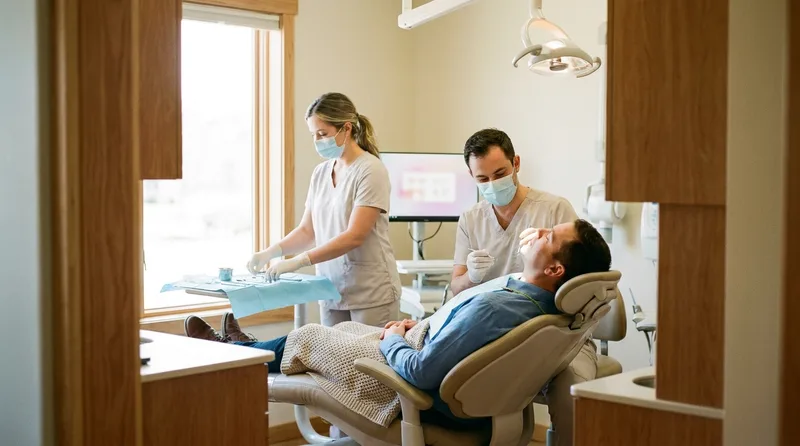
Book a Consultation →During implant surgery, the area is numbed with local anesthetic, with sedation available if you prefer. Your dentist makes a small opening in the gum, gently prepares a space in the bone, places the implant, and covers it with a healing cap or temporary tooth. A single implant often takes about an hour.
Inside the surgery appointment
Comfort first
Local anesthetic numbs the area completely. Sedation options are available if you feel anxious.
Accessing the bone
A small opening is made in the gum. In suitable cases, a flapless approach uses an even smaller opening.
Preparing the site
The bone is gently shaped to the exact size of the implant, following the digital plan.
Placing the implant
The implant is placed into the bone and checked for stability.
Closing up
A healing cap or temporary tooth goes on, and a few stitches may be placed.
You'll feel pressure and vibration, but not sharp sensations, while the area is numb. And when it's suitable, a flapless approach can make recovery even easier. A Cochrane-based review found that flapless placement led to significantly less postoperative discomfort than lifting a full flap of gum tissue.
Local anesthetic only
With sedation
Between surgery and your crown, the implant fuses with your jawbone over roughly three to six months. You'll have a short follow-up visit to check healing, usually within a couple of weeks. Otherwise, life goes on as normal while you avoid chewing hard foods directly on the implant site.
This is the quietest part of the process from the outside, and the most important on the inside. If you'd like to know what each week of healing feels like, our dental implant recovery timeline covers it step by step, from the first day to the final crown.
If you have a temporary tooth, it's there for appearance and to support the gums, not for heavy chewing. Treat it gently, keep the area clean as instructed, and call if anything feels loose or unusual. Your follow-up visit is a good time to ask any questions that came up during the first weeks.
Myth
“Implant surgery means weeks off work.”
Fact
Most people with a single implant are back at a desk job within a day or two. The months of healing happen quietly in the background.
Once the implant has fused with the bone, your dentist attaches a small connector called an abutment, takes a digital scan, and designs a crown to match your other teeth. At the final visit, the crown is attached to the abutment and your bite is fine-tuned so it feels natural.
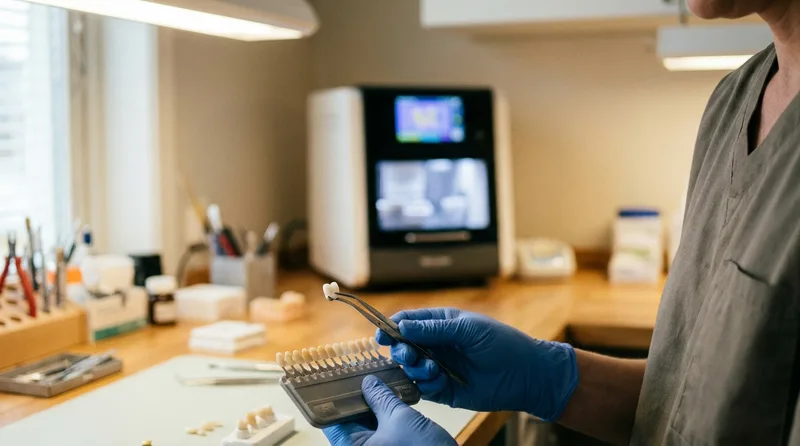
This part is usually quick and doesn't involve surgery. Digital scans replace the goopy impression trays many people remember, and our in-house lab and CEREC technology can help shorten the wait for your finished crown.
Before the final crown is attached, your dentist checks it in your mouth for fit and color, and adjusts it if needed. You'll bite down on thin marking paper so any high spots can be smoothed. Small details like this are what make an implant crown feel like it belongs there rather than something you notice every time you chew.
The color, shape, and size of the crown are matched to the teeth around it, so it blends into your smile. After it's on, you can chew normally again and care for it much like a natural tooth.
A straightforward single implant usually takes three to four main visits: the consultation, the surgery, a healing check, and the crown appointment. Extra visits are added if you need an extraction, bone graft, or several implants, and full-arch treatment follows its own schedule.
| Visit | What happens | Typical length |
|---|---|---|
| Consultation | Exam, 3D scan, plan, and quote | About an hour |
| Surgery | Implant placed under local anesthetic or sedation | Often about an hour for one implant |
| Follow-up | Healing check and stitch removal if needed | Short visit |
| Scan for crown | Abutment and digital scan, sometimes combined with fitting | Short visit |
| Crown fitting | Final crown attached, bite adjusted | Short visit |
Your own schedule depends on your case, and your written plan will lay it out before you start. The ADA's MouthHealthy overview of dental implants is also a helpful plain-language introduction.
If you have healthy gums and enough bone, or can rebuild it, the implant process is more manageable than most people expect: a few short visits, a comfortable surgery, and a few quiet months of healing before your new tooth is in place.
No single appointment is a marathon. The process is built in small steps so your body has time to heal between them.
Once healed, implants hold up well. A 2019 review in the Journal of Dentistry found 96.4% were still functioning after 10 years. Patients from Peterborough, Jaffrey, Dublin, Hancock, and across the Monadnock region trust us to guide them through each step, with a clear plan from the very first visit.
Results may vary. Please consult with your dentist at Peterborough Family Dental for personalized treatment recommendations.
Start With a Clear, Step-by-Step Plan
Schedule a consultation at our Peterborough, NH office. We'll take a 3D scan and map out every step of your implant treatment.
Request an Appointment →Prefer to talk it through first? Our front desk opens at 7 AM.
Call (603) 924-3664 →
Dr. Muhammad Rahim, DMD
Dentist · Peterborough Family Dental & Implant Center
Peterborough, NH dentist providing gentle general, cosmetic, restorative, and implant dentistry for the whole family.
Was this article helpful?
For a single implant, the whole process usually takes about three to six months, mostly healing time. If you need an extraction or bone graft first, add a few more months. The time you actually spend in the chair is only a few hours across all visits.
Our Peterborough team is happy to answer questions and get you on the calendar.


