
Back to all articlesRestorative Dentistry Dr. Muhammad Rahim, DMDNovember 15, 202611 min read
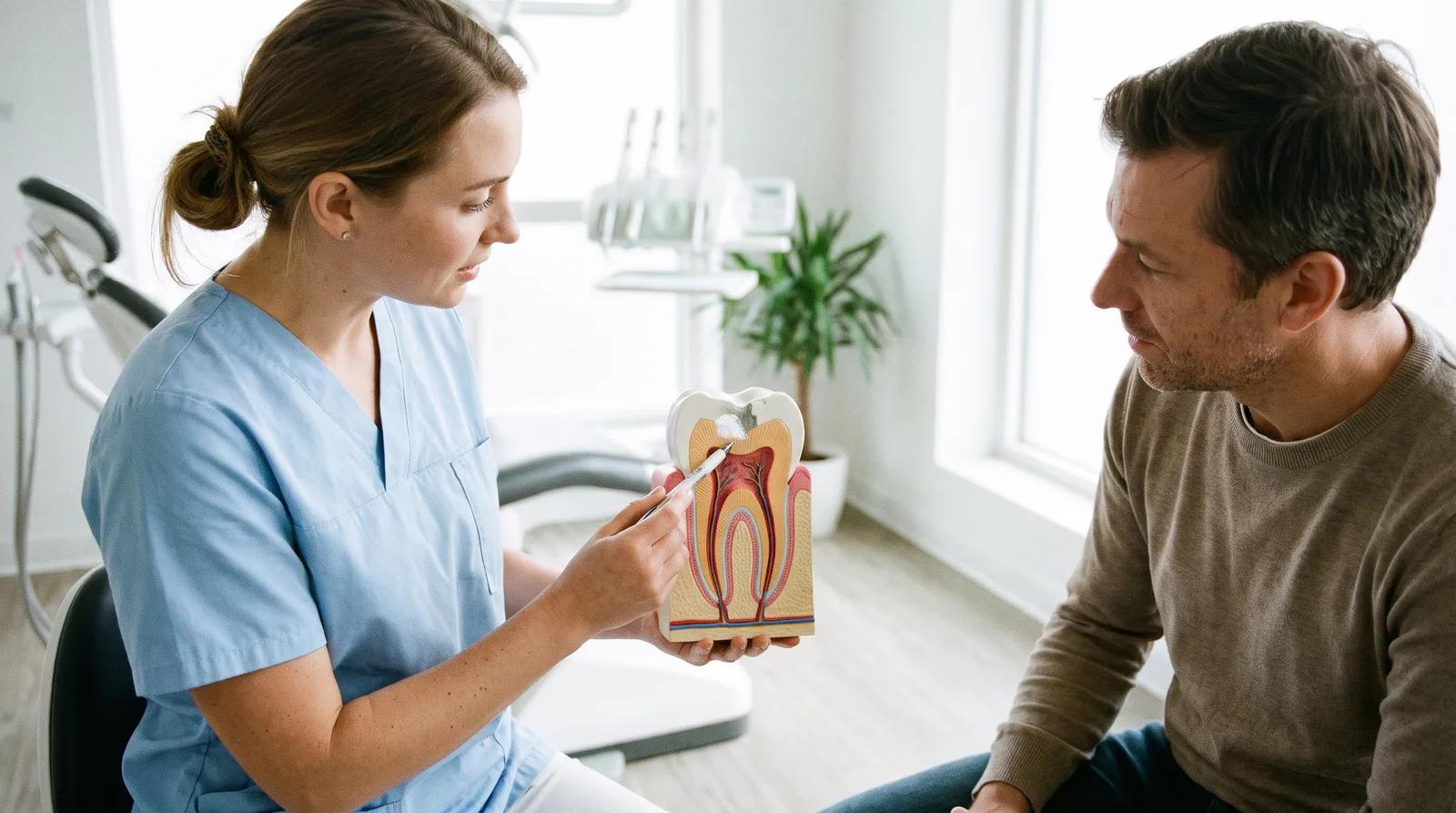
Stages of Tooth Decay: From White Spots to Root Canal
Dr. Muhammad Rahim, DMDNovember 15, 202611 min read
Loading blog post
Dr. Muhammad Rahim, DMDNovember 15, 202611 min readCall and you'll reach a real person on our team: no phone tree, no hold music. We'd genuinely love to help.
(603) 924-3664Rather write to us? Contact us
The stages of tooth decay start quietly and end loudly. A faint white spot you'd never notice can, over months or years, become a cavity, a throbbing toothache, and eventually an infection. At Peterborough Family Dental & Implant Center in Peterborough, NH, we provide preventive and restorative dental care, and the most encouraging news we can share is that the earliest stage can often be reversed.
The challenge is that early decay usually has no symptoms. By the time a tooth aches, the decay has often already moved deeper. Understanding the stages helps you see why checkups matter and why treating decay early is simpler, more comfortable, and less costly.
This guide walks through each stage, what it feels like, how it's treated, and how to stop the process before it starts.
Tooth decay starts when bacteria in your mouth turn sugars and starches into acid that attacks the tooth's enamel and draws minerals out of it. Over time, repeated acid attacks weaken the enamel until a hole, called a cavity, can form. It's a process that unfolds gradually, which is why it can be stopped early.
The National Institute of Dental and Craniofacial Research explains that when decay-causing bacteria come into contact with sugars and starches from foods and drinks, they form an acid, and repeated exposure causes the enamel to keep losing minerals. Mayo Clinic's guide to cavities and tooth decay describes the same chain, starting with plaque, a clear, sticky film that coats your teeth.
Frequency matters as much as quantity. Sipping a sugary drink all afternoon keeps your teeth under acid attack for hours, while the same drink with a meal exposes them for far less time.
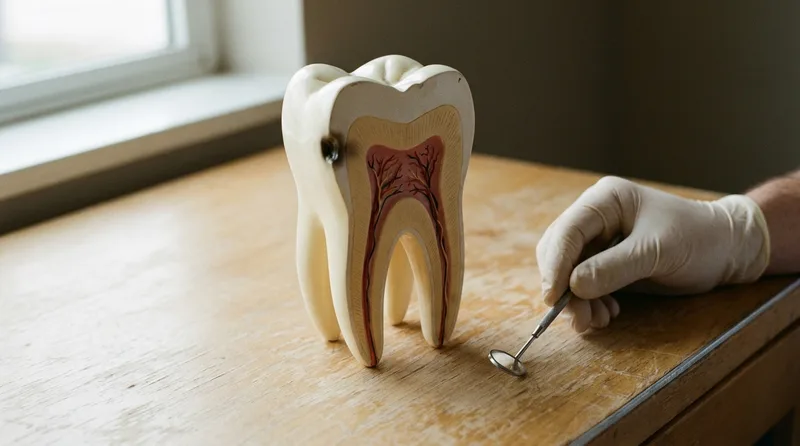
The stages of tooth decay are demineralization, enamel decay, dentin decay, pulp involvement, and abscess. Each stage reaches a deeper layer of the tooth. The earlier you catch it, the simpler the treatment, and only the first stage can be reversed without a dentist removing decayed tissue.
| Stage | What's happening | What you may notice | Typical treatment |
|---|---|---|---|
| 1. Demineralization | Acid draws minerals out of the enamel | A white spot, often with no symptoms | Fluoride and better habits |
| 2. Enamel decay | The enamel breaks down and a cavity forms | White spots may darken to brown, and a small hole may appear | A filling |
| 3. Dentin decay | Decay reaches the softer layer beneath the enamel | Sensitivity to sweets, hot, and cold | A larger filling, inlay, onlay, or crown |
| 4. Pulp involvement | Bacteria reach the nerves and blood vessels | A lingering ache, pressure, or swelling | Root canal treatment and a crown |
| 5. Abscess | Infection forms a pocket of pus | A severe throbbing ache, facial swelling, or fever | Draining the infection, then root canal treatment or removal |
Think of it as a staircase. At the top, a little fluoride and better habits can turn things around. Each step down takes more treatment, and the last steps involve infection. Regular exams and X-rays help your dentist find decay on the top steps, before you can feel anything.
Yes, white spots from early decay can often be stopped or reversed. At this stage, acid has drawn minerals out of the enamel, but the surface hasn't broken down. Enamel can repair itself using minerals from saliva and fluoride from toothpaste or from professional fluoride treatments.
NIDCR notes that a white spot may appear where minerals have been lost, that this is a sign of early decay, and that decay can be stopped or reversed at this point. It also explains that the dentist can apply fluoride to reverse decay that is still in its early stages, before a hole forms.
Many white spots show up near the gumline or around braces, where plaque lingers, and they often look like a dull, chalky patch. Either way, point them out to your dentist.
This is the ideal time to catch decay, and you'll rarely see it yourself. That's the job of regular exams. The ADA notes that regular visits can catch 80% of oral health issues before they become serious.
When enamel breaks down, the white spot can darken to brown and a small hole, called a cavity, can form. A cavity can't repair itself, so it needs a filling. Your dentist removes the decayed tissue and restores the tooth, which stops the decay from spreading.
Mayo Clinic describes the acids from bacteria removing minerals from the hard outer enamel, and says that this erosion causes tiny openings or holes in the enamel, which is the first stage of cavities. You may still not feel anything, which is why checkups matter even when your mouth feels fine.
A dental filling is the standard treatment at this stage, and it's usually quick. Our comparison of tooth-colored and amalgam fillings helps you choose a material. Treating a small cavity early keeps the filling small and the tooth strong.
Haven't had an exam in a while?
Request an appointment at our Peterborough office and we'll check for early decay, when it's easiest to treat.
Request an Appointment →Decay reaches the dentin when it moves through the enamel to the softer layer beneath. Dentin is less resistant to acid, so decay can spread faster, and teeth often become sensitive to sweets, hot, and cold. A larger filling, an inlay or onlay, or a crown may be needed.
Mayo Clinic explains that once areas of enamel are worn away, bacteria and acid reach the dentin, which is softer than enamel and less resistant to acid, making your teeth more sensitive. Dentin also contains tiny tubes that connect to the nerve, which is why sensitivity is often the first thing you notice.
Not every sensitive tooth means decay, since receding gums and worn enamel can cause it too. But sensitivity that keeps coming back in the same spot is worth an exam.
As the cavity grows, so does the repair. Our guide to inlays, onlays, fillings, and crowns explains how your dentist chooses between a filling, an inlay or onlay, and a crown. If a crown is the right fit, our guide to same day crowns explains how some can be placed in a single visit.
When decay reaches the pulp, the nerves and blood vessels at the center of the tooth, bacteria irritate and swell the tissue. There's no room inside the tooth for swelling, so the nerve becomes pressed, which can cause a persistent ache. Root canal treatment is usually needed to save the tooth.
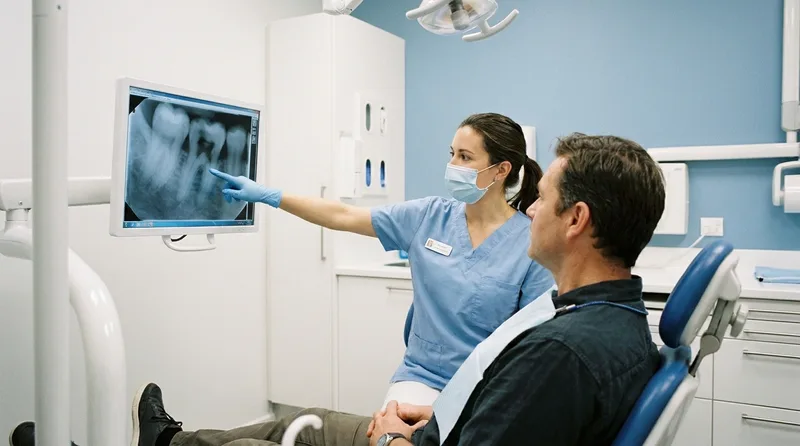
Mayo Clinic describes the pulp as the inner tooth material that contains nerves and blood vessels, and explains that because there is no place for swelling to expand inside the tooth, the nerve becomes pressed, causing discomfort. The damage can also spread outside the root to the bone.
Discomfort that wakes you at night, or lingers after hot or cold, are common clues. If you notice either, call rather than waiting to see if it settles.
This is the stage where many people finally call. A lingering or throbbing ache, especially at night, is a sign the decay may be deep. Root canal treatment can remove the infected tissue and save the tooth, and our guide to what a root canal feels like explains what to expect in plain language.
A tooth abscess is a pocket of pus caused by bacterial infection that has spread from a badly decayed tooth. It can cause a severe throbbing ache, facial swelling, and fever. It won't clear up without treatment, so it needs prompt dental care, and the infection can spread beyond the tooth.
NIDCR notes that if the tooth becomes infected, an abscess may form, causing facial swelling and fever. Our guide to tooth abscess symptoms covers the full list of symptoms, why waiting is risky, and when to go to an emergency room, such as trouble breathing or swallowing.
The earlier stages are far easier to treat. A tooth that reaches this point may need a root canal, or in some cases removal and replacement. The goal of understanding the stages is to never get here.
A toothache that won't go away?
Send us a note or call, and we'll help you get seen as soon as we can.
Contact Our Office →Risk goes up with frequent snacking and sipping on sugary or starchy foods, dry mouth, too little fluoride, hard-to-clean grooves in back teeth, worn fillings, and certain medicines. Age matters too, since receding gums expose roots to decay. Knowing your risk factors helps you and your dentist plan prevention.
You can lower your risk without changing everything. Keeping sweets to mealtimes instead of sipping or grazing, and rinsing with water afterward, makes a real difference.
Gum health connects to all of this. The CDC reports that 42% of adults aged 30 and older have some form of periodontal disease, and receding gums can expose the tooth root to decay-causing bacteria.
Brush twice a day with fluoride toothpaste, clean between your teeth daily, limit sugary snacks and sips, drink fluoridated tap water, avoid tobacco, and see your dentist for regular exams and cleanings. Sealants protect children's back teeth. These habits keep decay in stage one, or stop it from starting.

Kids need extra help. The CDC reports that 20% of children ages 5 to 11 have at least one untreated decayed tooth, and that dental sealants can reduce the risk of cavities in school-age children by nearly 80%. Our guide to dental sealants for kids explains how they work.
Regular visits pay off for everyone. The Journal of Dental Research reports that people who see a dentist regularly are 60% less likely to lose teeth. If dental visits make you nervous, you're not alone. BMC Oral Health (2024) reports that 36% of Americans have dental anxiety, and the Journal of Dental Anesthesia reports that sedation dentistry has helped 75% of fearful patients keep up with regular visits. We offer nitrous oxide and oral sedation.
Book an exam and X-rays so your dentist can check for early decay, when it's easiest to treat. A short visit can find a white spot or a small cavity long before it causes an ache. If you already have a toothache or sensitivity, don't wait, since decay only moves deeper.
If you take medicines that dry your mouth, mention them. Dry mouth raises decay risk, and your dentist can suggest ways to protect your teeth.
We welcome patients from Peterborough, Jaffrey, Dublin, Hancock, and across the Monadnock region, with early-morning hours from 7 AM Monday through Thursday. Bring your questions to Dr. Muhammad Rahim or Dr. Jasper Ainslie. If you request a time online, a real person from our team replies the same business day to confirm your visit.
Results may vary. Please consult with your dentist at Peterborough Family Dental for personalized treatment recommendations.
Catch decay while it's easy to treat
Request an appointment at Peterborough Family Dental & Implant Center for an exam and a clear plan to protect your teeth.
Request an Appointment →Prefer to talk to someone first?
Call (603) 924-3664 →
Dr. Muhammad Rahim, DMD
Dentist · Peterborough Family Dental & Implant Center
Peterborough, NH dentist providing gentle general, cosmetic, restorative, and implant dentistry for the whole family.
Was this article helpful?
Only in the earliest stage. When decay shows up as a white spot and the enamel surface hasn't broken down, fluoride and better habits can help the enamel repair itself. Once a cavity forms, a dentist needs to remove the decay and place a filling.
Our Peterborough team is happy to answer questions and get you on the calendar.


