Back to all articlesRestorative Dentistry Dr. Muhammad Rahim, DMDNovember 24, 202611 min read

How to Clean Under a Dental Bridge: Tools and Daily Routine
Dr. Muhammad Rahim, DMDNovember 24, 202611 min read
Loading blog post
Dr. Muhammad Rahim, DMDNovember 24, 202611 min readCall and you'll reach a real person on our team: no phone tree, no hold music. We'd genuinely love to help.
(603) 924-3664Rather write to us? Contact us
How to clean under a dental bridge comes down to this: brush twice a day, and once a day clean around and under it with pre-threaded flossers, small brushes, or a water flosser. You can't floss straight down between a bridge and the gum the way you can between natural teeth, so many people avoid the area. At Peterborough Family Dental & Implant Center in Peterborough, NH, we provide family, restorative, and implant dentistry, and we'll show you how to care for your bridge at your visit.
This guide explains why cleaning under a bridge matters, what tools can help, a simple daily routine, how a water flosser fits in, and the signs that something needs attention.
Brush twice a day for two minutes, and once a day clean under and around the bridge with a tool that reaches the area, such as pre-threaded flossers, small brushes, or a water flosser. The ADA says people with fixed bridges may find a water flosser helps them reach every nook and cranny. Keep your regular checkups too.
A fixed bridge can't be removed at home, so the cleaning has to happen around it. The ADA says a fixed bridge can only be removed by a dentist, which is exactly why daily cleaning of the area matters so much.
Many people avoid the area because they're afraid of damaging the gum or aren't sure where to start, which lets plaque build up. A few minutes with your dentist, learning the right tool and angle, usually solves both worries. If you're not sure which tool suits your bridge, ask us. The right choice depends on the type of bridge and how your gums sit around it.
Cleaning under a bridge matters because the bridge depends on the health of the teeth that hold it. The ADA's guide to bridges says that its success depends on the foundation, so it's very important to keep your remaining teeth healthy and strong. Plaque left around a bridge can lead to decay and gum disease, the same as anywhere else.
The ADA's guide to flossing explains that plaque is the sticky film that can lead to cavities and gum disease, and that plaque not cleaned away by brushing or flossing can harden into tartar. Once tartar forms, only a dentist can remove it, and flossing every day can prevent plaque buildup.
This is also why a bridge deserves attention even when it looks perfect. The part you can't see, the gum and the supporting teeth, is what keeps it in place. A bridge isn't a tooth, so it can't decay, but the teeth and gums around it can. Protecting them is how you protect the bridge. Our guide to how long dental bridges last explains what affects its lifespan.
You can choose from dental floss, pre-threaded flossers, dental picks, tiny brushes, and water flossers. The ADA says there are many safe, effective tools for cleaning between teeth, and that you should talk with your dentist and try different options to see which you like best. Look for products with the ADA Seal of Acceptance.
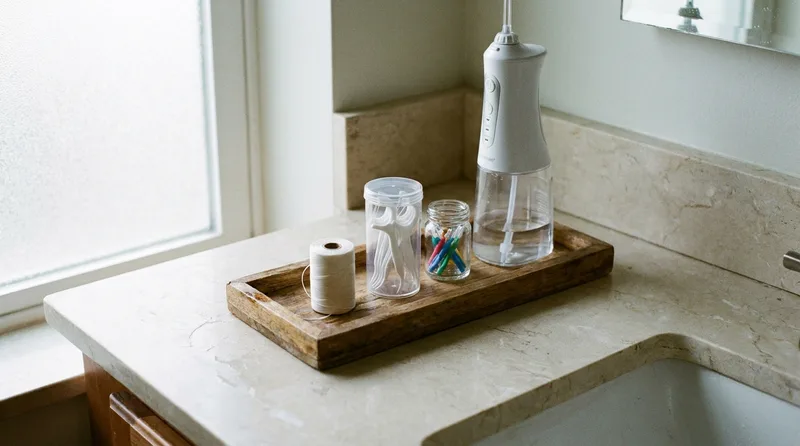
| Tool | What it is | Good to know |
|---|---|---|
| Dental floss | A smooth strand of nylon or Teflon made to slide between teeth | The traditional choice, and works well for many people |
| Pre-threaded flossers | Flossers fitted with a pick or brush at one end | A couple of different ways to get between teeth |
| Dental picks and tiny brushes | Small tools for reaching out-of-the-way spots | Useful where string floss is hard to maneuver |
| Water flosser | A handheld device that sprays a steady pulse of water | The ADA says people with fixed bridges may find one helpful |
Avoid improvising. The ADA notes that people have used fingernails, folded paper, forks, and safety pins to clear spaces between teeth, and that these aren't the right tools and can even be harmful. Around a bridge, where the margins matter, stick with tools made for the job.
Comfort matters as much as effectiveness. A tool you find awkward is a tool you'll skip, so try more than one and keep the one you'll use every day. The ADA also says to talk with your dentist about which flossing tool is right for you. Ask us at your next visit which of these fits your bridge best, and we'll show you how to use it.
Want a quick lesson on your own bridge?
Request an appointment at our Peterborough office. We'll show you the tools and technique that suit your bridge.
Request an Appointment →Knowing how to clean under a dental bridge comes down to a simple routine: two minutes of brushing twice a day, plus one thorough cleaning around and under the bridge each day. The ADA says it doesn't matter whether you clean between your teeth before or after brushing, as long as it's thorough and daily.
If you're too tired at night, the ADA suggests flossing in the morning or after lunch. The right time is the one you'll actually do every day.
The ADA describes a five-step flossing method for natural teeth: about 18 inches of floss, a gentle rubbing motion, a C shape against each tooth, and an up-and-down rub. A bridge needs one adjustment, a way to get floss under the replacement tooth, which your dentist can show you.

Pre-threaded flossers can help you get floss under a bridge, and your dentist can recommend a good fit for yours. Don't force anything that doesn't pass easily, since that's a sign to ask for help.
It can. The ADA's guide to water flossers says water flossers can be an option for people who have trouble flossing by hand, and that people with dental work that makes flossing difficult, such as braces or fixed bridges, also might try them. Water flossers with the ADA Seal have been tested to be safe and effective at removing plaque.
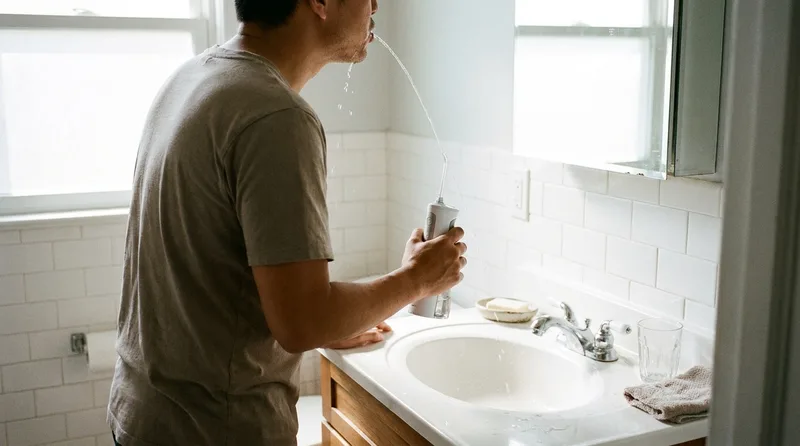
Many people find a water flosser easier to stick with, and the right routine is the one you'll do every day. The ADA adds that water flossers with the Seal can also help reduce gingivitis, the early form of gum disease. A water flosser doesn't replace brushing, and cleaning between your teeth once a day is still an important part of your routine.
Our comparison of a water flosser and floss explains how it compares with string floss. If you're torn between tools, many people use both: string floss where it fits and a water flosser for the hard-to-reach spots.
The goal is the same for every bridge: keep the supporting teeth or implants and the gums around them clean. Only what you're cleaning around changes. A traditional bridge crowns the teeth on either side of the gap, an implant-supported bridge is anchored to implants, and a Maryland bridge uses bonded wings.
The ADA says an implant bridge attaches artificial teeth directly to the jaw or under the gum tissue. Our dental bridges page explains each type, and our comparison of an implant and a bridge and comparison of a partial denture and a bridge help you compare. Ask us for specifics for your own bridge.
Watch for bleeding gums, a constant bad taste, a persistent odor, tenderness, or a bridge that feels loose or different. The ADA says bad breath that won't go away, or a constant bad taste, can be a warning sign of advanced gum disease, and that if cleaning between your teeth is still sore, you should talk with your dentist.
Our guide to bleeding gums and guide to dry mouth and bad breath explain two of the common warning signs. The CDC reports that 42% of adults aged 30 and older have some form of periodontal disease, and early gum disease often has no obvious signs, which is one more reason to keep your checkups.
At checkups, we examine the bridge and the teeth that support it, take X-rays when needed, and clean off the tartar you can't. The ADA says that once tartar forms, only your dentist can remove it. A professional cleaning also lets us check the margins of the bridge and the gum health around it.
Regular visits make a real difference. The Journal of Dental Research reports that people who see a dentist regularly are 60% less likely to lose teeth, and the ADA notes that regular visits can catch 80% of oral health issues before they become serious. Our guide on how often to see the dentist explains how often to come in.
Our professional teeth cleaning and gum disease treatment pages explain what we do, and our guide to scaling and root planing covers deeper cleanings. If you're nervous, BMC Oral Health (2024) reports that 36% of Americans have dental anxiety and 12% have extreme dental fear, and the Journal of Dental Anesthesia reports that sedation dentistry has helped 75% of fearful patients keep up with regular visits. Our comfort and sedation page and tips for nervous dental patients explain how we keep visits comfortable.
Not sure if you're cleaning your bridge correctly?
Send us a note or call, and we'll arrange a time to show you.
Contact Our Office →Start with the daily routine, ask us which tool suits your bridge, and keep your checkups. If you're considering a bridge, or comparing it with an implant, we can walk you through both. A real person from our team replies to online requests the same business day, and a free consultation comes with a clear written plan.
Missing teeth are common. The American College of Prosthodontists estimates that 120 million Americans are missing at least one tooth, and the Journal of Oral and Maxillofacial Surgery reports implant success rates of 95-98% over 10 years. Our dental implants pages and guide to crown vs implant explain the options. If it's been a while since your last visit, our guide for patients who haven't been to the dentist in years explains what to expect.
We welcome patients from Peterborough, Jaffrey, Dublin, Hancock, and across the Monadnock region, with early-morning hours from 7 AM Monday through Thursday. Bring your questions to Dr. Muhammad Rahim, Dr. Jasper Ainslie, or Dr. Nabeel Almaaz, and see our Meet Our Doctors page.
Results may vary. Please consult with your dentist at Peterborough Family Dental for personalized treatment recommendations.
Keep your bridge healthy
Request an appointment at Peterborough Family Dental & Implant Center and we'll show you how to care for it.
Request an Appointment →Prefer to talk to someone first?
Call (603) 924-3664 →
Dr. Muhammad Rahim, DMD
Dentist · Peterborough Family Dental & Implant Center
Peterborough, NH dentist providing gentle general, cosmetic, restorative, and implant dentistry for the whole family.
Was this article helpful?
Brush twice a day for two minutes, and once a day clean around and under the bridge with a tool that reaches the area, such as pre-threaded flossers, small brushes, or a water flosser. Ask your dentist which suits your bridge and how to use it.
Our Peterborough team is happy to answer questions and get you on the calendar.