
Back to all articlesgeneral-dentistry Dr. Muhammad Rahim, DMDNovember 18, 202610 min read

How Long Until Vaping Affects Your Teeth? Early Signs
Dr. Muhammad Rahim, DMDNovember 18, 202610 min read
Loading blog post
Dr. Muhammad Rahim, DMDNovember 18, 202610 min readCall and you'll reach a real person on our team: no phone tree, no hold music. We'd genuinely love to help.
(603) 924-3664Rather write to us? Contact us
If you vape and wonder how long until vaping affects your teeth, the honest answer is that nobody can give you a date. Your mouth is already changing, or not, depending on the device, how often you vape, what's in the liquid, and the shape your teeth and gums were in to begin with. At Peterborough Family Dental & Implant Center in Peterborough, NH, we provide preventive, restorative, and cosmetic dental care, and we talk about vaping without judgment.
This guide explains why there's no fixed timeline, the early signs worth watching for, what the research says so far, and what you can do to protect your teeth.
There is no reliable timeline, because vaping is too new to have long-term data. The ADA says we still don't have all the facts about vaping and dental health because e-cigarette use remains recent compared with traditional cigarettes. What you can do is watch for early signs and get regular exams.
The ADA's guide to vaping describes what researchers have found in vape cartridges, including carcinogens, heavy metals, and flavorings that contain sugar, which contributes to tooth decay. How quickly any of that shows up in your own mouth is a separate question that science hasn't answered. The ADA adds that researchers are still working out whether stickier aerosol contributes to cavity formation, which is why this guide focuses on signs you can recognize, not promises about dates.
That uncertainty cuts both ways. Some people may notice changes within months, while others may not notice any for years. Because changes can be gradual and quiet, a dentist's exam is the most dependable way to know.
Most studies on vaping and oral health are small and cross-sectional, meaning they compare groups at one point in time instead of following people for years. A 2021 review in the Journal of Dental Research notes that evidence from clinical trials is still limited. Another review notes the short-term and long-term effects of exposure are not yet known.
Researchers also note that it's hard to filter out vaping from other factors that influence oral health, such as age, general health, and other tobacco or cannabis use.
The earliest signs are usually quiet: a dry mouth, gums that look red or puffy, a new cavity at a checkup, or teeth that look more yellow. None of these proves vaping is the cause, but together they're a reason to book an exam. A dentist can look for them in a few minutes.

| Early sign | What it may mean | What to do |
|---|---|---|
| Dry mouth or irritation | Studies on e-cigarette users highlight concerns about oral dryness and irritation | Sip water, tell your dentist, and ask about saliva-friendly products |
| Red, puffy, or bleeding gums | Gum irritation or early gum disease; nicotine can make bleeding harder to notice | Book an exam and a cleaning rather than waiting |
| New cavities, especially near the gumline | Flavorings with sugar contribute to tooth decay, according to the ADA | Schedule a checkup and ask about fluoride |
| Yellow or stained teeth | A high heat setting can make the aerosol yellower and stickier, which can discolor teeth | A professional cleaning and, if you like, whitening |
Mention anything you've noticed when you book, even if it seems small. The more specific you are, the more useful the exam is. Don't try to diagnose yourself with a mirror. Early gum changes and early decay are easy to miss at home, and a dentist can see between teeth, along the gumline, and on X-rays what you can't. If dryness, a lingering bad taste, or sore gums don't go away, don't wait for your next routine visit.
These signs are shared by many causes, which is why a dentist's exam beats guessing. Our guide to bleeding gums, guide to the stages of tooth decay, and guide to tooth sensitivity to cold explain what each might mean.
Noticing changes in your mouth?
Request an exam at our Peterborough office. We'll check your teeth and gums and talk through what we find, with no judgment.
Request an Appointment →It can, depending on how you vape. The ADA notes that using a high heat setting can turn the aerosol more yellow, which could result in tooth discoloration, and can make it stickier, so it may remain on the teeth for a long time. Staining from vaping can look different from tobacco staining.
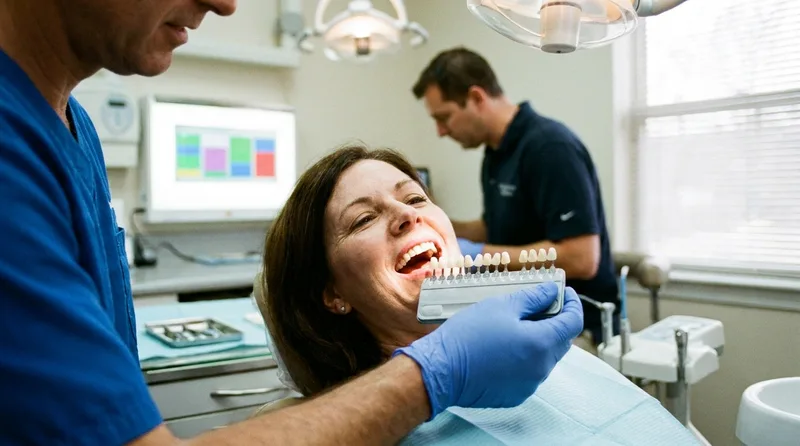
Stains matter beyond looks. The American Academy of Cosmetic Dentistry reports that 99.7% of adults believe a smile is an important social asset, so it's no surprise people want to deal with them.
Surface stains are often the easiest kind to improve, and a cleaning can make a visible difference. If stains are deeper, we'll talk through options at your visit. A professional cleaning removes surface stains. Our professional teeth cleaning service covers routine visits, our teeth whitening page explains brightening options, and our guide to why teeth turn yellow and comparison of in-office and at-home whitening explain what works.
Studies link vaping with a higher risk of cavities and gum problems, but they can't yet prove vaping is the cause. The ADA cites a JADA study that found a correlation between people who vape and people with untreated cavities, and says more research is needed.
A systematic review of 99 studies on e-cigarettes and oral health found e-cigarette exposure increased the risk of deteriorating gum, dental, and oral health. The same review found that most mouth and throat symptoms experienced by e-cigarette users were relatively minor and temporary. So early symptoms may be easy to dismiss, while slower changes to your gums and teeth build quietly.
Gum health is worth special attention. The CDC reports that 42% of adults aged 30 and older have some form of periodontal disease. Smoking is known to hide some of the usual warning signs, like bleeding gums, and nicotine from vaping may have a similar effect, so you can't rely on bleeding alone. Our gum disease treatment page explains how we treat it.
Reviews suggest vaping is associated with fewer harmful oral effects than smoking, but oral health still appears poorer than for people who use no tobacco or nicotine products. The ADA does not describe vaping as safe: e-cigarette aerosol contains fewer chemicals than cigarette smoke, but that doesn't mean vaping is safe.
Think of it as a spectrum rather than a verdict: using less of a harmful product is generally better for your mouth than using more, and using none is better still. If you're vaping to quit smoking, that's a real step, and your dentist can help you plan the next one. The goal isn't a lecture. It's an honest conversation about what's right for your mouth and your health.
Research on recovery after stopping vaping is limited, but stopping removes the ongoing exposure, and a dentist can check your gums and teeth and help you heal what's treatable. The ADA says quitting takes time and commitment, and offers free resources: smokefree.gov and 1-800-QUIT-NOW.
Quitting also lowers exposure to nicotine, which the ADA says is highly addictive, so support matters as much as willpower. Ask your dentist for suggestions and support too. The ADA notes your dentist cares about your health and is there to offer guidance and motivation. We'd be glad to be that support for you.
Your dentist can also tell you what has improved at each visit, which many people find motivating. Relapse is common with nicotine, and there's no shame in trying again, so ask us about support each time. Whether you stop, cut back, or keep vaping for now, regular checkups are what help you catch problems early. Early gum disease and early cavities are much easier to treat than advanced ones.
You can lower your risk with a few steady habits: drink water, brush twice a day with fluoride toothpaste, floss daily, and keep your checkups. If you vape, tell your dentist so they know what to look for. These steps don't make vaping safe, but they help your mouth cope.
If dry mouth is a regular issue, tell us. There are products and habits that can help, and we can check whether something else is contributing. If you'd like help cutting back or quitting, ask us. We can point you to the resources above and check in on your progress at your visits.
We talk about it plainly and without judgment. A dentist's job is to look at your teeth and gums, tell you what's going on, and give you options, not to scold. Honest answers lead to better care, and a private conversation is always an option.

We also build comfort into every visit: warm blankets, headphones, music, breaks whenever you need them, gentle numbing, and nitrous oxide or oral sedation if you'd like. BMC Oral Health (2024) reports that 36% of Americans have dental anxiety and 12% have extreme dental fear, and the Journal of Dental Anesthesia reports that sedation dentistry has helped 75% of fearful patients keep up with regular visits.
Our comfort and sedation page has the details, and our tips for nervous dental patients offer more ways to feel at ease. If it's been a while, our guide for patients who haven't been to the dentist in years explains what to expect. If you're a parent, our guide to whether vaping affects your teeth covers teens and vaping.
Not sure what a checkup would find?
Send us a note or call, and we'll talk through what to expect, without judgment.
Contact Our Office →Book an exam and tell us you vape, so we can check the things that matter most. A short visit tells you where your teeth and gums stand today and gives you a baseline to compare against later.
Regular visits help. The Journal of Dental Research reports that people who see a dentist regularly are 60% less likely to lose teeth, and the ADA notes that regular visits can catch 80% of oral health issues before they become serious.
Our guide on how often to see the dentist explains how often to come in. We welcome patients from Peterborough, Jaffrey, Dublin, Hancock, and across the Monadnock region, with early-morning hours from 7 AM Monday through Thursday.
Bring your questions to Dr. Muhammad Rahim, Dr. Jasper Ainslie, or Dr. Nabeel Almaaz. A real person from our team replies to online requests the same business day.
Results may vary. Please consult with your dentist at Peterborough Family Dental for personalized treatment recommendations.
Check where your mouth stands
Request an exam at Peterborough Family Dental & Implant Center. We'll check your teeth and gums and talk through what we find, with no judgment.
Request an Appointment →Prefer to talk to someone first?
Call (603) 924-3664 →
Dr. Muhammad Rahim, DMD
Dentist · Peterborough Family Dental & Implant Center
Peterborough, NH dentist providing gentle general, cosmetic, restorative, and implant dentistry for the whole family.
Was this article helpful?
There is no reliable timeline. The ADA says we still lack all the facts because e-cigarette use is recent, and most studies are small and cross-sectional. Effects depend on the device, how often you vape, and your starting oral health, so a dental exam is the clearest way to check.
Our Peterborough team is happy to answer questions and get you on the calendar.