
Back to all articlesOral Health Tips Dr. Muhammad Rahim, DMDOctober 13, 20269 min read
TMJ Disorder Symptoms: Causes and When to See a Dentist
Dr. Muhammad Rahim, DMDOctober 13, 20269 min read
Loading blog post
Dr. Muhammad Rahim, DMDOctober 13, 20269 min readCall and you'll reach a real person on our team: no phone tree, no hold music. We'd genuinely love to help.
(603) 924-3664Rather write to us? Contact us
The most common TMJ disorder symptoms are jaw soreness, clicking or popping when you open your mouth, headaches near the temples, and a jaw that feels stiff or tired. Many cases are mild and settle on their own. But if the discomfort keeps coming back, a dental exam can usually find what's driving it.
At Peterborough Family Dental & Implant Center in Peterborough, NH, jaw problems are one of the specialty dental services we treat, and we start with the simplest, most conservative steps. This guide explains what the symptoms mean, what causes them, what you can try at home, and when to get your jaw checked.
Jaw sore when you wake up?
A quick exam and bite assessment can tell you whether clenching or grinding is part of the picture.
Request an Appointment →Common TMJ disorder symptoms include aching in the jaw joint or chewing muscles, clicking or popping sounds, tension headaches at the temples, ear pressure without an infection, and a jaw that opens less comfortably than it used to. Symptoms are often worse in the morning or after chewing.

One thing worth knowing: jaw clicking on its own, with no discomfort or locking, is common and often doesn't need treatment. It's the combination of symptoms, and whether they affect daily life, that matters most. Keeping a simple log of when your jaw feels worst, such as mornings, after meals, or during stressful weeks, gives your dentist useful clues at your exam.
The temporomandibular joint, or TMJ, is the hinge that connects your lower jaw to your skull, one on each side just in front of the ears. TMJ disorders, often called TMD, are a group of conditions affecting the joint, the chewing muscles, or both, and they can cause discomfort and limit movement.
People often say "TMJ" when they mean the disorder. Technically, everyone has TMJs. The problem is TMD, short for temporomandibular disorder. You'll see both terms used, and they usually refer to the same thing.
Each joint has a small disc of cartilage that cushions movement. Trouble can start in the muscles, which is the most common pattern, in the disc itself if it slips out of place, or in the joint surfaces from arthritis or injury. Many people have more than one of these at once.
According to the National Institute of Dental and Craniofacial Research, TMD affects about 5% of U.S. adults and is about twice as common in women as in men, especially women aged 35 to 44.
In many cases, there's no single clear cause. Common contributors include clenching or grinding, stress that keeps the jaw muscles tight, an injury to the jaw, arthritis in the joint, and habits like gum chewing or nail biting. Often, several factors stack up at the same time.
A 2020 report from the National Academies of Sciences, Engineering, and Medicine described TMDs as a set of more than 30 conditions, not a single disease. That helps explain why two people with jaw discomfort can need very different care, and why a careful exam matters more than a quick label.
Researchers are still working out why some people develop ongoing symptoms while others don't. TMD can also show up alongside other conditions, such as headaches, back problems, and poor sleep, which suggests the nervous system plays a role in how discomfort is felt.
Here are the factors dentists look for most often:
Grinding and clenching, called bruxism, are among the most common contributors to TMJ disorder symptoms. Hours of pressure at night tire the jaw muscles and strain the joint, which is why many people with jaw discomfort wake up with soreness or headaches that ease as the day goes on.
It's a growing issue. According to the ADA's MouthHealthy guide to teeth grinding, a 2021 ADA Health Policy Institute survey found that more than 70% of dentists noticed signs of grinding and clenching in their patients, and more than 60% saw patients with TMJ problems like jaw discomfort and headaches.
The ADA also notes that people who smoke, drink alcohol, or drink coffee are about twice as likely to grind their teeth. Sleep problems are part of the picture too. Our article on whether a dentist can detect sleep apnea explains how grinding and disrupted breathing can be linked.
Not everyone who grinds develops TMD, and not everyone with TMD grinds. But when both are present, protecting the teeth and easing muscle strain usually go hand in hand. Our guide on night guards for teeth grinding covers how a guard helps and how to tell if you need one.
For mild TMJ disorder symptoms, simple self-care often helps: softer foods, warm compresses, gentle jaw relaxation, and cutting habits like gum chewing. The NIDCR notes that symptoms go away without treatment for many people, so starting with these easy steps makes sense.
If over-the-counter relievers are safe for you, they can help during a flare. Give these steps a couple of weeks. If symptoms don't improve, keep returning, or start affecting how you eat or sleep, it's time for an exam.
See a dentist if jaw discomfort lasts more than a couple of weeks, keeps coming back, wakes you up, makes chewing difficult, or comes with worn or chipped teeth. Get help promptly if your jaw locks open or closed, or if you notice swelling, fever, or a sudden change in how your teeth fit together.
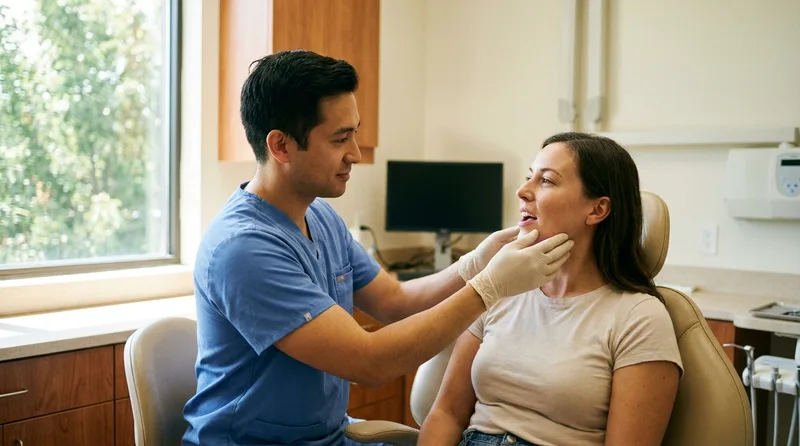
Dentists are often the first to spot TMD, because the signs show up in the mouth: worn edges, small cracks, tender chewing muscles, and a bite that's changed. An early look helps you avoid years of unnecessary discomfort and tooth damage.
Jaw discomfort isn't always TMD, either. A cracked tooth, a sinus problem, or an ear infection can feel similar. Part of the exam is ruling those out so you treat the right thing. It also helps to bring a list of medications and any past jaw injuries, since both can shape what your dentist looks for.
Ready to find out what's behind your jaw discomfort?
An exam, a bite assessment, and a conservative plan that starts with the simplest step likely to help.
Learn About TMJ Care →A TMJ evaluation starts with your history and symptoms, then a hands-on exam of your jaw joints and chewing muscles, a check of how far and how smoothly your jaw opens, and a look at how your teeth meet. X-rays or 3D imaging are added only if the exam suggests a joint problem.
Your dentist will ask when symptoms are worse, whether anyone has heard you grind at night, and what habits or stressors might be involved. They'll press gently on the muscles of your cheeks and temples, listen for clicking, and watch your jaw open and close.
At Peterborough Family Dental, understanding what's driving the discomfort comes before any treatment. If the picture points to the joint itself, or to something outside dentistry, we'll say so and coordinate a referral while staying involved in your care.
Members of our VIP Membership Plan also get a complimentary TMD consultation, which makes it easy to get answers early.
Dr. Muhammad Rahim and Dr. Jasper Ainslie both see patients with jaw concerns. If a night guard is recommended, a quick digital scan replaces messy impressions, and our in-house Formlabs 3D printers let us make many appliances right here in Peterborough, which means a precise fit and a faster turnaround.
Most TMJ disorders are treated conservatively first. Common options include custom night guards for grinding, self-care and habit changes, jaw exercises or physical therapy, and short-term medications. The NIDCR recommends avoiding treatments that permanently change the teeth, bite, or joint unless there's a clear reason.
Be cautious with anyone promising a quick fix. Many people get meaningful relief with simple care, and some symptoms settle over time, but there's no single treatment that works for everyone.
If jaw discomfort is part of your week, start with an exam. Learn more on our TMD and TMJ care page, or book a visit at our Peterborough office.
Results may vary. Please consult with your dentist at Peterborough Family Dental for personalized treatment recommendations.
Let's find out what your jaw is telling you
Book an exam and bite assessment at Peterborough Family Dental.
Request an Appointment →Prefer to talk it through first? Call our Peterborough office at (603) 924-3664.
Call (603) 924-3664 →
Dr. Muhammad Rahim, DMD
Dentist · Peterborough Family Dental & Implant Center
Peterborough, NH dentist providing gentle general, cosmetic, restorative, and implant dentistry for the whole family.
Was this article helpful?
Yes, often. The NIDCR notes that many TMDs last only a short time and resolve without treatment. Softer foods, warmth, and cutting habits like gum chewing help many people. If symptoms last more than a couple of weeks or keep returning, it's worth getting an exam.
Our Peterborough team is happy to answer questions and get you on the calendar.


