Back to all articlesDental Technology Dr. Muhammad Rahim, DMDNovember 15, 202610 min read
Laser Dentistry: What It Treats and What to Expect
Dr. Muhammad Rahim, DMDNovember 15, 202610 min read
Loading blog post
Dr. Muhammad Rahim, DMDNovember 15, 202610 min readCall and you'll reach a real person on our team: no phone tree, no hold music. We'd genuinely love to help.
(603) 924-3664Rather write to us? Contact us
Laser dentistry uses a focused beam of light to treat gum tissue with precision, and it can make some procedures calmer and quicker to heal. At Peterborough Family Dental & Implant Center in Peterborough, NH, we use a soft-tissue laser for frenectomy and gum treatment as part of our modern, comfort-focused dental care. It's a useful tool for specific jobs. It isn't a replacement for most of dentistry, and we'll tell you honestly which is which.
The word laser makes some people nervous and others overly hopeful. The truth sits in the middle. This guide explains what laser dentistry treats, what it feels like, where it falls short, and how to know whether it fits your situation.
You'll also see how a laser frenectomy works, what recovery looks like, and what to ask your dentist.
Laser dentistry uses a focused beam of light energy to treat teeth or gums, most often a soft-tissue laser used on gum tissue. The laser acts as a precise cutting instrument that also seals tissue as it works. It's a tool for certain procedures, not a general replacement for traditional dental instruments.
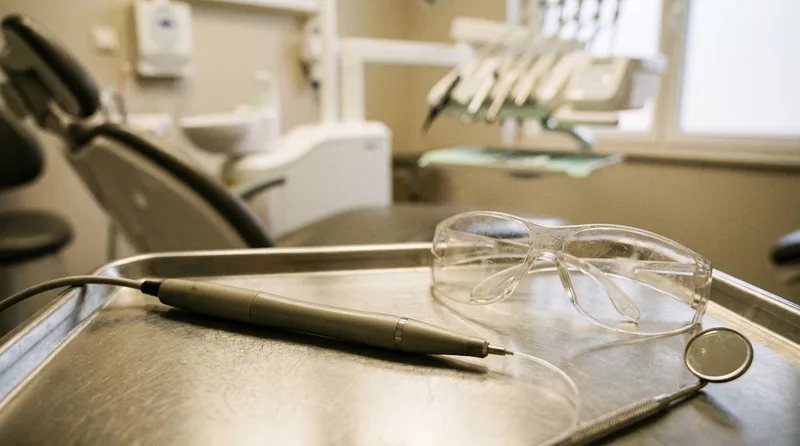
WebMD's overview of laser use in dentistry explains that all lasers work by delivering energy in the form of light, and that in surgical and dental procedures the laser acts as a cutting instrument or a vaporizer of the tissue it touches. It also notes that dental lasers have been in use since 1994.
Some people picture a laser as futuristic, and others picture it as a gimmick. In practice it's neither. It's a well-controlled heat source that can cut and seal soft tissue in a single step.
Different lasers suit different jobs. Our office uses a diode soft-tissue laser, which is designed for gum tissue. You can see how it fits with our other tools on our technology page.
A soft-tissue laser treats gum and other soft tissue, including frenectomy to release a tight frenum, and precise gum treatment and recontouring. It doesn't treat teeth themselves. Its strength is precision and control in the soft tissue around your teeth.
Gum recontouring is usually a cosmetic choice, while a frenectomy is usually a functional one. Knowing which category your concern falls into helps your dentist and your insurance plan discuss it clearly.
Uses vary from office to office, and what a given dentist treats with a laser depends on the equipment they own and the training they've had. Ask your dentist what their laser is used for.
Appearance can matter here. The American Academy of Cosmetic Dentistry reports that 99.7% of Americans believe a smile is an important social asset, and gum shape is part of how a smile looks.
A laser frenectomy releases a tight frenum, the small fold of tissue that connects your lip or tongue to your gums, using a soft-tissue laser instead of a scalpel. The area is numbed with local anesthetic, and many small releases need no stitches. Every case starts with an evaluation to confirm the release is truly needed.
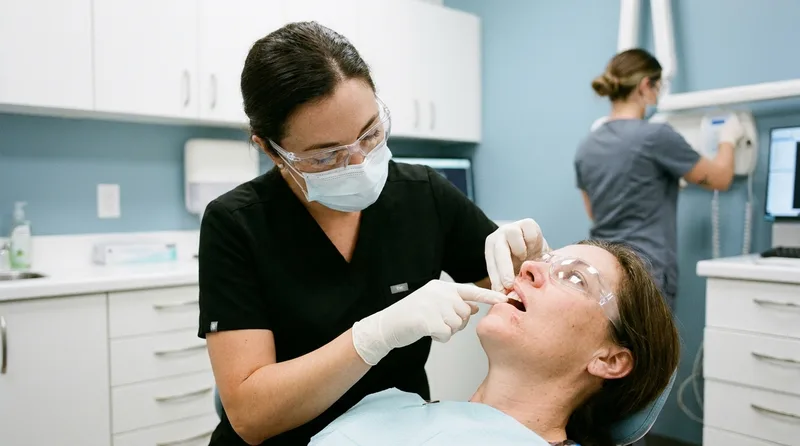
Everyone has frenums, and most cause no trouble. Releasing one only makes sense when it's tugging at the gums, disrupting a denture, or restricting movement of the tongue. Our frenectomy service page explains when it helps. If you wear a loose denture, a tight frenum can be part of the problem, as our guide to loose dentures explains.
One honest note. Infant and pediatric tongue-tie cases are referred to providers who focus on that care every day, since our practice serves a mostly adult patient base. If your baby needs an evaluation, we'll point you to someone experienced.
Wondering if a laser could help you?
Request an evaluation at our Peterborough office and we'll tell you honestly whether treatment makes sense.
Request an Appointment →Benefits of a soft-tissue laser include less bleeding, often no stitches for small releases, a precise treatment area, and quick healing for most patients. WebMD notes that lasers can minimize bleeding and swelling during soft-tissue treatments and may reduce anxiety for people uncomfortable with traditional instruments. They suit certain procedures well.
| Feature | Soft-tissue laser | Traditional scalpel |
|---|---|---|
| Bleeding | Less, because the laser seals tissue as it works | More, since tissue is cut with a blade |
| Stitches | Often not needed for small releases | More likely |
| Treatment area | Precise and conservative, so nearby tissue is left alone | Depends on the cut |
| Healing | Quick for most patients, with mild soreness for a few days | Varies with the size of the release |
Because the laser seals tissue as it works, bleeding is usually lighter than with a traditional scalpel release. A conservative treatment area leaves nearby tissue alone, and healing tends to be quick, with mild soreness for a few days.
WebMD also says lasers may cause less discomfort in some instances, which can reduce the need for anesthesia. In our office, the area is still numbed with local anesthetic, since comfort comes first.
Lasers can't be used on teeth with fillings already in place, and they aren't suited to many commonly performed dental procedures. WebMD also notes that no dental laser has received the ADA's Seal of Acceptance, although the ADA is cautiously optimistic about the technology. A laser is a better tool for some jobs, not a magic wand.
That honesty matters. You'll see offices that promise laser treatment for almost everything, and that isn't what the evidence supports. A laser is excellent for precise soft-tissue work, and traditional methods are still the right choice for many other procedures.
The right question isn't whether laser dentistry is better. It's whether a laser is the better tool for your specific problem. Sometimes the answer is yes. Sometimes it's no, and a good dentist will say so.
Not sure whether a laser is right for you?
Send us a note and our team will tell you what to expect for your situation.
Contact Our Office →Most patients find soft-tissue laser treatment comfortable because the area is numbed with local anesthetic, and nitrous oxide is available for nervous patients. You may feel pressure or warmth rather than sharp sensations. Soreness afterward is usually mild and lasts a few days.
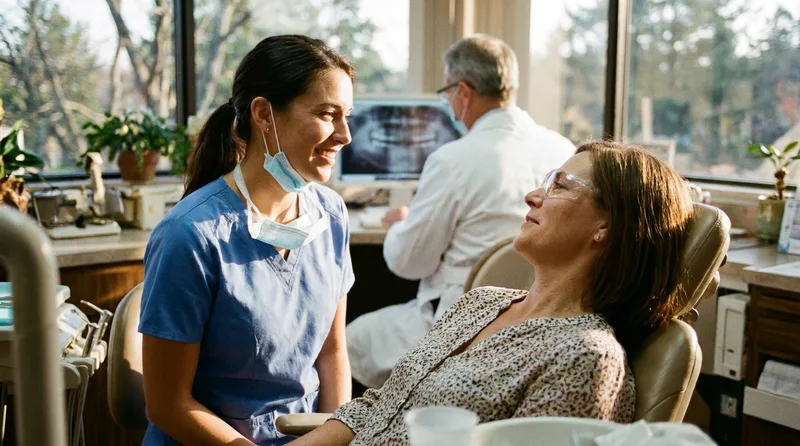
Nerves are normal. BMC Oral Health (2024) reports that 36% of Americans have dental anxiety and 12% have extreme dental fear, and the Journal of Dental Anesthesia reports that sedation dentistry has helped 75% of fearful patients keep up with regular visits. Our guide to sedation options explains your options, and our guide to what a dental implant feels like shows how we talk through each stage.
Warmth or mild pressure is common, and you can ask the team to pause at any point. Many patients are surprised by how quickly the procedure itself is over compared with the time they spent worrying about it.
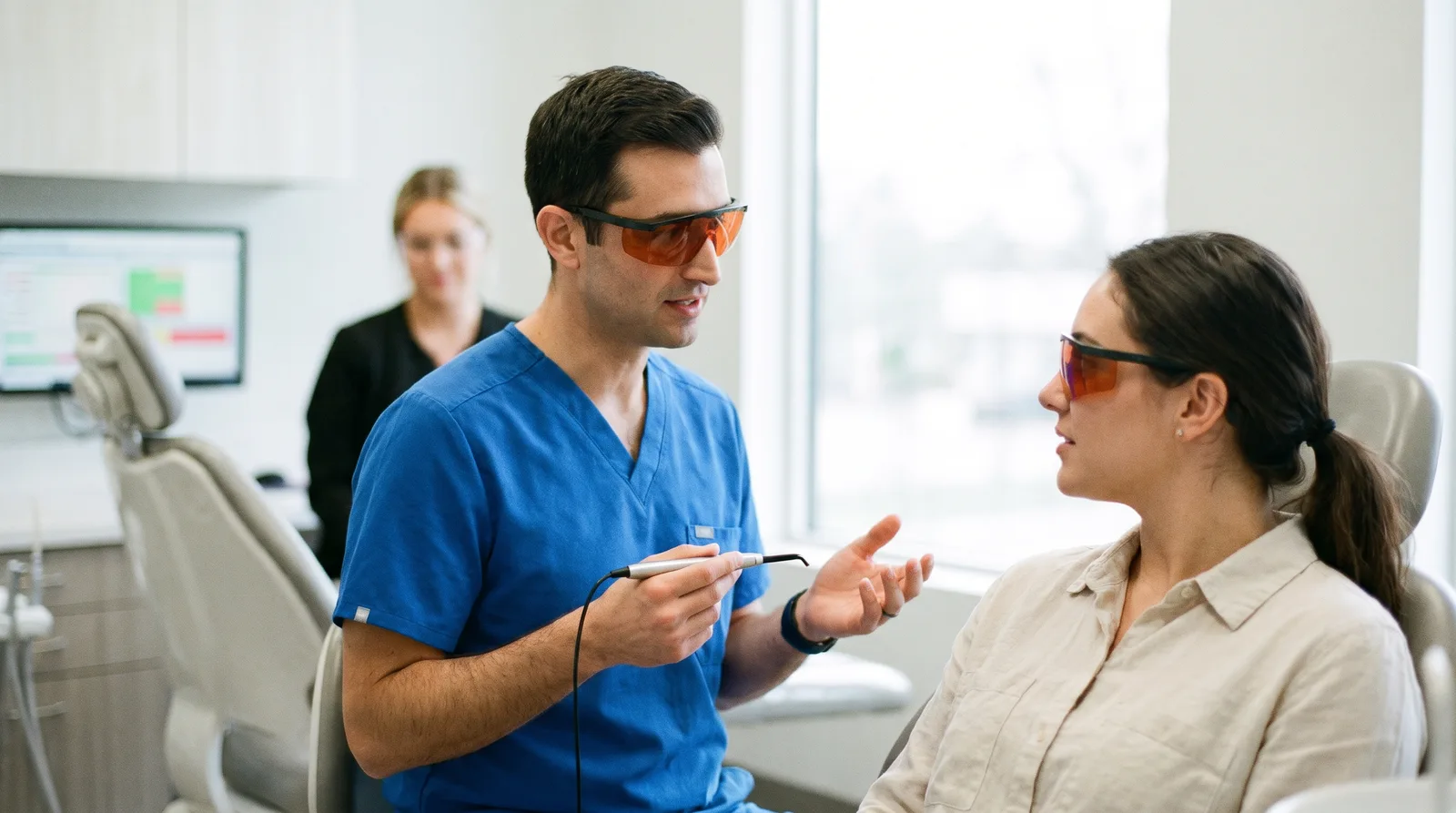
You'll wear protective eyewear during laser treatment, as the whole team does. It's a routine safety step, and it doesn't change how the procedure feels.
Expect mild soreness for a few days, soft foods at first, gentle cleaning around the area, and a quick return to normal routines. Most patients heal quickly after a laser release. Your dentist gives you written aftercare instructions and tells you when to call.
Soft foods and rest are the easiest way to manage mild soreness. Most people return to normal routines within a day or two, though the area can look different while it heals, with a whitish patch that fades as the tissue recovers.
Healing still takes a little patience, even though the laser makes the procedure gentler. Following your aftercare instructions is the most important thing you can do for a good result.
A soft-tissue laser can be used for precise gum treatment and recontouring, but gum disease usually needs an exam and a cleaning below the gumline first. The laser is one tool for reshaping gum tissue when your dentist finds it appropriate. It doesn't replace thorough cleaning and good home care.
The CDC reports that 42% of adults aged 30 and older have some form of periodontal disease, and the National Institute of Dental and Craniofacial Research describes it as an infection that can spread to the bones supporting the teeth. That's why your dentist starts with an exam and measurements, not with a tool.
If your gums bleed, start with our guide to bleeding gums, and see our gum disease treatment service for how we treat gum problems. Our guide to scaling and root planing explains the deeper cleaning that's often the first step. Regular visits help too. The Journal of Dental Research reports that people who see a dentist regularly are 60% less likely to lose teeth, and the ADA notes that regular visits can catch 80% of oral health issues before they become serious.
You're a good candidate if you have a tight frenum causing real problems, or gum tissue that needs precise reshaping, and an exam confirms a laser is appropriate. Most people with no soft-tissue problem don't need one. A short evaluation is the way to know.
Age isn't the main factor. Adults of any age can be candidates, and the question is whether the tissue is causing a real problem and whether a laser is a sensible way to treat it.
Bring your health history and a list of your medicines. Tell your dentist about any concerns, since the plan should fit you. If a laser isn't the right choice, you'll hear that plainly, along with what we'd recommend instead.
Book an evaluation if you think a tight frenum or your gum tissue may be causing a problem. A short exam shows whether a laser is the right tool, and you'll leave with a clear recommendation. If it isn't the right fit, we'll say so.
We welcome patients from Peterborough, Jaffrey, Dublin, Hancock, and across the Monadnock region, with early-morning hours from 7 AM Monday through Thursday. Bring your questions to Dr. Muhammad Rahim or Dr. Jasper Ainslie. If you request a time online, a real person from our team replies the same business day to confirm your visit.
Results may vary. Please consult with your dentist at Peterborough Family Dental for personalized treatment recommendations.
Find out if laser treatment fits
Request an appointment at Peterborough Family Dental & Implant Center for an honest evaluation and a clear plan.
Request an Appointment →Prefer to talk to someone first?
Call (603) 924-3664 →
Dr. Muhammad Rahim, DMD
Dentist · Peterborough Family Dental & Implant Center
Peterborough, NH dentist providing gentle general, cosmetic, restorative, and implant dentistry for the whole family.
Was this article helpful?
Most patients find soft-tissue laser treatment comfortable because the area is numbed with local anesthetic, and nitrous oxide is available for nervous patients. Some soreness for a few days afterward is typical, and your dentist explains what to expect.
Our Peterborough team is happy to answer questions and get you on the calendar.


