
Back to all articlesOrthodontics Dr. Muhammad Rahim, DMDNovember 15, 202611 min read
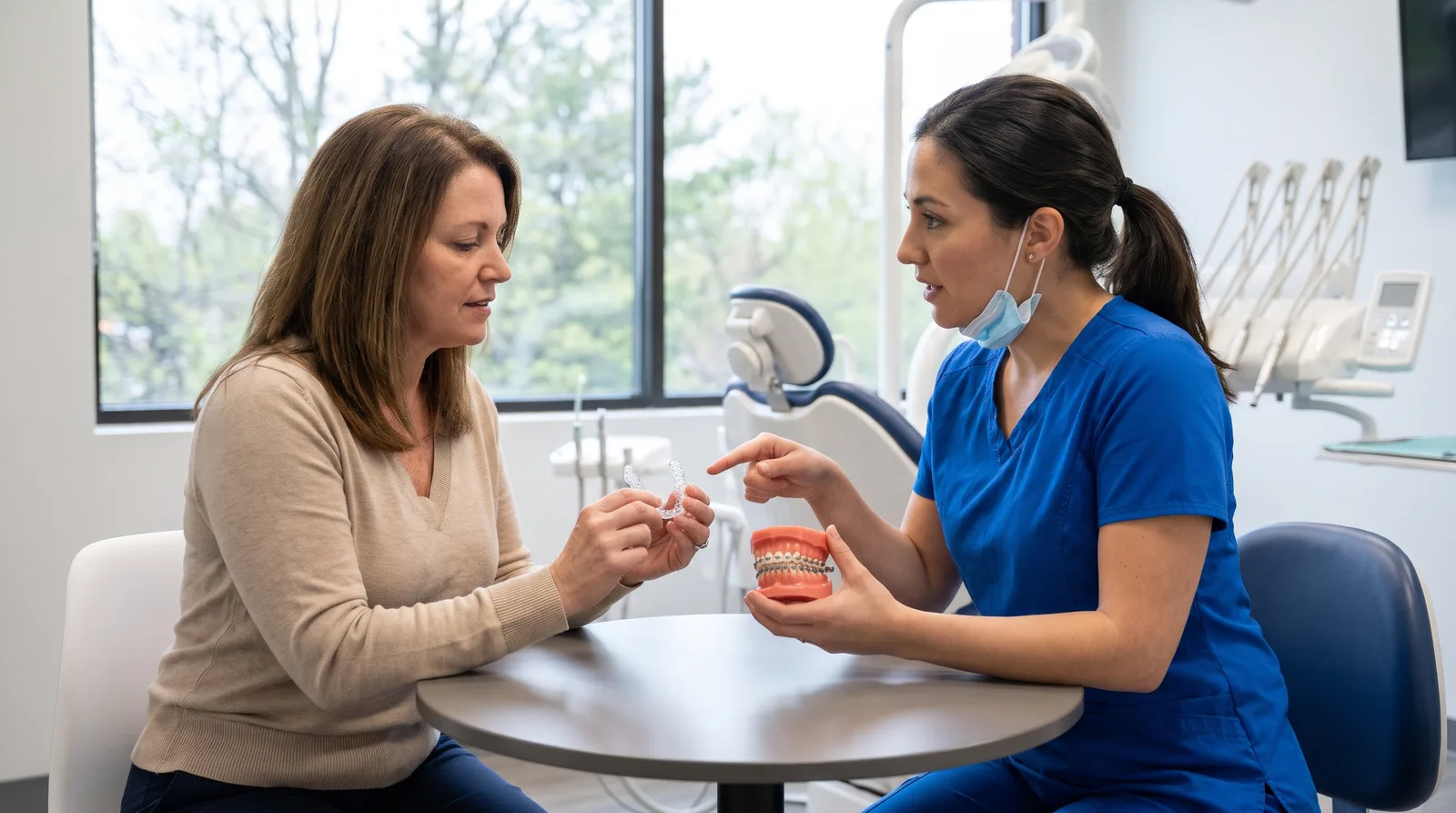
Invisalign vs Braces for Adults: Which Is Right for You?
Dr. Muhammad Rahim, DMDNovember 15, 202611 min read
Loading blog post
Dr. Muhammad Rahim, DMDNovember 15, 202611 min readCall and you'll reach a real person on our team: no phone tree, no hold music. We'd genuinely love to help.
(603) 924-3664Rather write to us? Contact us
Invisalign vs braces is the question almost every adult asks before straightening their teeth, and the honest answer is that both work. Which one fits you depends on your bite, your habits, and how visible you want treatment to be. At Peterborough Family Dental & Implant Center in Peterborough, NH, we offer both through our orthodontic care for adults and teens, so our advice isn't tilted toward one. You can see every option on our orthodontics page.
The American Academy of Cosmetic Dentistry reports that 99.7% of Americans believe a smile is an important social asset, and many adults finally act on that after years of putting it off. You're far from alone, and you're not too old.
This guide compares how each option looks, feels, and works, which cases suit each, and how to choose with confidence.
Invisalign uses a series of custom clear aligners that you wear and swap, while braces use brackets bonded to your teeth and connected by a wire that your dentist tightens over time. Both move teeth with gentle pressure. The big differences are visibility, removability, and which problems each handles.
The American Dental Association's guide to braces explains that traditional braces realign teeth by applying pressure, usually with small brackets cemented to the teeth and connected by a wire that is periodically tightened. The brackets may be metal or tooth colored. It also notes that, under a dentist's or orthodontist's supervision, removable aligners are another option.
Both approaches are well established, and many adults ask whether one is a shortcut. Neither is. They're two routes to the same result, chosen to match what your teeth need.
Think of it this way. Braces do the work on their own, all day and all night. Aligners do the work only when you wear them, which is nearly all the time, so they depend on you.
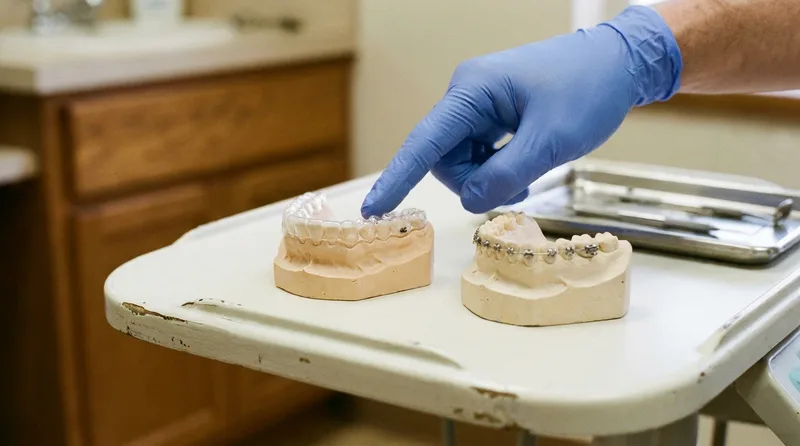
Clear aligners are discreet and removable, and they suit mild to moderate cases, while braces work around the clock and handle complex bites. Neither is better for every adult. The table below shows where each one stands on the points patients ask about most.
| Feature | Invisalign (clear aligners) | Braces |
|---|---|---|
| Appearance | Nearly invisible clear trays | Metal, tooth-colored ceramic, or self-ligating brackets |
| Removable | Yes, for eating, drinking, and cleaning | No, they stay on the whole time |
| Suits | Mild to moderate crowding, gaps, and bite issues | Simple and complex cases, including overbites, underbites, crossbites, and open bites |
| Wear time | About 22 hours a day | Always working, with no compliance needed |
| Visits | Fewer adjustment visits in many cases | Adjustments about every 4 to 6 weeks |
| Food rules | Take the trays out to eat | Avoid popcorn, corn on the cob, whole apples, gum, and sticky foods |
| Cleaning | Brush and floss normally, then clean the trays | Clean carefully around brackets and wires |
| After treatment | A retainer keeps teeth in place | A retainer keeps teeth in place |
Notice the trade-off. Aligners ask for discipline and offer freedom. Braces ask you to live with brackets and wires and offer certainty, since they're always working. The right one is the one you'll actually stick with, matched to what your teeth need.
Clear aligners are the least noticeable, because the trays are transparent and shaped to your teeth. Ceramic braces are the next least visible, with tooth-colored brackets. Metal braces are the most visible, though modern brackets are smaller and lower-profile than the braces you may remember.
Some adults choose the less visible option for work or social reasons, and others don't mind braces at all. Neither choice is wrong.
If looks matter most, tell us at your consultation. It's a legitimate priority, and it's one of the main reasons adults choose clear aligners.
Want a straighter smile without the guesswork?
Book a free smile consultation at our Peterborough office and we'll tell you honestly which option fits.
Request an Appointment →Braces handle more complex bites, including overbites, underbites, crossbites, open bites, and significant crowding or rotation. Clear aligners handle mild to moderate cases very well. The American Journal of Orthodontics reports that clear aligners can treat 90% of mild-to-moderate alignment issues.
The key phrase is mild to moderate. Aligners work well for crowded or overlapping teeth, gaps, mild to moderate bite problems, and teeth that drifted after earlier braces. For complex movement, braces apply continuous force that aligners may not match.
A scan and bite check at your consultation show which group you fall into. Many adults are surprised to learn their case is simpler than they feared, and some are surprised in the other direction.
The ADA explains why the bite matters beyond looks. Not correcting an abnormal bite could result in further problems, including tooth decay, gum disease, tooth loss, affected speech or chewing, abnormal wear to tooth enamel, and jaw problems. Your treatment is about health as much as appearance.
Treatment time depends on your case. The ADA says most people are in treatment for one to three years, our braces typically run 12 to 24 months, and many adults with mild to moderate cases finish aligner treatment in about a year. Your consultation gives you a realistic timeline for your own teeth.

Our guide to how long Invisalign takes covers the stages in more detail, and our guide to Invisalign attachments explains the small tooth-colored bumps that help aligners grip and move teeth.
Teeth can also move more slowly in adults, since adult bone is denser than a teenager's. Patience pays off, and consistency matters more than speed.
Be wary of anyone who promises an exact finish date before examining your teeth. Honest timelines come from a scan and an exam, not a brochure.
With aligners you remove the trays to eat, drink, and clean your teeth, and you wear them about 22 hours a day. With braces you eat around the brackets, avoid sticky and hard foods, and clean carefully around them. Both are very manageable once you settle into the routine.
Cleaning matters for your gums and teeth. The ADA notes that straight teeth are easier to clean, reducing the risk of cavities and gum disease by up to 30%. The CDC reports that 42% of adults aged 30 and older have some form of periodontal disease, so gum health deserves attention during treatment.
Not sure you'd keep up with aligners?
Send us a note and we'll talk honestly about which option suits your routine.
Contact Our Office →Clear aligners suit adults with mild to moderate crowding, gaps, or bite issues who can wear them most of the day, and braces suit adults with complex bites or anyone who wants treatment that works without relying on them. The ADA notes that healthy teeth can be treated at any age. Your teeth and gums should be healthy first.
Decay and gum disease should be treated before teeth are moved. If you have a cavity or bleeding gums, your dentist will address that first, since moving teeth over unhealthy gums causes problems.
Both options end with a retainer, because teeth naturally drift back toward their old positions without one. You usually wear it full time at first, then move to nights, and a few nights a week over time. Skipping the retainer is a common reason people need treatment again.

Our retainers service offers clear, fixed, and Hawley retainers, and we recommend the type that fits your teeth and your lifestyle. Some patients combine two types.
If you lose or break a retainer, don't wait to replace it. Teeth can begin to shift, and a quick replacement is far easier than correcting movement again.
Think of the retainer as part of treatment, not an add-on. The bone and tissue around your teeth need time to stabilize, and the retainer holds your teeth in place while that happens.
Questions about which option fits?
Call our Peterborough office and we'll walk through how each option would work for your teeth.
Call (603) 924-3664 →Cost depends on your case and the option you choose, and many plans cover orthodontic treatment for braces and aligners alike, subject to limits. FSA and HSA funds can often be used, and CareCredit financing and monthly payments can spread out the cost. A free consultation gives you a written plan with estimates.
Ask what's included in any quote: retainers, follow-up visits, and refinements. A clear written plan helps you compare Invisalign vs braces fairly, instead of comparing only the starting price.
If you already have a quote from another office, bring it. We offer a free second opinion and match the price on comparable care. You'll never be asked to decide on the spot.
Book a free smile consultation and bring your questions. You'll see your own teeth, hear honestly whether aligners or braces suit your case, and leave with a plan and a timeline. The ADA's overview of orthodontics also explains what orthodontists treat, if you'd like to read more first.
Here's what a consultation looks like.
Nerves about starting are normal. BMC Oral Health (2024) reports that 36% of Americans have dental anxiety, and the Journal of Dental Anesthesia reports that sedation dentistry has helped 75% of fearful patients keep up with regular visits. Regular care matters too. The Journal of Dental Research reports that people who see a dentist regularly are 60% less likely to lose teeth, and the ADA notes that regular visits can catch 80% of oral health issues before they become serious.
We welcome patients from Peterborough, Jaffrey, Dublin, Hancock, and across the Monadnock region, with early-morning hours from 7 AM Monday through Thursday. Bring your questions to Dr. Muhammad Rahim or Dr. Jasper Ainslie. If you request a time online, a real person from our team replies the same business day to confirm your visit.
Results may vary. Please consult with your dentist at Peterborough Family Dental for personalized treatment recommendations.
Find out which option fits your smile
Request a free smile consultation at Peterborough Family Dental & Implant Center and get an honest recommendation and a clear plan.
Request an Appointment →Prefer to talk to someone first?
Call (603) 924-3664 →
Dr. Muhammad Rahim, DMD
Dentist · Peterborough Family Dental & Implant Center
Peterborough, NH dentist providing gentle general, cosmetic, restorative, and implant dentistry for the whole family.
Was this article helpful?
It depends on the case. Many adults with mild to moderate issues finish aligner treatment in about a year, while braces typically run 12 to 24 months at our office. The ADA notes most people are in treatment one to three years, so your plan sets the real timeline.
Our Peterborough team is happy to answer questions and get you on the calendar.


