
Back to all articlesPediatric Dentistry Dr. Muhammad Rahim, DMDOctober 11, 20269 min read
Does Vaping Affect Your Teeth? A Guide for Parents of Teens
Dr. Muhammad Rahim, DMDOctober 11, 20269 min read
Loading blog post
Dr. Muhammad Rahim, DMDOctober 11, 20269 min readCall and you'll reach a real person on our team: no phone tree, no hold music. We'd genuinely love to help.
(603) 924-3664Rather write to us? Contact us
Does vaping affect your teeth? Yes, it can. Vape aerosol isn't harmless water vapor. It can contain nicotine, sweet flavorings, and other chemicals that are linked to a higher risk of cavities, gum problems, dry mouth, and staining. For teens, whose habits are still forming, those effects can build up quickly.
This guide is for parents. It covers what vaping does in the mouth, what the research shows, the signs a dentist might notice, and how to talk with your teen about it. You can also browse all of our dental services to see the care we offer families.
Worried about your teen's oral health?
Dr. Muhammad Rahim and Dr. Jasper Ainslie talk with teens openly and without judgment, and can check for early signs of decay and gum irritation at every visit.
Request an Appointment →Yes. Vaping can raise the risk of cavities, gum irritation, dry mouth, and stained teeth. According to the ADA, vape cartridges can contain sugary flavorings that feed decay, along with heavy metals and other harmful compounds. A 2022 study in The Journal of the American Dental Association linked vaping to higher cavity risk.
The ADA's guide to vaping also notes that high heat settings can make the aerosol more yellow and stickier, which may help it cling to teeth and cause discoloration. Researchers are still studying whether that sticky residue directly contributes to cavities.
It's worth being clear about what's known and what isn't. Vaping is still fairly new compared with cigarettes, so long-term data on teeth and gums is limited. But the early evidence points in one direction, and it isn't a good one.
The ADA's position is that marketing vaping as a "less harmful" option isn't a sound strategy for preventing disease. For a teen's mouth, the safest amount is none.
Research suggests people who vape have a higher risk of cavities. A 2022 JADA study by Irusa and colleagues reviewed records from more than 13,000 dental patients and found 79.1% of those who vaped were rated high cavity risk, compared with 59.6% of those who didn't. The study showed an association, not proof of cause.
You can read the abstract of the 2022 JADA study on vaping and cavity risk on PubMed. Of the 13,216 patient records included, 136 people reported vaping. Only 6.6% of the vaping group were rated low risk, compared with 14.5% of the non-vaping group.
79.1%
of patients who vaped were rated high cavity risk
Source: JADA, 2022
59.6%
of patients who didn't vape were rated high risk
Source: JADA, 2022
5.9%
of middle and high school students use e-cigarettes
Source: 2024 National Youth Tobacco Survey, via ADA
The authors recommended that dentists ask about vaping as part of routine cavity risk checks. That's a good reason to be honest about vaping at dental visits, even if it feels awkward.
Sweet vape flavors can be bad for teeth because some contain sugars that feed the bacteria responsible for decay. The ADA lists flavorings that contain sugar among the harmful substances found in vape cartridges. Fruity and candy-like flavors are especially popular with teens, which makes this a real concern for parents.
Think of it like sipping a sugary drink slowly all day. It isn't one big dose that does the damage. It's the frequent, repeated exposure that keeps the mouth in an acidic state, giving enamel little time to recover between puffs.
Add dry mouth to that picture and the risk grows. Saliva is the mouth's natural defense, washing away sugars and helping repair early enamel damage. When vaping dries the mouth, that defense weakens.
A few habits can reduce the damage while a teen works toward quitting:
None of these make vaping safe for teeth. They simply lower the risk while the bigger goal, quitting, is underway.
Vaping can dry out the mouth, irritate the gums, and expose the mouth to nicotine and other chemicals. The ADA says nicotine products are linked to higher rates of gum disease, bone damage, and tooth loss. A dry mouth also means less saliva to rinse away food and neutralize the acids that cause decay.
Here's how vaping can affect the mouth beyond cavities:
Nicotine levels matter too. The ADA cites a study showing average nicotine strength in e-cigarettes rose from 1.7% to 5% over five years, and even cartridges labeled nicotine-free have been found to contain some.
Nicotine is highly addictive and affects brain development in children, teens, and young adults, according to the ADA. That makes vaping a whole-body concern, not just a dental one.
Gum problems can also be harder to spot in nicotine users. Smoking is known to hide some of the usual warning signs, like bleeding gums, and nicotine from vaping may have a similar effect. That's one more reason a professional exam matters, even if your teen says their gums feel fine.
Vaping is the most common form of nicotine use among US teens. The 2024 National Youth Tobacco Survey, cited by the ADA, found 5.9% of middle and high school students use e-cigarettes, compared with 1.8% who use nicotine pouches and 1.4% who smoke cigarettes. More than 1 in 4 teen vapers use them daily.
That daily figure, 26.3% of youth e-cigarette users, is what concerns dentists most. A daily habit means daily exposure to sugary flavorings, nicotine, and dry mouth, often without good brushing afterward.
| Product | Share of middle and high school students using it |
|---|---|
| E-cigarettes | 5.9% |
| Nicotine pouches | 1.8% |
| Cigarettes | 1.4% |
Among adults, the ADA notes about 8% of people in the US use e-cigarettes, with the biggest increases among ages 18 to 24. Habits started in high school often carry into college and beyond.
Nicotine pouches deserve a mention too. They sit against the gums, and any nicotine product can affect gum health. If your teen uses them, it's worth mentioning at their dental visit as well.
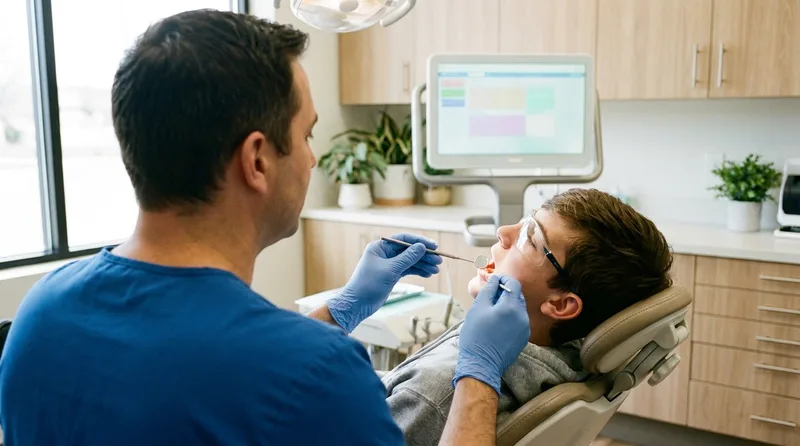
A dentist may notice new cavities, especially along the gumline, red or puffy gums, dry mouth, staining, or bad breath. These signs don't prove someone vapes, but together they can prompt a private, judgment-free conversation. The ADA encourages dentists to screen patients for nicotine use and offer help quitting.

For parents, the signs at home can be different. You might notice a sweet, fruity smell with no obvious source, unfamiliar USB-like devices or chargers, more thirst than usual, or complaints of a sore mouth or throat.
A dental visit can be a helpful, neutral space. Teens sometimes find it easier to hear health information from a dentist than from a parent, especially when the focus is on facts rather than blame.
If your teen is willing, let them have a few minutes alone with the dentist. That privacy often leads to a more honest conversation, and it builds the habit of managing their own health as they grow up.
Start with calm, curious conversation rather than punishment. Share what you've learned about how vaping affects teeth and health, listen to why your teen vapes, and offer support to quit. Free resources like smokefree.gov and 1-800-QUIT-NOW, recommended by the ADA, can help teens and parents make a plan.
These steps can help:
In the meantime, protect their teeth. Encourage brushing twice a day with fluoride toothpaste, drinking water to fight dry mouth, and keeping up with dental checkups. The ADA recommends a soft-bristled brush and brushing for two minutes each time.
Expect setbacks. Nicotine is addictive, and many people need more than one attempt to quit for good. Praise every step forward, and treat a slip as information about triggers rather than a failure. Teens who feel supported are more likely to keep trying.
Also store any nicotine products out of reach of younger children. The ADA warns that nicotine is toxic if swallowed and can cause serious illness.
We treat teens with respect and keep conversations about vaping private and judgment-free. At each visit, we check for early decay, gum irritation, and dry mouth, explain what we see in plain language, and share practical tips. If a teen wants to quit, we point them to free support and cheer them on.

Teens have their own dental needs, from sealants and sports mouthguards to wisdom teeth checks. Our children's dental care by age guide covers what to expect through the teen years.
If gums are already irritated or bleeding, early care makes a big difference. Our gum disease treatment starts with a gentle evaluation and a clear plan.
So, does vaping affect your teeth? The research says it likely does, through cavities, gum irritation, dry mouth, and staining. Keep the conversation open, keep up with checkups, and lean on your dental team for support.
Results may vary. Please consult with your dentist at Peterborough Family Dental for personalized treatment recommendations.
Judgment-free care for teens
Book your teen's checkup and we'll check for early signs of trouble and talk openly about healthy habits. Call (603) 924-3664 or request a visit online.
Book a Teen Checkup →
Dr. Muhammad Rahim, DMD
Dentist · Peterborough Family Dental & Implant Center
Peterborough, NH dentist providing gentle general, cosmetic, restorative, and implant dentistry for the whole family.
Was this article helpful?
It can. Even nicotine-free vapes can contain sugary flavorings and chemicals that may contribute to decay, dry mouth, and staining. The ADA also notes that some cartridges labeled nicotine-free have been found to contain nicotine, so the label isn't always reliable.
Our Peterborough team is happy to answer questions and get you on the calendar.


