
Back to all articlesDental Implants Dr. Muhammad Rahim, DMDOctober 12, 20269 min read
All-on-4 Dental Implants: Full-Arch Restoration Explained
Dr. Muhammad Rahim, DMDOctober 12, 20269 min read
Loading blog post
Dr. Muhammad Rahim, DMDOctober 12, 20269 min readCall and you'll reach a real person on our team: no phone tree, no hold music. We'd genuinely love to help.
(603) 924-3664Rather write to us? Contact us
If you're missing most or all of your teeth, the traditional answer has long been a removable full denture. All-on-4 dental implants take a different path. A full arch of fixed replacement teeth sits on just four implants, with no suction or adhesive holding it in place.
It's one of the dental services we provide in Peterborough. This guide explains how the technique works, who it suits, what the procedure involves, and how it compares to traditional dentures and other full-arch options.
At Peterborough Family Dental & Implant Center, Dr. Muhammad Rahim, DMD, and Dr. Jasper Ainslie, DDS, provide full-arch restoration for patients in Peterborough and across the Monadnock region, including Jaffrey, Dublin, Hancock, and Greenfield.
It's one of several implant treatments we offer, alongside single implants and implant-supported dentures.
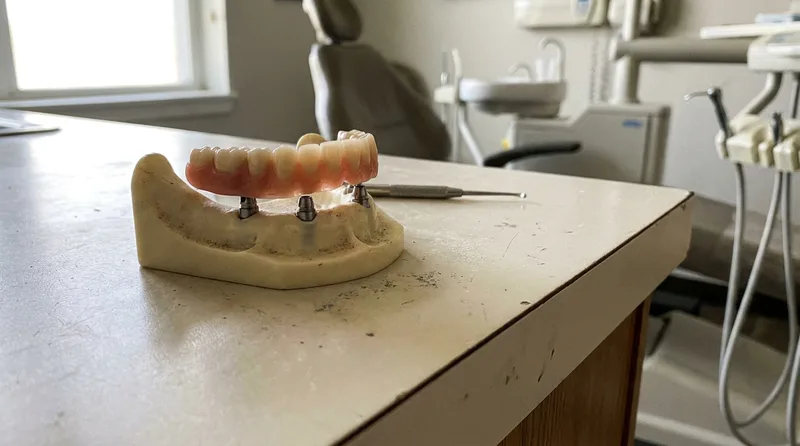
All-on-4 is a full-arch implant technique that anchors a complete set of replacement teeth on four implants. It can restore the upper jaw, the lower jaw, or both, and most patients leave surgery day with temporary fixed teeth.
Two implants go straight in at the front of the arch, and two angle toward the back. That spread carries the biting load across a wider base. So a full row of teeth needs four posts, not one for every missing tooth.
The resulting restoration is a fixed prosthesis, meaning it does not come out for cleaning the way a denture does. It looks and works far more like natural teeth than a removable appliance. Patients often say they eat, speak, and smile with a confidence their old denture never gave them. The procedure gets its name from this core design principle: all teeth on four implants.
All-on-4 was developed in part to address the problem of bone loss. People who have been missing teeth for years often lack the bone for traditional full-arch placement. That approach needs an implant at each tooth position. The angled back implants grip the denser bone further forward in the jaw. Often, that makes extensive bone grafting unnecessary.
All-on-4 dental implants differ from traditional full dentures in three fundamental ways: they are fixed rather than removable, they preserve jawbone rather than allowing it to continue shrinking, and they deliver a biting force much closer to natural teeth. These differences translate directly into quality of life for patients who make the switch.
A traditional full denture rests on the gum surface and relies on suction, a tight fit, or adhesive for retention. Over time, as the bone beneath continues to resorb, the fit changes and the denture becomes loose. Eating hard foods, laughing, or coughing can dislodge it. Patients often restrict their diet to accommodate the denture rather than the other way around.
A fixed full-arch bridge is anchored to implants that integrate directly with the jawbone. It does not move. Biting forces are transmitted into the bone the way natural tooth roots do, which helps maintain the bone volume rather than allowing continued resorption.
Patients with a fixed full arch typically regain the ability to eat a normal diet, including foods they had given up with a denture. The ADA's MouthHealthy resource describes implant-supported teeth as the closest option to natural teeth. That holds for both function and bone preservation.
Up to 90%
of natural chewing power can be restored with implant-supported teeth
Source: AAID
| Factor | Removable Full Denture | All-on-4 |
|---|---|---|
| Stays in place | Removed nightly, can shift | Fixed, cleaned in the mouth |
| Jawbone | Bone continues to resorb | Implants stimulate the bone |
| Chewing | Limited with harder foods | Close to natural function |
| Palate coverage | Upper denture covers the palate | Palate stays open, taste is unaffected |
Related: Wearing dentures now? This guide explains how years of denture wear affect implant candidacy. Implants after wearing dentures →
Good candidates are patients missing all or most of their teeth in one or both arches, or those whose remaining teeth are in a condition that makes keeping them impractical.
They should be in reasonable general health with no uncontrolled systemic disease. Enough bone in the front of the jaw matters most. The technique is built to use that front-jaw bone when the back of the arch has shrunk.
Were you told bone loss rules out traditional full-arch implants? You may still qualify here. The angled design was created to work around thin bone. A 3D cone-beam CT scan at the consultation shows exactly how much bone you have. It also shows whether any grafting is needed.
A few factors need extra evaluation first. Uncontrolled diabetes slows healing. Heavy smoking raises the risk of implant failure. And active gum disease in remaining teeth should be treated before surgery. None of these is an automatic disqualifier, but they affect the planning and timing of the procedure.
⚠ Mention these at your consultation
None of these rules you out, but each one changes the plan or the timing:
Age is rarely a barrier on its own. Healthy adults in their 60s, 70s, and beyond are often excellent candidates. Bone quality and general health matter far more than the number of birthdays.
The All-on-4 procedure usually runs in four stages: a consultation with 3D imaging, surgery day, a healing phase, and the final bridge. On surgery day, any remaining teeth come out, the four implants go in, and a temporary fixed bridge is attached before you leave.
Here is what the process looks like from start to finish:
Patients often call surgery day the biggest moment. They arrive with failing teeth or none at all. They leave with a full, fixed smile.
That works because the implants are placed with enough stability to bear a load right away. The temporary bridge also protects them while they heal, without giving up function or looks.

All-on-4 implants are designed to last for decades when they're placed well and cared for. A 2019 systematic review in the Journal of Dentistry reported 10-year implant survival of about 96%, and All-on-4 studies show similar long-term results.
The bridge on top of the implants may need refinishing or replacing after years of normal wear. Any dental restoration does, eventually. The implants themselves, once integrated, rarely fail without a significant external cause such as severe infection or trauma. Most patients who maintain their oral health and attend regular checkups keep their restorations functioning well for many years.
Success rates are influenced by the same factors that affect all implant outcomes: smoking, diabetes management, oral hygiene habits, and regular professional maintenance. Patients who commit to their cleaning routine and follow-up appointments protect their investment over the long term.
A fixed full arch is cleaned differently from a removable denture but still require a consistent daily routine to stay healthy. The bridge doesn't come out, so cleaning means reaching under and around it. Plaque left on the gums and implant surfaces can lead to peri-implant infection.
That risk is real. A 2015 systematic review in the Journal of Clinical Periodontology estimated that about 22% of implant patients develop peri-implantitis, a gum and bone infection around the implant. Daily cleaning and regular checkups are the best protection.
Your daily full-arch care kit
The cleaning routine is simpler than many patients expect, but it does require more attention than brushing natural teeth. The dentist and hygienist will demonstrate the technique at the delivery appointment and provide the right tools for the patient's specific prosthesis design.

All-on-4 dental implants are the right choice for patients who are missing all or most of their teeth and want a fixed, non-removable restoration that feels and functions like natural teeth. They suit people with major bone loss especially well. That includes anyone told they'd need extensive grafting for conventional full-arch implants.
The main alternative is a conventional full-arch restoration on six to eight implants. It spreads forces across more points. But it needs more bone, and often more grafting when bone is thin. A consultation with 3D imaging is the only reliable way to determine which approach fits a patient's specific anatomy and goals.
Not everyone needs a fixed bridge. An implant overdenture snaps onto two to four implants and comes out for cleaning, like a denture that can't slip. The McGill consensus statement, published in 2002, recommends a two-implant overdenture as the minimum standard of care for a lower jaw with no teeth.
So which fits you? A fixed full arch feels most like natural teeth and never comes out. An overdenture usually costs less, needs fewer implants, and is easier to clean. Your bone, budget, and how you feel about removing your teeth at night all shape the answer.
To schedule a consultation at Peterborough Family Dental & Implant Center, call (603) 924-3664 or use our contact page. The team at 21 Grove Street in Peterborough, NH can walk you through what treatment would look like for your situation.
Keep reading
Results may vary. Please consult with your dentist at Peterborough Family Dental for personalized treatment recommendations.
Ready to explore All-on-4?
Book a consultation at Peterborough Family Dental & Implant Center. Dr. Rahim and Dr. Ainslie will review your bone volume, explain your options, and tell you honestly whether it fits.
Request a Consultation →
Dr. Muhammad Rahim, DMD
Dentist · Peterborough Family Dental & Implant Center
Peterborough, NH dentist providing gentle general, cosmetic, restorative, and implant dentistry for the whole family.
Was this article helpful?
All-on-4 is a full-arch dental implant technique that uses four implants per arch to support a complete set of fixed replacement teeth. Two implants are placed straight at the front and two are angled toward the back to maximize bone contact and allow same-day delivery of a fixed temporary prosthesis.
Our Peterborough team is happy to answer questions and get you on the calendar.


