
Back to all articlesOral Health Tips Dr. Muhammad Rahim, DMDOctober 11, 202610 min read
Sleep Apnea Treatment in Peterborough, NH: Oral Appliances
Dr. Muhammad Rahim, DMDOctober 11, 202610 min read
Loading blog post
Dr. Muhammad Rahim, DMDOctober 11, 202610 min readCall and you'll reach a real person on our team: no phone tree, no hold music. We'd genuinely love to help.
(603) 924-3664Rather write to us? Contact us
If you're researching sleep apnea treatment options, you may have heard that a dentist can help. It's true. For many people with mild-to-moderate obstructive sleep apnea, a custom oral appliance offers a comfortable alternative to a CPAP machine.
Sleep apnea is more than loud snoring. It's a condition where breathing repeatedly pauses during sleep, which can leave you exhausted and, over time, raise the risk of serious health problems. Many people live with it for years without knowing.
This guide explains the dental side of sleep apnea: how oral appliances work, who they suit, how they compare to CPAP, and where a dentist fits into your care. One thing to know upfront: a sleep physician diagnoses sleep apnea, and a dentist provides the appliance as part of your team.
Wondering if an oral appliance could help you sleep?
Peterborough Family Dental & Implant Center fits custom oral appliances for patients across the Monadnock region.
Request an Appointment →This is one of the dental services offered at Peterborough Family Dental & Implant Center in Peterborough, NH.
Sleep apnea is a disorder in which breathing repeatedly stops and starts during sleep. The most common form, obstructive sleep apnea, happens when soft tissue at the back of the throat relaxes and blocks the airway. In a single night, these breathing pauses can occur dozens or even hundreds of times. Each pause pulls you out of deep sleep, often without you realizing it.
It's also more common than most people think. Using Wisconsin Sleep Cohort data, a 2013 study in the American Journal of Epidemiology estimated moderate to severe sleep apnea in 10% of men ages 30 to 49 and 17% of men ages 50 to 70, along with 3% of women ages 30 to 49 and 9% of women ages 50 to 70.
The signs are easy to miss or dismiss. Loud snoring, gasping awake, morning headaches, and daytime exhaustion are common. A partner often notices the breathing pauses before the person does. According to the ADA's overview of sleep apnea and snoring, snoring is common among people with sleep apnea, though not everyone who snores has the condition.
Common signs worth paying attention to include:
Why it matters goes beyond feeling tired. In obstructive sleep apnea, each breathing pause typically lasts 10 seconds or more, according to clinical guidance from the NIH, and repeated pauses strain the body over time. Left unmanaged, sleep apnea is linked to high blood pressure, heart strain, and other health concerns.
The CDC recommends that adults get at least 7 hours of sleep a night, and untreated apnea makes that restorative rest hard to reach. That's why proper diagnosis matters. If you suspect sleep apnea, effective treatment starts with talking to a physician, who may order a sleep study to confirm it.
Oral appliance therapy uses a custom-fitted device, worn like a mouthguard during sleep, to keep your airway open. It gently holds the lower jaw slightly forward, which prevents the soft tissue at the back of the throat from collapsing and blocking airflow.
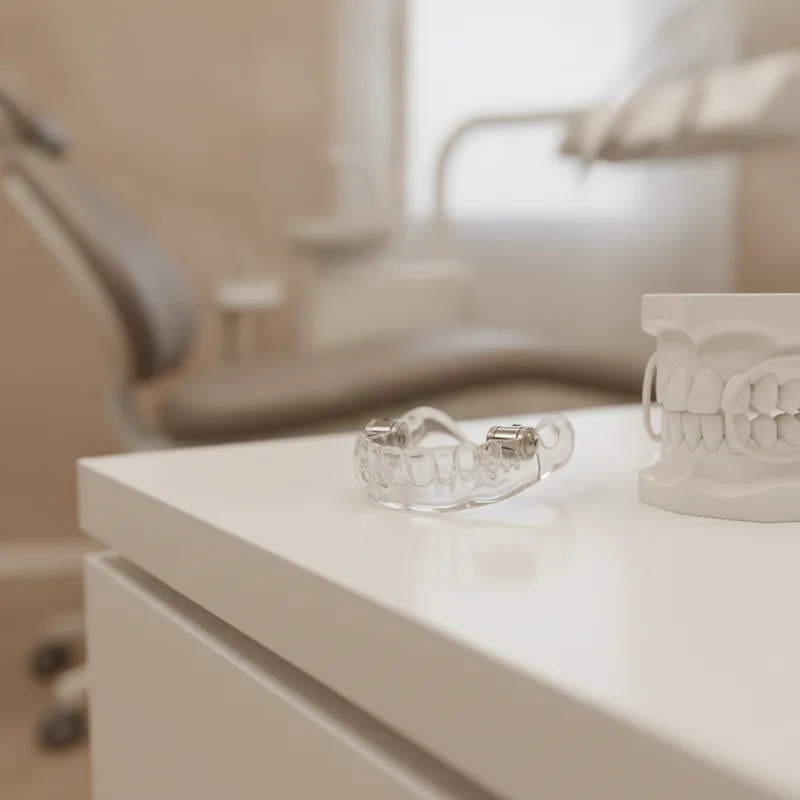
The most common type is a mandibular advancement device. It fits over your upper and lower teeth and connects them so the jaw stays in a forward position overnight. By maintaining that position, the appliance keeps the airway open without forcing air in, the way a machine does. Many are adjustable, so the fit can be fine-tuned for comfort and effect.
Why does jaw position make such a difference? During sleep, the muscles in your throat relax. In obstructive sleep apnea, that relaxation lets the tongue and soft tissue fall back and block the airway. Holding the jaw slightly forward pulls those tissues forward too, leaving the airway clear so air can move freely while you sleep.
It helps to set expectations clearly:
Dentists often spot the signs first, because grinding and worn enamel travel with disordered breathing. According to the CDC, 42% of adults aged 30 and older have some form of periodontal disease, and chronic mouth breathing makes that harder to control.
Good candidates for oral appliance therapy usually have mild-to-moderate obstructive sleep apnea, or struggle to tolerate a CPAP machine. People who primarily snore may also benefit. A sleep physician's diagnosis and recommendation come first, before a dentist fits any appliance.
A 2015 clinical practice guideline from the American Academy of Sleep Medicine and the American Academy of Dental Sleep Medicine recommends that sleep physicians consider oral appliances for adults with obstructive sleep apnea who can't tolerate CPAP or prefer another option. It also suggests a custom, adjustable appliance made by a qualified dentist over store-bought devices. Oral appliances can manage sleep apnea successfully in many mild-to-moderate cases, which makes them a valuable option for people who find CPAP uncomfortable or hard to keep up with. The NIH outlines several treatment paths, and for severe sleep apnea, CPAP or other medical treatment is often still the recommended approach, sometimes alongside an appliance.
Here's the key point. The decision isn't made by a dentist alone. After a sleep study, your physician determines the severity and the right treatment path. If an oral appliance fits that plan, that's where a dentist steps in to design and fit it. The two roles work together.
A few personal factors also shape whether an appliance is a good fit. You'll need enough healthy teeth to anchor the device, and your dentist will check your jaw joints and bite before recommending one. People with significant gum disease or certain jaw conditions may need those addressed first. A short evaluation sorts this out before anything is made.
Related: Explore the full range of care our team provides for healthy smiles and better sleep. See our dental services →
CPAP and oral appliances both treat sleep apnea, but in different ways. CPAP uses a machine and mask to push a steady stream of air that keeps the airway open. An oral appliance repositions the jaw to hold the airway open. CPAP suits all severities; appliances suit milder cases and CPAP-intolerant patients.
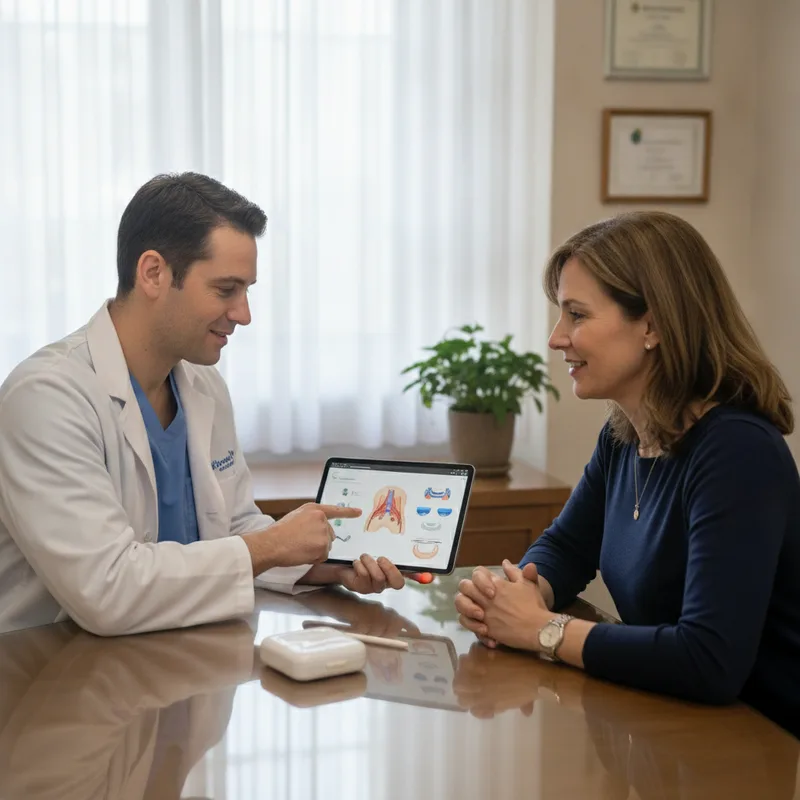
For many people, the difference comes down to comfort and consistency. A treatment only works if you actually use it every night. CPAP is highly effective, but some find the mask and noise hard to live with. An oral appliance is small and quiet, which can make nightly use easier to sustain.
| Feature | Oral appliance | CPAP machine |
|---|---|---|
| How it works | Repositions the jaw to open the airway | Pushes pressurized air through a mask |
| Best suited for | Mild-to-moderate cases, CPAP intolerance | All severities, including severe |
| Portability | Small, easy to travel with | Bulkier, needs power |
| Fitted by | A trained dentist | Prescribed by a physician |
Neither option is better across the board. The right choice depends on the severity of your condition and what you'll realistically stick with. That's a conversation for you, your physician, and your dentist together, guided by your sleep study results.
Some people use both. It's not unusual to rely on CPAP at home and keep an oral appliance for travel, when carrying a machine isn't practical. Others start with CPAP and move to an appliance once their physician confirms their case allows it. The goal is consistent, effective treatment, not loyalty to one device.
Already diagnosed and exploring an oral appliance?
A consultation at Peterborough Family Dental can help you understand whether a custom appliance fits your care plan.
Request an Appointment →Getting an oral appliance starts after a sleep apnea diagnosis from your physician. The dentist takes digital scans or impressions of your teeth, designs a custom appliance, and fits it. Follow-up visits fine-tune the fit, and your physician confirms the treatment is working.
The process is straightforward and comfortable. There's no surgery and no recovery time. Once your appliance is ready, the dentist makes sure it fits well and shows you how to wear and care for it. Because many devices are adjustable, small changes can improve both comfort and results over the first few weeks.
From start to finish, the journey usually looks like this:
Ongoing follow-up matters. You'll check in periodically so the dentist can monitor fit and your physician can confirm your sleep has improved, sometimes with a follow-up sleep study. This team approach is what keeps the treatment safe and effective over time.
According to the ADA, regular dental visits catch 80% of oral health issues before they become serious. Sleep-related grinding and airway signs are among the things that surface at a routine exam long before a patient thinks to raise them.
Peterborough Family Dental & Implant Center provides custom oral appliance therapy as part of complete family dental care in Peterborough, NH. The team works alongside your physician, using precise digital scanning to design an appliance that fits comfortably and does its job through the night.
Comfort and convenience shape the experience. Dr. Muhammad Rahim, DMD and Dr. Jasper Ainslie, DDS take a gentle, patient-focused approach and keep early-morning hours for busy schedules. The practice serves families and adults across the Monadnock region, including Jaffrey, Dublin, and Hancock.
Having your appliance care close to home, with a team that knows your dental history, makes follow-up far easier. Coordinated care between your dentist and physician is what turns a device into real, lasting improvement in how you sleep.
There's also a practical advantage to keeping appliance care under the same roof as your general dentistry. The same team that fits your appliance already tracks your bite, your gum health, and any jaw concerns, so they can catch and address small issues early. When your routine cleanings, dental work, and oral appliance all live in one place, nothing gets lost between providers.
For the right person, sleep apnea treatment with a custom oral appliance can be a comfortable, effective way to breathe easier and sleep better. The first step is a conversation with your physician, then with a dentist who can build the appliance around your needs.
If you've been diagnosed and want to explore an oral appliance, the team at Peterborough Family Dental & Implant Center can answer your questions and map out a plan that fits your care.
Results may vary. Please consult with your dentist at Peterborough Family Dental for personalized treatment recommendations.
Sleep better with a custom oral appliance
Schedule a consultation at Peterborough Family Dental & Implant Center to see whether oral appliance therapy fits your sleep apnea care plan.
Request an Appointment →Have questions or want to speak with our team?
Contact Us →
Dr. Muhammad Rahim, DMD
Dentist · Peterborough Family Dental & Implant Center
Peterborough, NH dentist providing gentle general, cosmetic, restorative, and implant dentistry for the whole family.
Was this article helpful?
A dentist can provide oral appliance therapy as part of sleep apnea treatment, but cannot diagnose the condition. A sleep physician diagnoses sleep apnea, usually through a sleep study, then a trained dentist designs and fits a custom oral appliance if it suits your plan.
Our Peterborough team is happy to answer questions and get you on the calendar.


