Back to all articlesRestorative Dentistry Dr. Muhammad Rahim, DMDNovember 11, 202610 min read

Loose Dentures: Why They Slip and What Actually Fixes Them
Dr. Muhammad Rahim, DMDNovember 11, 202610 min read
Loading blog post
Dr. Muhammad Rahim, DMDNovember 11, 202610 min readCall and you'll reach a real person on our team: no phone tree, no hold music. We'd genuinely love to help.
(603) 924-3664Rather write to us? Contact us
Loose dentures are frustrating, and they're rarely your fault. A denture that clicks, slips when you laugh, or needs more and more adhesive is telling you something has changed in your mouth. At Peterborough Family Dental & Implant Center in Peterborough, NH, we make dentures and place dental implants, so we can look at both the quick fixes and the longer-term answer.
About 120 million Americans are missing at least one tooth, according to the American College of Prosthodontists, and many wear dentures. Looseness is one of the most common complaints, and it usually has a clear cause and a clear solution.
This guide explains why dentures loosen, what helps right away, what a dentist can do, and when it makes sense to consider implants.
Loose dentures usually slip because the jawbone and gums change shape after tooth loss, so the fit drifts over time. A denture rests on the gums and holds by suction and fit. When the ridge underneath shrinks, the denture no longer matches it, and movement begins.
That's why a denture that fit well for years can start to rock, click, or float. Your denture didn't change. Your mouth did.
Many people also notice the change gradually, so they adapt without realizing it. They chew more carefully, speak more cautiously, and reach for adhesive more often. By the time they call, the problem has usually been building for a long time.
Understanding this takes the guilt out of the problem. A slipping denture isn't a sign that you're cleaning it wrong or wearing it wrong. They're a sign that the foundation under them has shifted, and that's something a dentist can measure and address.
Loose dentures are caused by jawbone shrinkage, gum changes, normal wear, weight changes, dry mouth, or a fit that wasn't ideal from the start. Bone loss is the biggest factor, because the jaw shrinks without tooth roots to stimulate it. Several causes often overlap.
Gum health matters here. The CDC reports that 42% of adults aged 30 and older have some form of periodontal disease, and the National Institute of Dental and Craniofacial Research describes gum disease as an infection that can spread to the bones supporting the teeth. Healthy tissue holds a denture better.
Clicking, slipping when you talk or laugh, sore spots, food trapped underneath, and needing more adhesive than before all mean your dentures need attention. Any one of these is worth a visit. Several together are a clear sign the fit has changed.

Here's a simple test. If you can't comfortably bite into a sandwich or talk for a few minutes without the denture moving, it's time for an exam. Comfort and confidence are the measures that matter.
Don't wait for sore spots to become constant. A denture that moves rubs the gums, and rubbing creates irritation that makes everything worse. Small problems are much easier to fix when they're caught early.
Denture adhesive can make a slipping denture feel steadier for a short time, but it doesn't fix the underlying fit. Think of it as a temporary aid, not a repair. If you need more adhesive each month, the denture needs professional attention.
Adhesive also has limits. Thick layers can alter your bite, and old residue builds up on the denture and your gums. Using the right amount in the right places matters more than using a lot.
Used properly, adhesive can add comfort while you wait for an appointment. Used to cover a poor fit, it can hide a problem that keeps getting bigger.
Our guide to cleaning dentures explains how to remove adhesive residue and keep a denture in good shape between visits.
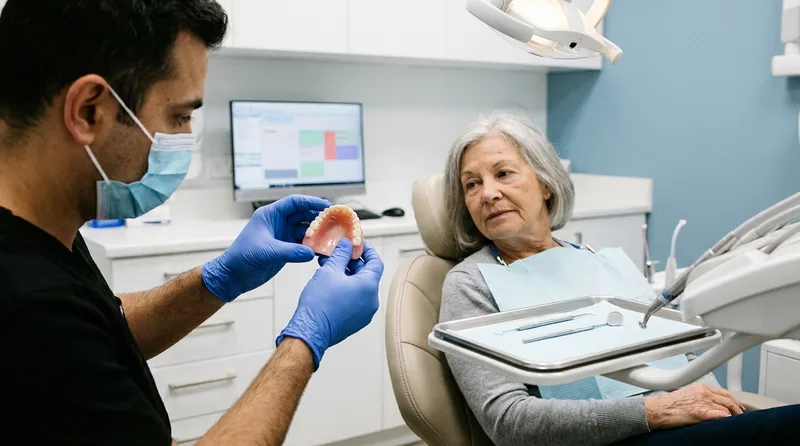
Professional options include adjustment, a reline, a rebase, a new denture, or an implant-supported denture. The right one depends on whether the teeth are in good shape and how much your ridge has changed. A dentist can tell by examining the denture and your gums.
| Option | What it does | When it helps |
|---|---|---|
| Adjustment | Smooths pressure points and sore spots | Minor rubbing or a small bite issue |
| Reline | Adds new material to the surface that sits on your gums | Gums and bone have changed but the teeth are in good shape |
| Rebase | Replaces the pink base while keeping the teeth | The base is worn or cracked but the teeth still look good |
| New denture | Starts fresh with new impressions and a new fit | The denture is worn, cracked, or no longer fits |
| Implant-supported denture | Snaps onto implants so it can't drift | The denture keeps slipping even after relines |
A reline is the most common first step. It adds new material to the fitting surface so the denture matches your gums again. If the denture is cracked, badly worn, or several years old, a new one may be a better investment. Our guide to when dentures should be replaced explains the signs.
The key point is that you have options. Looseness doesn't mean living with a poor fit.
Dentures slipping? Let's check the fit.
Request an appointment at our Peterborough office and we'll look at your denture and your gums.
Request an Appointment →Lower dentures are harder to keep in place because the tongue pushes against them and the lower ridge offers less surface than the upper palate. The upper denture can hold by suction against the roof of the mouth. The lower one has no such help.
That's why so many people struggle with a loose lower denture even when the upper fits well. Cheeks, lips, and tongue all move against it during every meal.
Upper dentures that loosen usually respond well to relines, because the palate gives them a larger surface to seal against. Lower dentures often need more help over time, which is why dentists discuss implants earlier for the lower jaw.
Adhesive and relines help, but a lower denture often keeps moving as the ridge changes. This is also the situation where implants make the biggest difference, since a few implants can hold a lower denture firmly in place.
Yes, implants can fix loose dentures by anchoring them to posts in the jawbone, so the denture snaps into place instead of resting on the gums. Two to four implants often hold a lower denture, and the denture stays removable for cleaning. A scan shows what your bone can support.
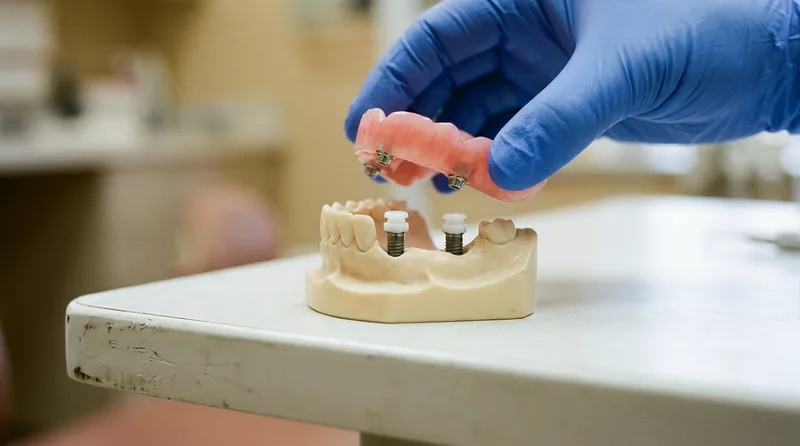
Mayo Clinic's overview of implant surgery describes a removable denture that snaps onto implant abutments and can be taken out for repair or daily cleaning. That's the idea behind implant-supported dentures.
The American Academy of Implant Dentistry reports that implant-supported teeth can restore up to 90% of natural chewing power, and the Journal of Oral and Maxillofacial Surgery reports implant success rates of 95-98% over 10 years. Many patients tell us they stop thinking about their teeth at meals.
If you want teeth that stay fixed in place, All-on-4 is another route. Our comparison of All-on-4 and implant-supported dentures explains how the two differ.
Tired of adhesive and slipping?
Send us a note and our team will explain how implants could hold your denture firmly.
Contact Our Office →You're a likely candidate if you have enough bone, healthy gums, and good general health, and a 3D scan confirms it. Years in dentures often mean thinner bone, but many long-term wearers still qualify. Bone grafting or a design that works with less bone can help when bone is limited.
Our guide to implants with bone loss explains what happens when bone has thinned. Nerves about surgery are common. BMC Oral Health (2024) reports that 36% of Americans have dental anxiety, and the Journal of Dental Anesthesia reports that sedation dentistry has helped 75% of fearful patients keep up with regular visits. We offer nitrous oxide and oral sedation.
Avoid DIY repair kits and glue, wearing a cracked denture, sleeping in a loose denture, and ignoring sore spots. These habits can damage the denture and irritate your gums. A loose denture is a reason to call your dentist, not a reason to improvise.
Keep your checkups. The ADA notes that regular dental visits can catch 80% of oral health issues before they become serious, and the Journal of Dental Research reports that people who see a dentist regularly are 60% less likely to lose teeth. A yearly check of the fit is a good habit for any denture wearer.
Not sure what your denture needs?
Call our Peterborough office and we'll tell you whether it needs a quick fix or a bigger change.
Call (603) 924-3664 →Book an exam so your dentist can check the denture and your gums, and a scan if you'd like to explore implants. Most fit problems have a clear fix, and you'll leave with a written plan. Waiting only lets the ridge change more, which makes every option harder.
We welcome patients from Peterborough, Jaffrey, Dublin, Hancock, and across the Monadnock region, with early-morning hours from 7 AM Monday through Thursday. Bring your questions to Dr. Muhammad Rahim or Dr. Jasper Ainslie. If you request a time online, a real person from our team replies the same business day to confirm your visit. If you already have a quote from another office, we offer a free second opinion and match the price on comparable care.
Results may vary. Please consult with your dentist at Peterborough Family Dental for personalized treatment recommendations.
Get your dentures feeling steady again
Request an appointment at Peterborough Family Dental & Implant Center and find out what your denture needs.
Request an Appointment →Prefer to talk first?
Call (603) 924-3664 →
Dr. Muhammad Rahim, DMD
Dentist · Peterborough Family Dental & Implant Center
Peterborough, NH dentist providing gentle general, cosmetic, restorative, and implant dentistry for the whole family.
Was this article helpful?
The jawbone and gums slowly change shape after teeth are lost, so a denture that fit well can loosen over time. Weight changes and normal wear play a part too. A reline or a new denture often restores the fit.
Our Peterborough team is happy to answer questions and get you on the calendar.