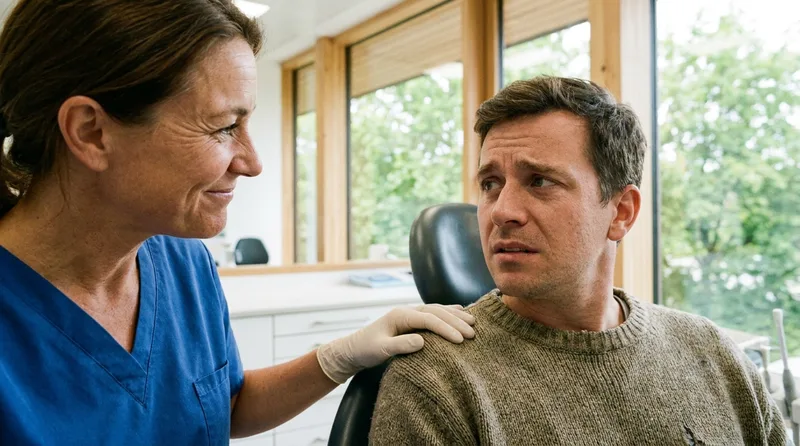
Dental Anxiety Tips for Nervous Patients in Peterborough
Dr. Muhammad Rahim, DMDOctober 11, 202610 min read
If your stomach tightens at the thought of a dental appointment, you are far from alone, and dental anxiety tips that actually work start with understanding why the fear happens in the first place.
This guide walks through practical ways to manage dental anxiety, how sedation options help, what to say to your dental team, and how Peterborough Family Dental & Implant Center approaches nervous patients of every age.
None of this requires you to simply push through discomfort on your own; judgment-free dental care exists specifically for situations like this.
Nervous About Your Next Visit?
Tell our team what worries you when you book. Dr. Rahim and Dr. Ainslie build the visit around your comfort, not a fixed script.
Why Do So Many People Feel Anxious About the Dentist?
Dental anxiety usually comes from a past uncomfortable experience, a feeling of losing control while lying back in a chair, or simply the sounds and sensations that come with dental tools. It is an extremely common reaction, not a personal failing, and it shows up in patients of every age and background.
A 2021 meta-analysis in the Journal of Dentistry pooled 31 studies covering more than 72,000 adults and estimated that about 15% of adults worldwide live with dental fear and anxiety, with about 3% reporting severe fear. That's a lot of people in the waiting room feeling some version of what you might be feeling right now.
A 2014 review by Beaton and colleagues found dental fear can grow from a bad experience, from hearing about other people's experiences, or from inherited traits and personality. For some people, the anxiety traces back to a single difficult visit years ago. For others, it builds gradually from a general sense of vulnerability that comes with someone working inside your mouth while you can't see what's happening.
There isn't always a single clear cause, and it's common for the feeling to intensify the longer someone avoids addressing it.
Understanding that this reaction is common, and that dental teams see it every single day, is often the first step toward feeling less alone with it. It doesn't erase the anxiety by itself, but it does mean you're not walking into a room full of people who will be surprised or put off by it.
What Are Simple Dental Anxiety Tips You Can Try Right Now?
Simple dental anxiety tips include booking an early morning appointment before anxiety has all day to build, bringing headphones for distraction, and agreeing on a hand signal to pause the appointment at any point. Small, practical steps often make a bigger difference than expected.
Dentist · Peterborough Family Dental & Implant Center
Peterborough, NH dentist providing gentle general, cosmetic, restorative, and implant dentistry for the whole family.
Was this article helpful?
Frequently asked questions
Book a morning appointment, bring headphones for distraction, and agree on a hand signal with your dentist to pause at any point. Small, practical steps often make a bigger difference than expected.
Yes. Nitrous oxide helps with mild to moderate nerves, and a prescribed oral sedative offers a deeper sense of calm for stronger anxiety or longer visits. Both keep you awake and responsive. For cases that need deeper IV sedation, an oral surgery office is usually the right setting.
Be specific about what triggers your anxiety, whether it's a past experience, a particular sound, or a feeling of losing control, rather than just saying you're nervous in general.
Yes, dental anxiety is common in children and often shows up as tears or resistance to sitting in the chair. It's a normal developmental response, and gentle, patient care helps considerably.
That's an extremely common situation. The first visit back is designed to understand where things stand and rebuild trust, not to catch up on years of care in a single appointment.
The ADA describes nitrous oxide as a safe and effective sedative for many dental procedures. You breathe it through a small mask, stay awake and able to respond, and the effects wear off soon after the mask is removed. Your dentist will review your health history first.
Peterborough Family Dental & Implant Center offers early-morning hours starting at 7 AM alongside nitrous oxide and oral sedation.
Book a morning appointment so you spend less time anticipating it beforehand
Bring headphones or music to help you focus on something other than the sounds in the room
Agree on a simple hand signal with your dentist to pause at any moment
Practice slow, steady breathing in the waiting room before you're called back
Bring a friend or family member if the office allows it
None of these require special equipment or a long conversation. Most take thirty seconds to set up and can meaningfully change how the visit feels. Different tips work for different people, so it's worth trying more than one over a few visits to find what actually helps you personally.
Coping Strategies at a Glance
Strategy
How It Helps
When to Use It
Agree a stop signal
Restores a sense of control
Agree it before treatment starts
Book the first slot of the day
Less waiting-room build-up
Whenever scheduling allows
Bring headphones
Removes the sounds that trigger most people
Any appointment
Start with a talk-only visit
No treatment, no pressure
After a long gap in care
How Does Sedation Dentistry Help With Dental Anxiety?
Sedation dentistry uses medication, ranging from a light, inhaled option to a prescribed oral sedative, to help patients relax during treatment when anxiety tips alone aren't enough. Peterborough Family Dental & Implant Center offers nitrous oxide and oral sedation for exactly this reason.
Sedation can help fearful patients get back to regular visits they've been avoiding. That matters, because Americans who visit a dentist regularly are 60% less likely to lose teeth, according to the Journal of Dental Research. And avoidance tends to compound.
A person who skips checkups for a few years because of fear often needs more involved treatment than someone who came in on schedule the whole time, which only adds to the anxiety around a future visit. Sedation options are designed to break that specific cycle.
Nitrous oxide, often called laughing gas, is the lightest option. The ADA explains it's inhaled through a small mask, isn't meant to put you to sleep, and wears off soon after the mask comes off. Not everyone needs more than that. Oral sedation, a prescribed pill taken before your visit, suits stronger anxiety or longer appointments, and you'll need a ride home. Deeper IV sedation is provided by oral surgery offices when a case truly calls for it.
Curious Whether Sedation Is Right for You?
Ask about sedation options the next time you book, and the team can walk you through what fits your specific situation.
What Should You Tell Your Dentist About Your Anxiety?
Tell your dentist specifically what triggers your anxiety, whether it's a past experience, a particular sound, or simply the feeling of not being in control, rather than just saying you're nervous in general. Specifics let the team actually adjust the visit around you.
A general "I'm nervous" is a fine starting point, but a specific detail, like "the sound of the handpiece bothers me" or "I had a bad experience with a filling as a kid," gives Dr. Rahim and Dr. Ainslie something concrete to work around. That might mean explaining every step before it happens, offering more frequent breaks, or simply pacing the appointment more slowly than usual.
Mentioning this when you book, not just when you arrive, also gives the front desk time to schedule appropriately, whether that means a longer appointment slot or a specific time of day that works better for you. There's no detail too small to mention. Even something like preferring not to have small talk during a procedure is useful information for the team.
A brief conversation about your specific concerns can change how the whole visit feels.
Can Kids Have Dental Anxiety Too?
Yes, dental anxiety is common in children, often showing up as tears, resistance to sitting in the chair, or simply refusing to open their mouth. It's a normal developmental response, not a sign that something is wrong with your child.
Peterborough Family Dental & Implant Center treats families and children as a core part of the practice, and a gentle, patient approach with kids is standard rather than an exception. Short visits, a calm tone, and letting a child see and touch tools beforehand often help far more than rushing through an appointment.
For very anxious children, sedation options exist here too, used carefully and only when genuinely appropriate for the child's age and situation. Parents are welcome to stay close by during a young child's appointment, which often helps more than any single technique on its own.
Short, positive visits help build comfort long before any treatment is needed.
Starting early with short, positive visits, even before any treatment is needed, tends to prevent dental anxiety from taking hold in the first place. A child's first few visits are often more about building comfort with the environment than about any actual treatment, which pays off considerably later on.
What If It's Been Years Since Your Last Dental Visit?
If it's been years since your last dental visit, that's an extremely common situation and not something the team will judge you for. The goal of that first visit back is simply to understand where things stand, not to overwhelm you with treatment all at once.
Nearly 1 in 4 adults in the US has untreated tooth decay, according to CDC data, and dental anxiety is one of the most common reasons behind that gap. Coming back after a long absence usually means a straightforward exam and a conversation about next steps, paced at whatever speed feels manageable for you. Nothing gets rushed, and nothing happens without you understanding why first.
The visit is designed to rebuild trust, not to catch up on years of care in a single uncomfortable afternoon. If multiple appointments end up being needed, they're spread out deliberately rather than packed into one overwhelming visit.
How Does Peterborough Family Dental Handle Nervous Patients?
Peterborough Family Dental & Implant Center handles nervous patients with a judgment-free, unhurried approach, offering sedation options, clear step-by-step explanations, and flexibility around pacing for patients of every age. Comfort is treated as a standard part of care, not an add-on.
Dr. Muhammad Rahim and Dr. Jasper Ainslie both approach anxious patients the same way: ask what specifically worries you, explain what's about to happen before it happens, and check in throughout rather than assuming silence means everything is fine.
Extended early-morning hours starting at 7 AM also give patients who prefer to get a visit over with early in the day, before anxiety has time to build, a practical option.
This applies whether it's a routine cleaning, a filling, or a more involved restorative procedure; the same judgment-free approach carries through regardless of what's being treated.
According to MouthHealthy, the ADA's patient education site, your dental team is better able to treat you when they know your needs, so it's worth mentioning your anxiety when you book and again when you arrive.
What's the First Step If You've Been Avoiding the Dentist?
The first step if you've been avoiding the dentist is simply calling and saying so, rather than waiting until a problem forces the issue. Mentioning your anxiety upfront changes how the entire visit gets planned around you.
Call and mention your anxiety directly, rather than waiting to bring it up in person.
Ask about sedation options if you think you might need them.
Request a specific time of day that works best for your comfort level.
Consider bringing a support person or headphones for your first visit back.
Focus only on the first appointment, not everything that might come after it.
Most patients find that the anticipation of the visit is harder than the visit itself, and that first step of simply making the call is usually the biggest hurdle to clear. Once that call is made, everything else tends to fall into place around your specific comfort level rather than a generic script.
Dental anxiety tips can genuinely help, but the bigger shift often comes from working with a dental team that treats your comfort as central to the visit rather than an inconvenience to work around. Peterborough Family Dental & Implant Center builds that approach into every appointment, for children, teens, and adults throughout Peterborough, Jaffrey, Dublin, Hancock, and the wider Monadnock region.
Results may vary. Please consult with your dentist at Peterborough Family Dental for personalized treatment recommendations.
If dental anxiety has kept you or a family member away from care, the next step is simply telling us what worries you, so we can build the visit around it.
Ready to Take the First Step?
Request an appointment with Peterborough Family Dental & Implant Center and let us know your concerns ahead of time.


 Dr. Muhammad Rahim, DMDOctober 11, 202610 min read