
Back to all articlesOrthodontics Dr. Muhammad Rahim, DMDOctober 11, 202610 min read
Clear Aligners in Peterborough, NH: A Complete Guide
Dr. Muhammad Rahim, DMDOctober 11, 202610 min read
Loading blog post
Dr. Muhammad Rahim, DMDOctober 11, 202610 min readCall and you'll reach a real person on our team: no phone tree, no hold music. We'd genuinely love to help.
(603) 924-3664Rather write to us? Contact us
Clear aligners have changed how adults and teens think about straightening their teeth. Instead of metal brackets and wires, you wear a series of clear, removable trays that gently shift teeth into place. Most people won't even notice you're wearing them.
The appeal is obvious. You can eat what you like, brush and floss normally, and smile through treatment without a mouth full of metal. For busy professionals and self-conscious teens alike, that discretion matters.
This guide covers how clear aligners work, what they can and can't fix, how they compare to braces, what affects the cost, and how to care for them, so you can decide if they fit your life.
Curious whether clear aligners are right for you?
Peterborough Family Dental & Implant Center offers aligner consultations for patients across the Monadnock region.
Request an Appointment →This is one of the dental services offered at Peterborough Family Dental & Implant Center in Peterborough, NH.
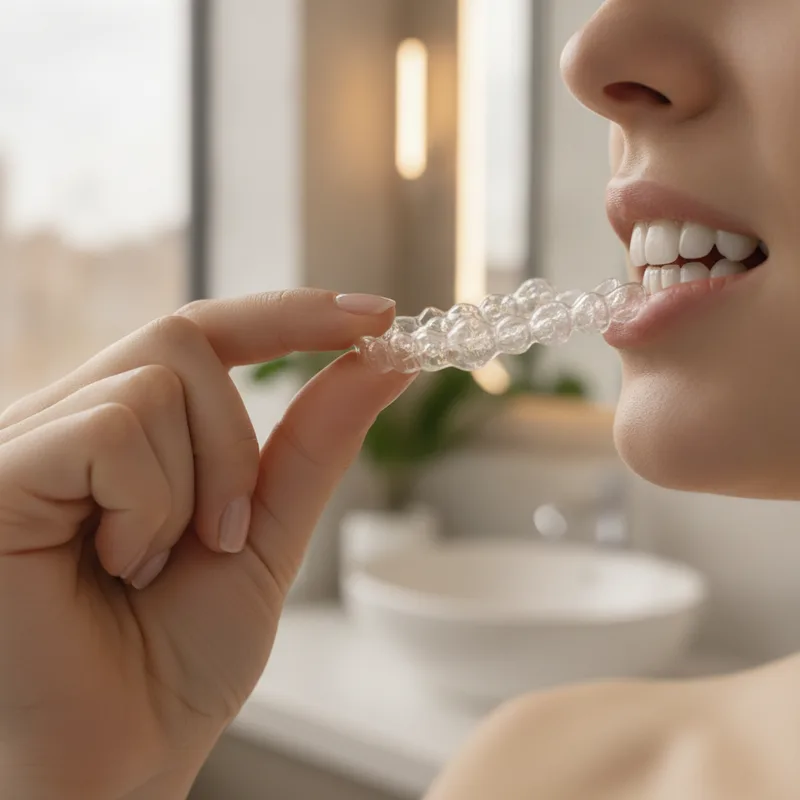
Clear aligners are custom-made plastic trays that fit snugly over your teeth and move them a little at a time. You wear each set for about one to two weeks, then switch to the next in the series. Every tray nudges your teeth closer to their final position.
The process starts with a digital scan of your mouth, not a tray of putty. In a 2023 randomized trial in Orthodontics & Craniofacial Research, 75% of children preferred a digital scan, and scanning was about 118 seconds faster than a putty impression.
The scan is the foundation. From that scan, a treatment plan maps out exactly how your teeth will move, step by step. You receive a series of trays, each slightly different from the last, and you progress through them at home with periodic check-ins at the office.
What makes this work is precision. The digital plan calculates the small, safe distance each tooth should travel in every stage, so nothing is rushed or forced. You can often preview the projected end result before you even begin, which takes a lot of the guesswork out of the decision. Each tray builds on the last until your teeth reach the planned position.
The technology has matured a lot. As the ADA's orthodontics overview explains, braces and aligners are the main appliances dentists use to guide teeth into their proper positions. The trays apply gentle, controlled pressure, which is what moves teeth into alignment over the months of treatment.
Adults make up a growing share of aligner patients. Orthodontic care was once associated mainly with children and teens, but many adults now choose aligners to fix long-standing crowding or shifting that crept in over the years. The discreet trays make that a far easier decision than visible braces ever did.
Every plan is different, but most follow a similar rhythm:
Aligners can correct crowding, gaps between teeth, and many mild-to-moderate bite problems, including some overbites, underbites, and crossbites. They work best on cases that don't require major jaw repositioning. A consultation confirms whether your situation is a good fit.
The range is wider than many people expect. Many adults who want a straighter smile but assumed they'd need braces turn out to be good candidates. The ADA notes that braces and aligners are the appliances orthodontists most commonly use, and that many adults now seek treatment for long-standing problems.
There are limits, and honesty matters here. Severe crowding, complex bite corrections, or teeth that need significant rotation may still call for braces or a specialist referral. The straightening itself is only part of the goal. A healthy, functional bite is what makes the result last.
If any of these sound familiar, aligners may be worth a conversation:
That last one is common. Plenty of adults had braces as teens, skipped the retainer, and watched their teeth slowly shift back. Aligners are a discreet way to correct that relapse without going through full braces again.
Related: Explore the full range of care we offer for healthy, confident smiles. See our dental services →
Aligners and braces both straighten teeth, but they suit different needs. Aligners are removable, nearly invisible, and often faster for mild-to-moderate cases. Braces handle complex corrections better and don't rely on you remembering to wear them. The right choice depends on your case and habits.

Speed is one real difference. Aligner treatment commonly runs 6 to 18 months, while traditional braces often take 18 to 36 months. That gap depends heavily on the complexity of your case, but for straightforward correction, aligners frequently finish sooner.
| Feature | Aligners | Traditional braces |
|---|---|---|
| Appearance | Nearly invisible | Visible brackets and wires |
| Removable | Yes, for eating and cleaning | No, fixed in place |
| Typical timeline | 6 to 18 months | 18 to 36 months |
| Best for | Mild-to-moderate cases | Complex corrections |
There's a discipline factor too. Aligners only work when you wear them, so they reward people who'll keep them in 20 to 22 hours a day. If that sounds like a struggle, braces remove the willpower question entirely. Neither is better across the board. They're better for different people.
Want to know which option suits your smile?
A consultation at Peterborough Family Dental sorts out the right path for your teeth and your lifestyle.
Request an Appointment →The cost of clear aligners in Peterborough, NH depends on how complex your case is and how long treatment takes. A short, simple correction costs less than a longer, more involved one. A consultation gives you a clear, personalized estimate before you commit to anything.
At Peterborough Family Dental, clear aligner treatment starts at $3,500, and the consultation and treatment plan are free. CareCredit and monthly payment plans are available, and orthodontic insurance or FSA and HSA funds can often help.
It helps to weigh value alongside price. Straighter teeth aren't only cosmetic. Per the ADA, a good bite makes it easier to bite, chew, and speak, and straighter teeth are simply easier to brush and floss well. That long-term benefit is part of what you're paying for.
A few factors shape your final number:
Many patients are surprised that aligner treatment is more accessible than they assumed. The team can review what your insurance may cover and walk you through financing so the cost fits your budget.
Caring for aligners is simple but matters a lot. Rinse and gently brush the trays daily, keep them in for 20 to 22 hours, and remove them before eating or drinking anything but water. Clean your teeth before putting the trays back in to avoid trapping food.
If your plan includes small tooth-colored bumps, our guide to Invisalign attachments explains what they do and how to keep them clean.

A few habits keep treatment on track and your trays clear:
Consistency is the whole game. Aligners left out for hours each day slow your progress and can throw off your timeline. Treat the wear schedule as non-negotiable and you'll reach the finish line as planned.
Finishing treatment isn't the end of the story. Once your teeth are straight, they'll try to drift back toward their old position, especially in the first year. A retainer holds them in place while the surrounding bone and tissue settle. Skipping it is the single most common reason people end up needing treatment a second time.
Most patients wear a retainer full-time for a short stretch, then switch to nights only. It's a small habit that protects months of work. Your dentist will tell you exactly how long to wear it based on your case.
Aligners come out for meals and go back in immediately after. Most people settle into that rhythm within the first week, though it does mean rethinking grazing habits, since every snack costs wear time.
A mild lisp in the first few days is normal and passes as the tongue adapts. Pressure and tenderness are most noticeable in the first day or two after switching to a new tray, which is why many patients change trays in the evening.
Cleaning is straightforward. Rinse the trays whenever they come out, brush them gently with a soft brush and cool water, and avoid hot water, which can distort the plastic.
Peterborough Family Dental & Implant Center offers aligner treatment as part of complete family dental care, all under one roof. Your aligner treatment, routine cleanings, and any other dental needs stay with one trusted team in Peterborough, NH, rather than being scattered across offices.
Comfort and convenience drive the experience. Dr. Muhammad Rahim, DMD and Dr. Jasper Ainslie, DDS use modern digital scanning for a precise, mold-free start, and the practice keeps early-morning hours for busy schedules. The team serves families and adults across the Monadnock region, including Jaffrey, Dublin, and Hancock.
Choosing where to straighten your teeth is about trust and follow-through. A practice that already knows your dental history and is close for check-ins makes the months of treatment far smoother.
There's also real value in keeping orthodontic care alongside your general dentistry. As your teeth move, your dentist is already watching your gum health, checking for cavities, and keeping your cleanings on schedule, so nothing falls through the cracks. When treatment wraps up, the same team handles your retainer and long-term follow-up. That continuity is harder to get when straightening and routine care live at separate practices.
A straighter smile is within reach for most people, and clear aligners offer a discreet, flexible way to get there without the look of traditional braces. The first step is finding out whether your case is a good fit.
If you're ready to explore your options, the team at Peterborough Family Dental & Implant Center can answer your questions and map out a plan built around your smile.
Results may vary. Please consult with your dentist at Peterborough Family Dental for personalized treatment recommendations.
Straighten your smile with clear aligner treatment
Schedule a clear aligner consultation at Peterborough Family Dental & Implant Center and find out if they're right for you.
Request an Appointment →Have questions or want to speak with our team?
Contact Us →
Dr. Muhammad Rahim, DMD
Dentist · Peterborough Family Dental & Implant Center
Peterborough, NH dentist providing gentle general, cosmetic, restorative, and implant dentistry for the whole family.
Was this article helpful?
Most people feel mild pressure or tenderness for a day or two after switching to a new tray, which fades quickly. This is a sign the aligners are working. Any lasting discomfort should be mentioned to your dentist at a check-in.
Our Peterborough team is happy to answer questions and get you on the calendar.


